
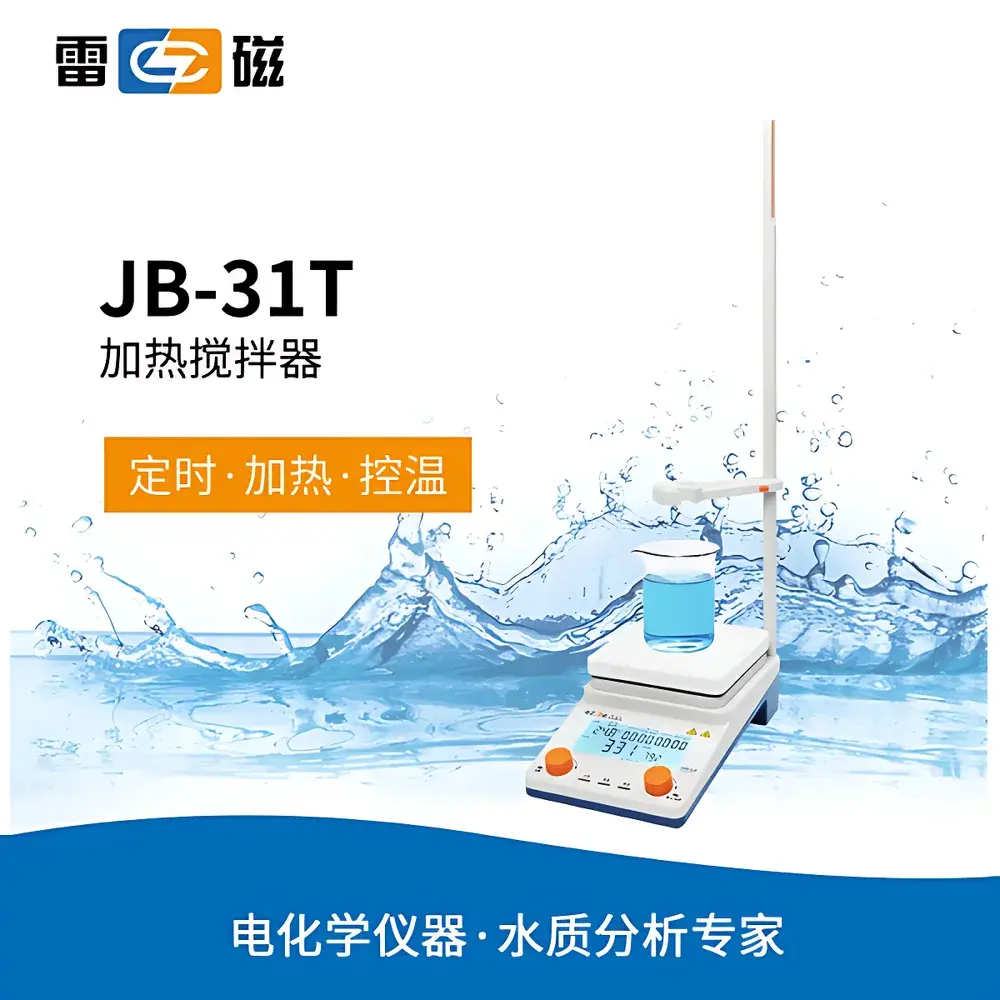
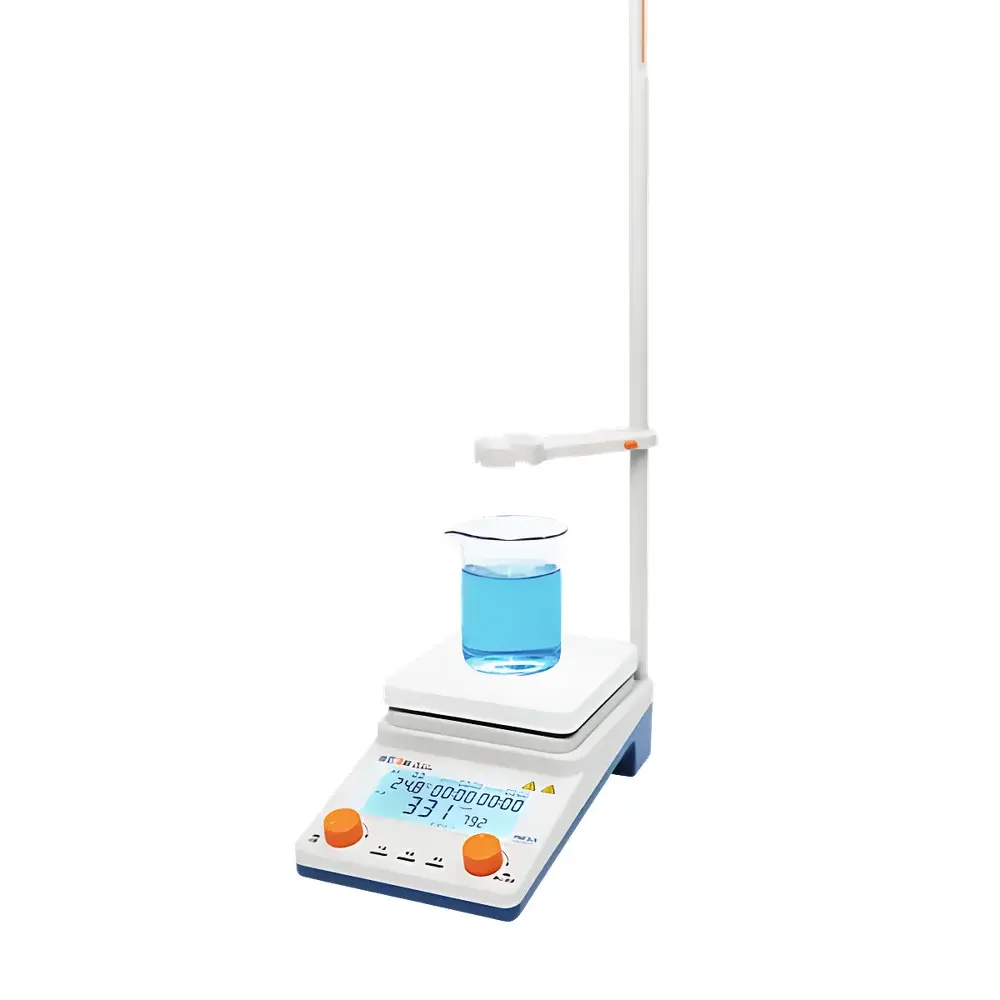
Leici JB-31T Benchtop Magnetic Stirrer with Integrated Hotplate
| Brand | Leici |
|---|---|
| Origin | Shanghai, China |
| Manufacturer Type | Direct Manufacturer |
| Product Category | Domestic (China-made) |
| Model | JB-31T |
| Instrument Type | Magnetic Stirrer |
| Max Stirring Volume | 5000 mL |
| Speed Range | 100–2000 rpm |
| Heating Plate Temperature Range | Ambient to 280 °C |
| Speed Accuracy | ±10 rpm |
| Speed Stability | ±10 rpm over 4 h |
| Timer Range | 0 min – 99 h 59 min |
| Timer Accuracy | ±1 min/h |
| Heating Power | 700 W |
| Work Surface | 145 mm × 145 mm Aluminum Alloy with Ceramic Coating |
| Dimensions | 160 × 280 × 95 mm |
| Weight | ~1.8 kg |
| Power Supply | AC 220 ± 22 V, 50 ± 1.0 Hz |
Overview
The Leici JB-31T is a precision-engineered benchtop magnetic stirrer with integrated hotplate functionality, designed for reproducible mixing and temperature-controlled sample preparation in academic, industrial, and quality control laboratories. It operates on the principle of magnetic coupling—rotating a PTFE- or glass-coated stir bar within a vessel via a rotating magnetic field generated beneath a thermally stable ceramic-coated aluminum work surface. Unlike overhead mechanical stirrers, this device eliminates shaft seal leakage risks and enables contamination-free operation ideal for sterile, viscous, or volatile samples. Its dual-control architecture supports simultaneous independent regulation of rotational speed and surface temperature—critical for kinetic studies, dissolution testing, buffer equilibration, and electrochemical cell conditioning where thermal homogeneity and mechanical consistency must be maintained across extended durations.
Key Features
- High-resolution LCD display showing real-time speed (rpm) and plate temperature (°C), with intuitive dual-knob interface for rapid parameter adjustment
- Wide speed range (100–2000 rpm) with ±10 rpm accuracy and long-term stability of ±10 rpm over 4 hours—engineered for high reproducibility across repeated runs
- Heating capability up to 280 °C with ceramic-coated aluminum plate (145 × 145 mm), offering uniform thermal distribution and resistance to chemical etching and thermal shock
- Multi-mode rotation control: forward, reverse, and alternating direction—enabling optimized dispersion in heterogeneous suspensions or layered systems
- Programmable timer (0–99 h 59 min) with ±1 min/h accuracy; auto-restart and last-setting memory function ensures operational continuity after power interruption
- Dedicated electrode holder accommodating up to three standard analytical electrodes—supporting concurrent pH, conductivity, or redox monitoring during stirring
- Three included magnetic stir bars (Φ5×20 mm, Φ7×30 mm, Φ10×60 mm) calibrated for optimal torque transfer across volumes from 50 mL to 5 L
Sample Compatibility & Compliance
The JB-31T accommodates a broad range of container geometries—including beakers, Erlenmeyer flasks, and custom reaction vessels—up to 5 L capacity. Its low-profile design and non-magnetic base minimize electromagnetic interference with adjacent instrumentation. The ceramic-coated surface complies with ISO 8573-1 for cleanroom-compatible material outgassing profiles and resists degradation from common solvents (e.g., ethanol, acetone, dilute acids/bases). While not certified for explosion-proof environments, it meets IEC 61010-1:2010 safety requirements for laboratory electrical equipment. For GLP/GMP-regulated workflows, its stable speed/temperature performance supports documentation of critical process parameters in batch records per FDA 21 CFR Part 11–aligned SOPs.
Software & Data Management
The JB-31T operates as a standalone instrument without proprietary software dependency. All operational parameters are locally stored in non-volatile memory and displayed in real time. No USB, Bluetooth, or RS-232 connectivity is provided—ensuring electromagnetic compatibility in sensitive measurement environments (e.g., near potentiostats or NMR consoles). However, its precise, repeatable output allows seamless integration into validated lab workflows: users may log speed, temperature, and duration manually or via external data acquisition systems interfaced through analog voltage outputs (optional accessory). Audit trails for method execution rely on operator-entered batch identifiers and timestamped manual logs consistent with ALCOA+ data integrity principles.
Applications
- Preparation of homogeneous standard solutions and calibration standards for spectrophotometry, titration, and ion chromatography
- Temperature-dependent solubility and dissolution rate studies per USP & Ph. Eur. guidelines
- Electrochemical cell conditioning and electrolyte equilibration prior to cyclic voltammetry or impedance spectroscopy
- Buffer and reagent aging protocols requiring sustained agitation under controlled thermal conditions
- Viscosity-independent mixing of high-density suspensions (e.g., catalyst slurries, nanoparticle dispersions) using multi-directional rotation modes
- Supporting ASTM D2196 and ISO 2557-2 procedures for polymer solution homogenization prior to rheological analysis
FAQ
Does the JB-31T support solution temperature feedback control?
No—it provides plate-surface temperature control only. Solution temperature must be monitored externally using a calibrated probe.
Can the JB-31T be used with metal containers?
No. Magnetic coupling requires non-ferromagnetic vessels (e.g., glass, ceramic, or non-magnetic stainless steel). Ferrous materials disrupt field uniformity and reduce torque transmission.
What is the maximum viscosity this unit can effectively stir?
Performance depends on stir bar geometry and vessel depth; it is rated for aqueous and low-to-medium viscosity organic solutions (< 500 mPa·s) at full 5 L volume. Higher viscosities require reduced volume or alternative agitation methods.
Is the ceramic coating resistant to hydrofluoric acid?
No. HF attacks silicon-based ceramics. Avoid direct contact with HF or fluoride-containing etchants.
How often should the stir bars be recalibrated?
Stir bars do not require calibration; however, visual inspection for coating integrity and demagnetization (e.g., reduced rotational torque at high speeds) is recommended before each high-value experiment.



