
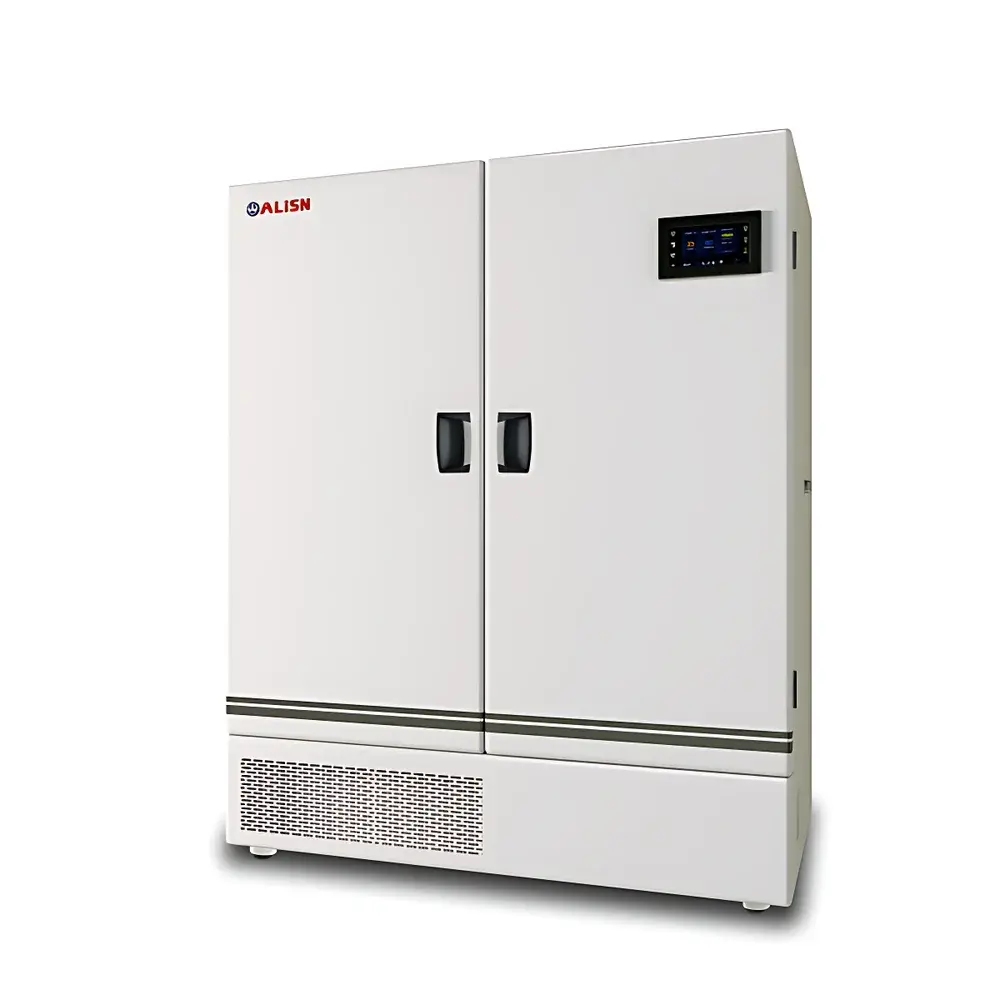
ALISN QCA 1000 Low-Temperature Photostability Testing Chamber
| Brand | ALISN |
|---|---|
| Origin | Shanghai, China |
| Model | QCA 1000 |
| Chamber Volume | 1000 L |
| Temperature Range (Dark) | −10 to +65 °C |
| Temperature Range (Illuminated) | +4 to +65 °C |
| Temperature Uniformity (at 25 °C, dark) | ±0.3–0.8 °C |
| Control Accuracy | ±0.1 °C |
| Illuminance Range | 0–10,000 lux (continuously adjustable) |
| UV Spectral Range | 320–400 nm |
| UV Irradiance | 0–5 W/m² |
| Light Source | D65 daylight simulator + ICH Q1B-compliant UV module |
| Cooling System | Inverter-driven SECOP (Danfoss) compressor with R404a refrigerant |
| Humidity Control | Not applicable (dry operation only) |
| Data Logging | 3-year storage (1-min interval), USB export, write-protected |
| Audit Trail | 16,000 entries (user actions & alarms), non-modifiable, USB exportable |
| User Management | Up to 5 configurable roles with hierarchical permissions |
| Interface | 7-inch color TFT touch screen, RS232/RS485/USB ports, bilingual (EN/CN) menu |
| Insulation | Monolithic polyurethane foam, thermal conductivity ≤0.022 W/(m·K) |
| Construction | Double-door design with tempered inner glass door, 50 mm silicone rubber port on right side |
| Compliance | Designed per ICH Q1B, ICH Q5C, USP <115>, ISO 14644-1 Class 8 (cleanroom-compatible airflow management) |
Overview
The ALISN QCA 1000 Low-Temperature Photostability Testing Chamber is an engineered environmental simulation system designed explicitly for pharmaceutical stability testing under controlled light exposure and sub-ambient temperature conditions. It implements the photostability protocols defined in ICH Q1B (‘Photostability Testing of New Drug Substances and Products’) and aligns with supplementary guidance from USP (‘Photostability Testing’) and ICH Q5C (‘Quality of Biotechnological Products’). Unlike general-purpose climate chambers, the QCA 1000 integrates dual-spectrum illumination—D65-standard visible light and regulated UV-A (320–400 nm)—with precise low-temperature control down to −10 °C, enabling evaluation of cold-chain pharmaceuticals, lyophilized biologics, ophthalmic suspensions, and temperature-sensitive APIs under photolytic stress. Its architecture employs a closed-loop PID-fuzzy hybrid control algorithm, ensuring stable thermal profiles during extended test durations (up to 6 months per ICH Q1A(R2)), while minimizing thermal lag during door openings—a critical factor in maintaining ICH-defined exposure integrity.
Key Features
- ICH Q1B-compliant illumination system: Top-mounted, height-adjustable D65 daylight simulator and independently controllable UV-A module (320–400 nm), both calibrated using traceable NIST-traceable spectroradiometry
- High-fidelity optical monitoring: Integrated hemispherical photodiode sensor enables real-time, separate measurement of visible illuminance (lux) and UV irradiance (W/m²), with automatic compensation for lamp aging and spectral drift
- Thermal precision engineering: Inverter-controlled SECOP (Danfoss) compressor with R404a refrigerant delivers ±0.1 °C setpoint accuracy and <0.5 °C spatial uniformity across the 1000 L chamber volume (measured at 25 °C, empty load)
- Robust data governance: Onboard non-volatile memory logs temperature, illuminance, UV intensity, and system status at 1-minute intervals for up to 3 years; all records are cryptographically write-protected and exportable via USB in CSV format
- Audit-ready software architecture: Full 16,000-entry audit trail—including user logins, parameter changes, alarm events, and door openings—with timestamp, operator ID, and action context; supports FDA 21 CFR Part 11-compliant electronic signatures when paired with validated ALISN LabManager software
- Multi-tier access control: Administrator-configurable user roles (e.g., Operator, Reviewer, QA Auditor) with granular permissions over method editing, data export, calibration access, and alarm acknowledgment
- Energy-optimized thermal envelope: Monolithic polyurethane insulation (density 38 kg/m³, λ ≤0.022 W/(m·K)) reduces power consumption by ≥40% versus conventional foamed chambers of equivalent volume
Sample Compatibility & Compliance
The QCA 1000 accommodates standard pharmaceutical packaging formats—including blister cards, amber vials (2–50 mL), HDPE bottles (up to 1 L), and aluminum-laminated pouches—within its 1200 × 1180 × 720 mm internal cavity. The double-door configuration (outer insulated door + inner tempered glass door) minimizes radiant heat ingress and permits continuous visual monitoring without compromising thermal or photometric stability. All materials in contact with the test environment comply with USP (plastic packaging systems) and ISO 10993-5 (cytotoxicity). The chamber meets mechanical safety requirements per IEC 61010-1 and electromagnetic compatibility per EN 61326-1. Validation documentation (IQ/OQ/PQ templates) and factory-assembled calibration certificates (temperature, illuminance, UV irradiance) are provided with each unit.
Software & Data Management
The embedded 7-inch TFT touchscreen interface runs ALISN’s proprietary LabOS firmware, supporting bilingual (English/Chinese) operation and intuitive workflow navigation. Real-time trend visualization includes overlay plots of chamber temperature, D65 illuminance, and UV-A irradiance over the last 10 hours. Historical data queries support date-range filtering, parameter-specific export, and anomaly flagging (e.g., excursions beyond ±0.5 °C or ±5% illuminance). For enterprise integration, the RS485/RS232 interfaces support Modbus RTU protocol, enabling bidirectional communication with LIMS or MES platforms. Optional ALISN LabManager v3.2 software provides automated report generation compliant with GLP and GMP Annex 11 requirements—including electronic signature workflows, change control logs, and versioned method archiving.
Applications
- ICH Q1B photostability studies for new drug substances and products, including forced degradation under UV/visible light at −10 °C to +40 °C
- Stability assessment of cold-chain biologics (e.g., monoclonal antibodies, mRNA vaccines) exposed to ambient light during transport or storage deviations
- Accelerated photolytic stress testing of ophthalmic formulations, topical gels, and pediatric suspensions sensitive to thermal cycling
- Light-induced oxidation kinetics modeling for lipid-based delivery systems (e.g., liposomes, nanoemulsions)
- Reference standard qualification per USP : verification of light source spectral output, irradiance homogeneity, and chamber uniformity
- Regulatory submission support: Raw data packages generated meet EMA CHMP/ICH requirements for inclusion in Module 3 (Quality) of CTD dossiers
FAQ
Does the QCA 1000 meet ICH Q1B Option 1 and Option 2 irradiance requirements?
Yes. The system delivers ≥1.2 million lux·hr (Option 1) and ≥200 W·hr/m² UV-A (Option 2) within 72 hours at maximum settings, verified using calibrated spectroradiometric mapping per ICH Q1B Annex 2.
Can the chamber operate continuously at −10 °C with full illumination?
Yes. The inverter-driven refrigeration system maintains stable operation across the full temperature range (−10 to +65 °C) under simultaneous D65 + UV illumination, with no derating of cooling capacity.
Is the data logging compliant with FDA 21 CFR Part 11?
The hardware-level write protection and audit trail meet technical controls for Part 11; full compliance requires implementation of ALISN LabManager v3.2 with configured electronic signatures and network authentication.
What calibration standards are used for UV irradiance verification?
UV sensors are factory-calibrated against NIST-traceable reference lamps (Optronics OL 754) and certified annually per ISO/IEC 17025-accredited service providers.
Are validation documents included with shipment?
Yes. Each unit ships with Factory Acceptance Test (FAT) reports, IQ/OQ templates aligned with ASTM E2500, and a Certificate of Conformance listing all measured performance parameters against ICH Q1B and USP .







