
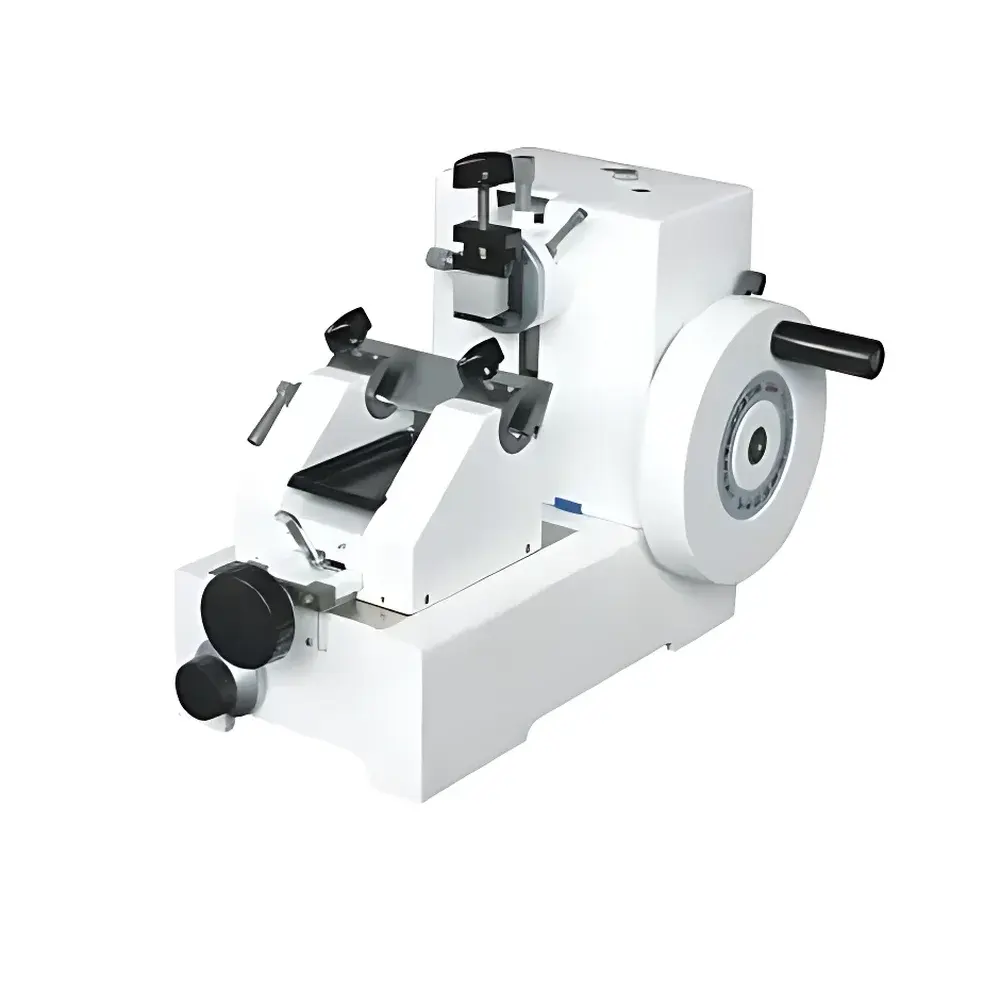
Jiayuan JY-1508R Rotary Microtome
| Brand | Jiayuan |
|---|---|
| Origin | Beijing, China |
| Model | JY-1508R |
| Max Sample Section Size | 60 × 45 mm |
| Slice Thickness Range | 1–60 µm |
| Trim Thickness Range | 1–60 µm |
| Minimum Increment | 1 µm |
| Slice Accuracy | ±5% |
| Horizontal Specimen Translation | 28 mm |
| Vertical Specimen Translation | 60 mm |
| Specimen Orientation Adjustment | ±8° horizontal, ±8° vertical, 360° rotation |
| Knife Base Travel | ±25 mm (front/back) |
| Dimensions | 400 × 350 × 350 mm |
| Compliance | Designed for ISO 13485-aligned lab environments and GLP-compliant histology workflows |
Overview
The Jiayuan JY-1508R Rotary Microtome is an advanced, precision-engineered instrument designed for reproducible sectioning of both hard and soft biological specimens—including decalcified bone, plastic-embedded tissues, mineralized plant structures, fibrous matrices, and keratin-rich samples such as hair shafts. Unlike conventional microtomes optimized solely for paraffin-embedded soft tissue, the JY-1508R integrates a high-rigidity mechanical architecture with cross-roller linear guidance to maintain dimensional stability under elevated cutting resistance. Its operating principle follows the classic rotary microtomy mechanism: the specimen advances vertically in precise increments while the knife remains stationary; the specimen block moves horizontally across the blade in a single stroke per section. This design ensures consistent shear force distribution and minimizes compression artifacts—critical for ultra-thin sections required in electron microscopy sample preparation or quantitative histomorphometry.
Key Features
- Precision cross-roller linear guides ensure sub-micron positional repeatability and long-term wear resistance during high-load hard-tissue sectioning.
- Three-axis specimen orientation system: ±8° horizontal tilt, ±8° vertical inclination, and full 360° rotational adjustment—enabling optimal plane-of-section alignment for anisotropic materials such as cortical bone or vascular bundles.
- Dual-mode thickness control: independent fine-adjustment dials for sectioning (1–60 µm) and trimming (1–60 µm), both calibrated to 1 µm minimum increment with tactile feedback and vernier scale readout.
- Motor-assisted knife advancement eliminates manual contact with the blade surface, enhancing operator safety and reducing contamination risk in sterile or BSL-2 environments.
- Modular knife holder compatible with both standard steel knives and disposable tungsten-carbide blades—maintaining edge integrity across heterogeneous sample hardness profiles.
- Sealed chassis design prevents wax debris accumulation in internal mechanisms, simplifying routine maintenance and extending service intervals without disassembly.
- Integrated handwheel locking mechanism allows secure specimen positioning during reorientation or multi-angle serial sectioning protocols.
Sample Compatibility & Compliance
The JY-1508R supports a broad spectrum of embedding media and tissue types: paraffin, methacrylate (MMA), epoxy resins, cellulose nitrate, and cryo-protectant-infused frozen blocks. It routinely processes calcified bone (human, murine, bovine), dental enamel, sclerotic plant xylem, synthetic polymer scaffolds, and composite biomaterials—provided appropriate pre-treatment (e.g., EDTA decalcification or microwave-accelerated resin infiltration) is applied. The instrument conforms to general laboratory safety standards (IEC 61010-1) and is engineered for use in environments adhering to Good Laboratory Practice (GLP) and clinical pathology quality systems. While not FDA-cleared as a medical device, its mechanical consistency and traceable calibration support compliance with ISO/IEC 17025 requirements for accredited histology laboratories performing morphometric analysis or IHC validation studies.
Software & Data Management
The JY-1508R is a fully manual, electromechanically actuated microtome with no embedded digital controller or connectivity interface. All operational parameters—including slice count, thickness setting, and specimen translation coordinates—are recorded manually in laboratory notebooks or integrated into LIMS via external barcode-scanned log sheets. For labs requiring audit trails, the device supports integration with third-party documentation platforms through standardized SOP templates aligned with 21 CFR Part 11 principles (e.g., user-defined sign-off fields, timestamped entries, and revision-controlled procedure logs). No firmware updates or cloud synchronization are applicable.
Applications
- Quantitative bone histomorphometry in osteoporosis research, requiring 5–10 µm sections from methylmethacrylate-embedded undecalcified bone.
- Serial section reconstruction of mineralized cartilage growth plates using 3–7 µm consecutive cuts.
- Preparation of ultra-thin (1–3 µm) sections from fiber-reinforced hydrogels for SEM-EDS elemental mapping.
- Clinical neuropathology workflows involving amyloid plaque detection in formalin-fixed, paraffin-embedded brain tissue.
- Botanical anatomy studies of lignified vascular tissue where differential hardness necessitates stable feed rate control.
- Quality control of 3D-bioprinted scaffolds prior to in vitro cell seeding assays.
FAQ
What embedding media are compatible with the JY-1508R?
Paraffin, low-viscosity methacrylate (e.g., Technovit 7100), epoxy resins (e.g., Epon 812), and cryo-protected OCT compound (when used with optional cold stage accessories).
Can it cut frozen sections without a cryostat?
No—the JY-1508R is not a cryomicrotome. It requires pre-frozen or room-temperature solid blocks; for true frozen sectioning, pairing with a dedicated cryostat (e.g., JY-2950) is recommended.
Is the 1 µm minimum thickness achievable across the full 60 × 45 mm section area?
Yes, provided the specimen block is properly trimmed, oriented, and clamped with uniform thermal and mechanical stability—especially critical for hard-tissue applications.
Does the unit include a knife or blade holder?
It ships with a universal knife base compatible with standard microtome blades; disposable blade holders (e.g., for Leica-compatible disposable knives) are available as optional accessories.
What maintenance schedule is recommended for sustained accuracy?
Lubrication of linear guides every 200 hours of operation; annual recalibration of micrometer dials by authorized service personnel using NIST-traceable gauges.



