
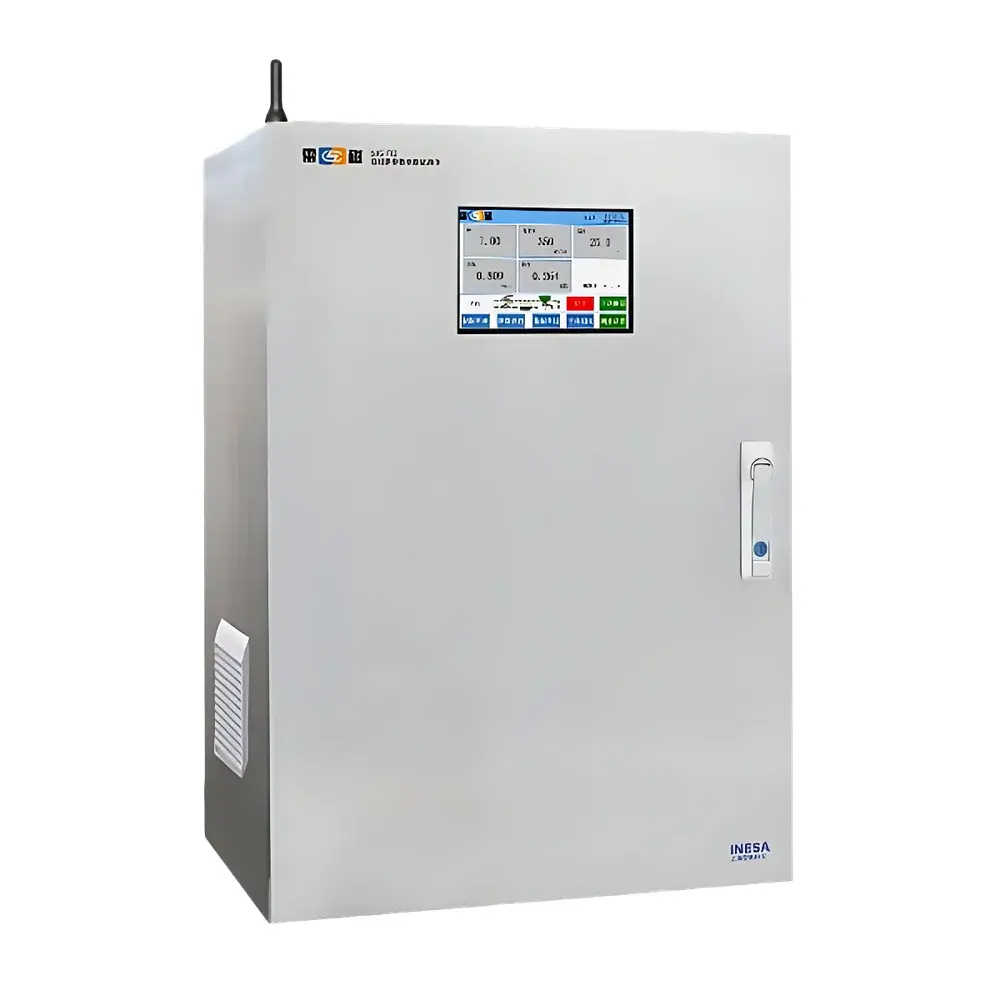
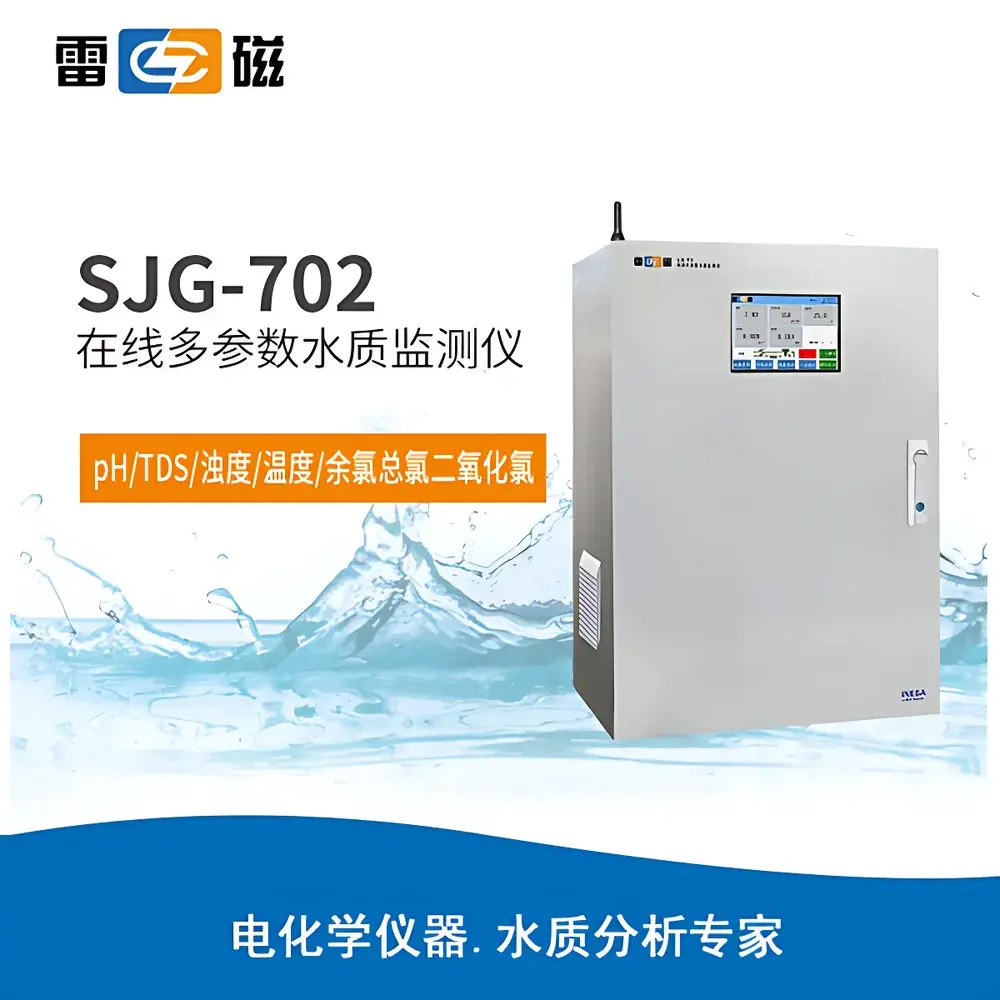
Leici SJG-702 Online Multi-parameter Water Quality Monitor
| Brand | Leici |
|---|---|
| Origin | Shanghai, China |
| Manufacturer Type | OEM Manufacturer |
| Country of Origin | China |
| Model | SJG-702 |
| Price | USD 14,000 (FOB Shanghai) |
| Measurement Principles | pH & Conductivity & TDS — Electrode-based |
| Calibration | Built-in Standard Curves + Manual Calibration Support |
| Compliance | CE, RoHS |
| Sensor Types | PH-2-173 (pH), DJS-2-141 (Conductivity), TGF-2-005 (Turbidity), DCS4.2MA2/DCS4MA5 (Free Chlorine), DCP4.0MA2/DCP4.0MA5 (Total Chlorine), DCD4.2MA2/DCD4.2MA5 (Chlorine Dioxide) |
| Display | Color TFT Touchscreen |
| Power Supply | AC 220 V ±10%, 50 Hz (Optional Solar DC Input) |
| Communication | RS-232 / RS-485 Serial Interface, Optional Wireless GPRS/4G Module |
| Operating Environment | 0–40 °C, ≤90% RH |
| Dimensions (W×D×H) | 730 × 520 × 330 mm |
| Weight | 20 kg |
| Auto-cleaning | Integrated Brush + Bubble-removal Cell + Drain Control for Turbidity Sensor |
| Measurement Modes | Continuous, Intermittent Cycle, Timed, and Manual |
| Alarm | Programmable Upper/Lower Limits with Relay Output |
| Data Logging | Internal Storage + Remote Upload to Central SCADA or Cloud Platform |
Overview
The Leici SJG-702 Online Multi-parameter Water Quality Monitor is an industrial-grade, modular instrumentation platform engineered for continuous, real-time monitoring of critical water quality parameters in municipal and commercial water distribution systems. It operates on validated electrochemical and optical detection principles: pH, conductivity, TDS, and temperature are measured using high-stability ion-selective and conductometric electrodes; turbidity is determined via 90° nephelometric light scattering per ISO 7027-1:2016; free chlorine, total chlorine, and chlorine dioxide are quantified using amperometric membrane electrodes with selective gas-permeable membranes—eliminating pH-dependent interference and enabling direct measurement without chemical reagents or pH compensation. The instrument’s architecture integrates automatic temperature compensation (ATC) across all electrochemical channels, referencing 25 °C as the standard calibration point, and maintains metrological integrity across dynamic flow conditions ranging from low-pressure secondary supply lines to pressurized potable water networks.
Key Features
- Modular sensor architecture: Individual parameter modules—including pH, conductivity/TDS, turbidity, and residual disinfectants—can be independently installed, replaced, or upgraded without system downtime.
- Intelligent turbidity measurement cell: Features integrated air-removal chamber, self-cleaning brush mechanism, and programmable drain cycle to prevent fouling and ensure long-term signal stability in suspended-solids-rich environments.
- Full operational autonomy: Supports four configurable measurement regimes—continuous streaming, intermittent cycling (user-defined intervals), scheduled time-triggered sampling, and manual initiation—enabling adaptive deployment across diverse infrastructure scenarios.
- Industrial HMI interface: 7-inch color TFT touchscreen with intuitive icon-driven navigation, multilingual UI support (English, Spanish, French), and context-sensitive help overlays for field technicians.
- Robust mechanical design: Enclosure rated IP65; pressure-regulated inlet manifold accommodates variable line pressures (0.1–0.6 MPa); dual power input option (AC 220 V or solar-charged 12/24 V DC) for off-grid installations.
- Comprehensive alarm and event management: Configurable upper/lower thresholds per parameter with dry-contact relay outputs, timestamped event logging, and non-volatile memory retention during power interruption.
Sample Compatibility & Compliance
The SJG-702 is validated for use with potable water, secondary distribution loop water, direct drinking water (e.g., building loop systems), and treated recreational water (swimming pools, spas). All electrochemical sensors utilize solid-state reference systems and hydrophilic diffusion membranes compliant with EN ISO 15839:2012 for online water analyzers. Turbidity measurements adhere to ISO 7027-1:2016 methodology, ensuring comparability with laboratory benchtop nephelometers. The device carries CE marking under Directive 2014/30/EU (EMC) and 2011/65/EU (RoHS), and its sensor firmware supports audit-ready data integrity features including user-access logs, calibration history tracking, and tamper-evident timestamps—facilitating alignment with GLP and ISO/IEC 17025 documentation requirements.
Software & Data Management
Data acquisition and remote supervision are enabled via dual serial interfaces (RS-232 and RS-485 Modbus RTU protocol), supporting integration into existing SCADA, DCS, or BMS platforms. Optional embedded GPRS/4G LTE module enables secure wireless transmission to cloud-based dashboards (MQTT or HTTP POST), with TLS 1.2 encryption and configurable upload intervals (1 min to 24 h). Local storage retains ≥30 days of second-resolution data (pH, turbidity, Cl₂, etc.) with cyclic overwrite. Firmware supports remote OTA updates and diagnostic self-tests—including electrode impedance diagnostics, membrane integrity checks, and optical path contamination alerts—to minimize unscheduled maintenance.
Applications
- Municipal drinking water treatment plants: Real-time verification of disinfectant residual decay across distribution grids.
- High-rise building secondary water supply systems: Monitoring for stagnation-induced biofilm risk via combined turbidity and free chlorine trending.
- Direct drinking water (DDW) dispensing networks: Ensuring compliance with national standards (e.g., GB 5749-2022, WHO Guidelines) at point-of-use locations.
- Swimming pool and aquatic facility management: Simultaneous tracking of oxidation-reduction potential surrogates (free chlorine, pH, turbidity) to maintain bather safety and regulatory adherence (e.g., CDC Model Aquatic Health Code).
- Industrial process water loops: Closed-loop monitoring of cooling tower or boiler feedwater quality where rapid detection of organic load (via turbidity) and oxidant demand is critical.
FAQ
Does the SJG-702 require daily manual calibration?
No. While manual one-point or two-point calibration is supported for field verification, the instrument uses factory-trimmed electrodes with built-in reference stability monitoring and auto-compensated drift correction algorithms—enabling calibration intervals of up to 30 days under stable operating conditions.
Can turbidity and chlorine sensors operate simultaneously without cross-interference?
Yes. Sensor modules are physically isolated within separate flow cells; the chlorine electrodes employ gas-permeable membranes that reject particulate matter, while the turbidity cell uses a dedicated optical path with anti-fouling surface treatment and scheduled cleaning cycles.
Is the device compatible with third-party data platforms such as Siemens Desigo or Honeywell Experion?
Yes. Native Modbus RTU implementation allows seamless mapping of register addresses for real-time parameter polling and control command ingestion; configuration templates and register maps are provided in the Engineering Integration Guide.
What is the minimum detectable turbidity level, and how is accuracy verified?
The lower detection limit is 0.01 NTU (resolution), with traceability to NIST-traceable formazin standards (0.02, 1.0, 20.0, 100.0 NTU). Accuracy validation follows ISO 7027-1 Annex C procedures using certified reference materials and documented uncertainty budgets.
How does the system handle power outages or communication loss?
All measurement data is buffered in non-volatile flash memory; upon recovery, queued records are transmitted with original timestamps. Relay alarms remain active during brownout conditions via internal capacitor hold-up circuitry (≥100 ms).
Related Products







