
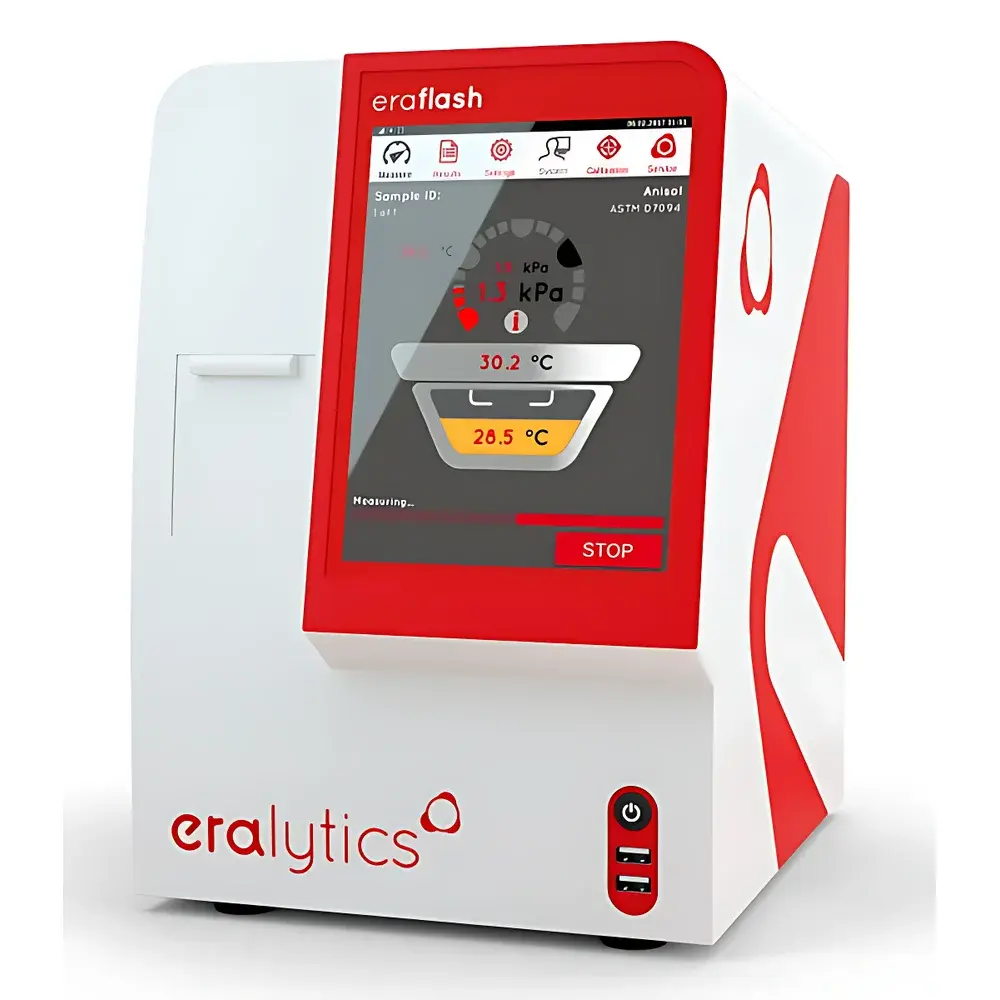
ERAFLASH Fully Automated Micro Flash Point Tester
| Brand | ERALYTICS |
|---|---|
| Origin | Austria |
| Model | ERAFLASH |
| Detection Method | Closed Cup |
| Operation Mode | Automatic |
| Temperature Range | −40 °C to 200 °C (optional high-temp module up to 420 °C |
| LT module with external cooling | −40 °C to 120 °C) |
| Ignition Source | Electric Arc |
| Repeatability | ±4.1 °C |
| Compliance Standards | ASTM D6450, ASTM D7094, SH/T 0768–2005 |
Overview
The ERAFLASH Fully Automated Micro Flash Point Tester is an advanced closed-cup flash point analyzer engineered for precision, safety, and regulatory compliance in petroleum, chemical, fragrance, coating, and hazardous material laboratories. Based on the patented CCC-FP (Constant Closed Cup – Flash Point) technology, it replicates true thermodynamic equilibrium conditions within a hermetically sealed test chamber—ensuring measurement fidelity aligned with internationally recognized flash point definitions. Unlike open-cup or semi-closed methods, the ERAFLASH maintains constant vapor-phase saturation and pressure integrity throughout heating and ignition cycles, eliminating ambient interference and enabling reliable determination of the lowest temperature at which vapors above a liquid sample ignite under controlled, standardized conditions. Designed for routine QC/QA, R&D screening, and safety classification per GHS and UN TDG requirements, the instrument delivers rapid, repeatable results across an extended operational range—from cryogenic formulations to high-boiling industrial fluids.
Key Features
- True closed-cup methodology (CCC-FP patent) ensuring strict adherence to ASTM D6450/D7094 and SH/T 0768–2005 protocols
- Extended temperature capability: standard range −40 °C to 200 °C; optional high-temperature module extends upper limit to 420 °C; ERAFLASH LT variant with external chiller support enables stable sub-zero operation down to −40 °C
- Minimal sample consumption: only 1–2 mL required per test—critical for expensive, limited-availability, or highly regulated samples
- Electric arc ignition system eliminates open flame hazards and ensures consistent energy delivery without consumables or maintenance-intensive spark gaps
- Integrated Peltier-based cooling and PID-controlled heating provide ±0.1 °C thermal stability and precise ramp control
- Automated post-test cup cooling to ambient temperature prevents operator contact burns and supports unattended sequential analysis
- Onboard fuel dilution algorithm enables direct flash point calculation for diluted hydrocarbon blends without manual recalibration
- Compact, benchtop-integrated architecture (220 × 320 × 280 mm; 9.7 kg) suitable for fixed laboratories, mobile testing units, and field-deployable applications—including vehicle-mounted configurations with 12 V DC input support
Sample Compatibility & Compliance
The ERAFLASH accommodates diverse sample matrices including low-flash hydrocarbons (e.g., gasoline, acetone, ethanol), viscous lubricants, polymer-modified bitumens, fragrance concentrates, solvent-borne paints, and water-miscible formulations. Its adaptive vapor-phase detection logic compensates for volatility gradients and surface tension effects, delivering robust performance with high-volatility, high-viscosity, or thermally unstable materials. The system complies with key international standards governing flash point determination: ASTM D6450 (equilibrium method), ASTM D7094 (mini-method adaptation), and Chinese national standard SH/T 0768–2005. All measurements are traceable to NIST-certified reference materials, and audit-ready data logs meet GLP/GMP documentation requirements. Optional 21 CFR Part 11-compliant software modules support electronic signatures, user access controls, and immutable audit trails for regulated environments.
Software & Data Management
The ERAFLASH operates via an intuitive 7-inch color touchscreen interface with full Chinese language support and context-sensitive guidance—requiring no specialized operator training. Measurement data—including raw temperature curves, ignition event timestamps, vapor pressure profiles, and combustion onset characteristics—are stored locally in non-volatile memory (capacity: ≥100,000 records). Export options include CSV, PDF, and XML formats via three USB ports, RS232 serial link, Ethernet (TCP/IP), and native LIMS integration through ASTM E1384-compliant messaging. Trend analysis tools enable comparative assessment across batches, time-series stability monitoring, and automated outlier detection based on statistical process control (SPC) thresholds. Firmware updates and method libraries are distributed via secure HTTPS channels, maintaining long-term instrument validation status.
Applications
- Petroleum refining: Crude assay, distillate fraction characterization, blending stock verification
- Hazardous materials classification: UN 3334, GHS Category 1–4 flammability assignment
- Fine chemicals & fragrances: IFRA-recommended instrumentation for essential oil and aroma compound safety profiling
- Coatings & inks: VOC-compliant formulation development and regulatory submission support
- Aviation & marine fuels: Cold-weather operability screening and specification conformance (e.g., Jet A-1, RMG 380)
- Research laboratories: Kinetic modeling of vapor generation, evaporation rate studies, and fire point correlation analysis
FAQ
What flash point standards does the ERAFLASH support?
ASTM D6450, ASTM D7094, and SH/T 0768–2005 are fully implemented in firmware; method parameters are preconfigured and user-lockable to ensure procedural consistency.
Can the ERAFLASH test samples below 0 °C?
Yes—the base configuration supports −40 °C using the integrated Peltier cooling system; the optional ERAFLASH LT module enhances low-temperature stability when paired with an external chiller unit.
Is external calibration required between tests?
No—each test cycle includes automatic zero-point verification and thermal equilibration; certified reference standards (e.g., n-heptane, decane) are used only for periodic performance qualification per ISO/IEC 17025 guidelines.
How does the instrument handle residue buildup during high-boiling sample analysis?
An integrated ceramic heater and programmable pyrolysis sequence combust residual organics after each test; optional ultrasonic cleaning mode may be activated for persistent deposits.
Does the system support remote diagnostics or preventive maintenance alerts?
Yes—Ethernet connectivity enables secure remote firmware updates, real-time sensor health monitoring, and predictive maintenance notifications based on cumulative thermal cycling and ignition event statistics.





