
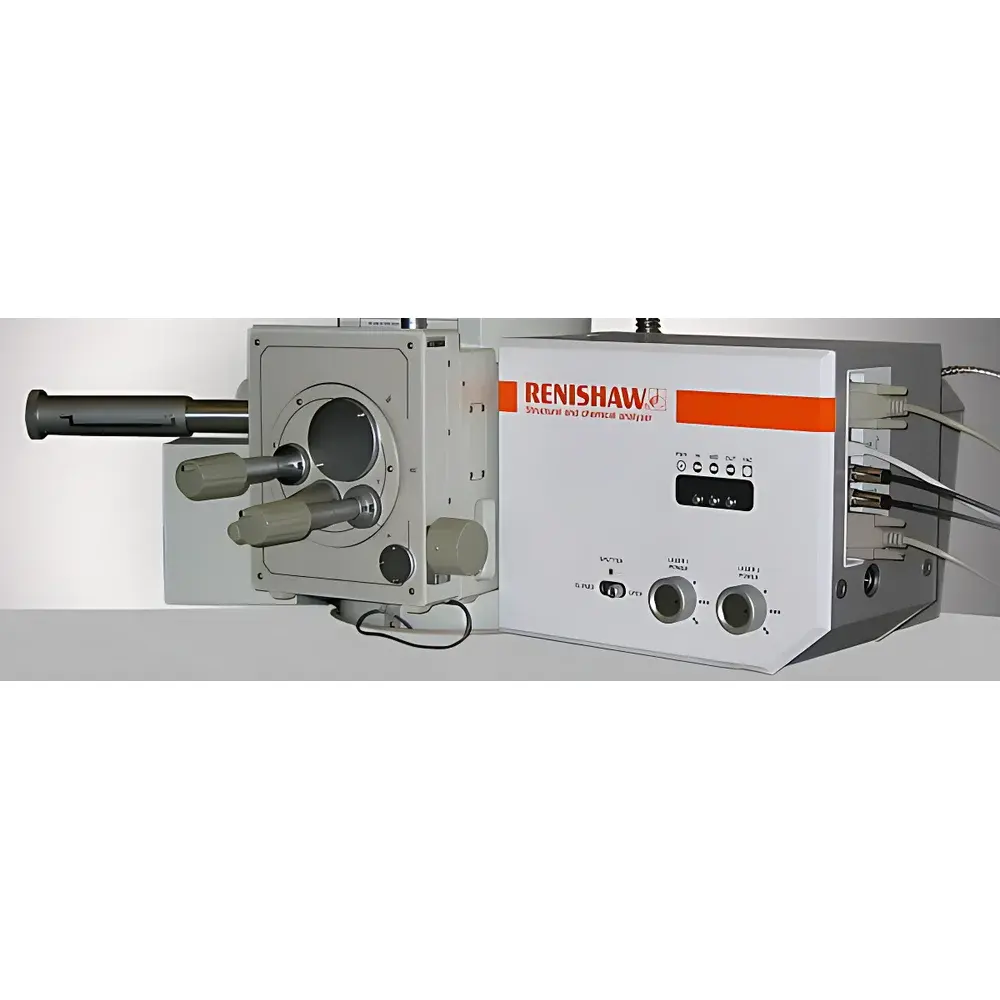
Renishaw inVia Raman-SCA-SEM Integrated Correlative Microscopy System
| Brand | Renishaw |
|---|---|
| Origin | United Kingdom |
| Model | Raman-SCA-SEM |
| Instrument Type | Confocal Micro-Raman Spectrometer Integrated with Scanning Electron Microscope |
| Spectral Range | 100–4000 cm⁻¹ |
| Spectral Resolution | ≤1 cm⁻¹ |
| Spatial Resolution | XY ≈ 1 µm, Z ≈ 2 µm |
| Low-Wavenumber Capability | down to 10 cm⁻¹ |
| Spectral Reproducibility | ≤0.1 cm⁻¹ |
Overview
The Renishaw inVia Raman-SCA-SEM Integrated Correlative Microscopy System enables true multimodal, in situ characterization by combining high-resolution scanning electron microscopy (SEM) with confocal micro-Raman spectroscopy within a single vacuum-compatible platform. This integration leverages the complementary strengths of electron-beam imaging and vibrational spectroscopy: SEM delivers nanoscale topographic, compositional (via EDS/WDS), and crystallographic (via EBSD) data, while confocal Raman provides molecular fingerprinting—identifying chemical bonds, crystallinity, phase distribution, stress/strain states, and defect signatures in organic, inorganic, and semiconductor materials. Unlike post-hoc correlation workflows requiring physical relocation and re-registration of samples, the SCA (Structural and Chemical Analysis) interface ensures precise spatial registration between SEM coordinates and Raman mapping positions, eliminating stage drift, sample handling artifacts, and registration uncertainty. The system operates on the principle of laser-induced inelastic scattering, where monochromatic excitation (typically 532 nm or 785 nm) interacts with molecular vibrations to generate characteristic Stokes/anti-Stokes shifts, resolved via a high-throughput Czerny–Turner spectrometer and deep-cooled CCD detector.
Key Features
- Seamless hardware integration via Renishaw’s SCA interface—no modification to existing SEM column or chamber required.
- Full compatibility with major SEM platforms including Zeiss, Thermo Fisher Scientific (FEI), JEOL, Hitachi, and TESCAN.
- Confocal optical design enabling depth-resolved Raman analysis with axial resolution of ~2 µm and lateral resolution approaching 1 µm (diffraction-limited).
- Extended low-wavenumber capability down to 10 cm⁻¹ for detection of lattice modes, interlayer vibrations (e.g., in 2D materials), and heavy-element phonons.
- Dual-mode acquisition: simultaneous or sequential SEM imaging and Raman mapping with sub-micron coordinate alignment accuracy.
- Integrated photoluminescence (PL) and cathodoluminescence (CL) spectroscopy capabilities using shared optical path and detector.
- Thermally stabilized optical bench and active wavelength calibration ensure spectral reproducibility ≤0.1 cm⁻¹ over extended acquisition periods.
Sample Compatibility & Compliance
The Raman-SCA-SEM system accommodates conductive and non-conductive solid samples—including thin films, nanoparticles, geological sections, battery electrodes, polymer composites, and biological tissue replicas—without mandatory metal coating when operated in low-vacuum or variable-pressure SEM modes. For insulating specimens, charge compensation is achieved via beam current modulation or low-energy flood gun, preserving native chemical integrity. All Raman acquisitions comply with ISO/IEC 17025 requirements for analytical testing laboratories when implemented with documented calibration protocols (NIST-traceable polystyrene and silicon standards). Data acquisition workflows support audit trails and electronic signatures per FDA 21 CFR Part 11 when deployed in regulated environments (e.g., pharmaceutical polymorph screening or medical device material verification).
Software & Data Management
Control and analysis are unified under Renishaw’s WiRE™ software platform (v6.x), which provides synchronized SEM-Raman navigation, multi-layered hyperspectral data fusion (RGB + EDS + Raman + CL), and quantitative chemometric tools (PCA, cluster analysis, spectral unmixing). Raw spectra are stored in vendor-neutral HDF5 format, ensuring long-term archival integrity and third-party interoperability (e.g., with Python-based SciPy/NumPy pipelines or MATLAB). Metadata embedding includes instrument parameters, calibration history, stage coordinates, and environmental conditions (vacuum level, stage temperature). WiRE supports GLP/GMP-compliant reporting templates with automated pass/fail thresholds for batch release testing.
Applications
- Failure analysis of microelectronic interconnects—correlating Cu diffusion pathways (EDS) with oxidation states (Raman) and grain boundary strain (peak shift mapping).
- 2D material characterization—identifying layer count, stacking order, doping, and interfacial coupling in graphene, MoS₂, and h-BN heterostructures.
- Pharmaceutical solid-state analysis—mapping polymorphic distribution in tablet cross-sections alongside particle morphology and elemental impurities.
- Geological mineral identification—distinguishing structurally similar silicates (e.g., quartz vs. cristobalite) and detecting fluid inclusions via low-frequency Raman modes.
- Carbon-based nanomaterial quality control—quantifying D/G band ratios in CNTs and graphene, correlated with defect density observed in SEM secondary electron contrast.
FAQ
Can the SCA interface be retrofitted to an existing SEM?
Yes—the SCA is designed as a modular, vacuum-integrated add-on compatible with standard SEM flange ports (CF100 or CF150). Installation requires no electron-optical modifications and typically completes within two working days.
Is Raman acquisition possible under high-vacuum SEM conditions?
Yes—Renishaw’s fiber-coupled, vacuum-compatible optical pathway maintains signal throughput and alignment stability across full vacuum ranges (10⁻⁷ mbar and below), enabling concurrent high-resolution SEM imaging and Raman spectroscopy.
How is spectral calibration maintained during long-duration mapping?
WiRE software executes real-time peak tracking using internal reference lines (e.g., Si 520 cm⁻¹) and applies dynamic pixel-shift correction, ensuring wavenumber accuracy remains within ±0.05 cm⁻¹ across 24-hour acquisitions.
Does the system support time-resolved or pump-probe Raman measurements?
No—the standard configuration is optimized for steady-state Raman, PL, and CL. Time-resolved capabilities require external ultrafast laser integration and are not part of the SCA-SEM product scope.
What training and support options are available?
Renishaw provides on-site installation commissioning, operator certification courses (including correlative workflow design), and annual preventive maintenance contracts with certified field engineers based in EMEA, North America, and APAC regions.
Related Products




