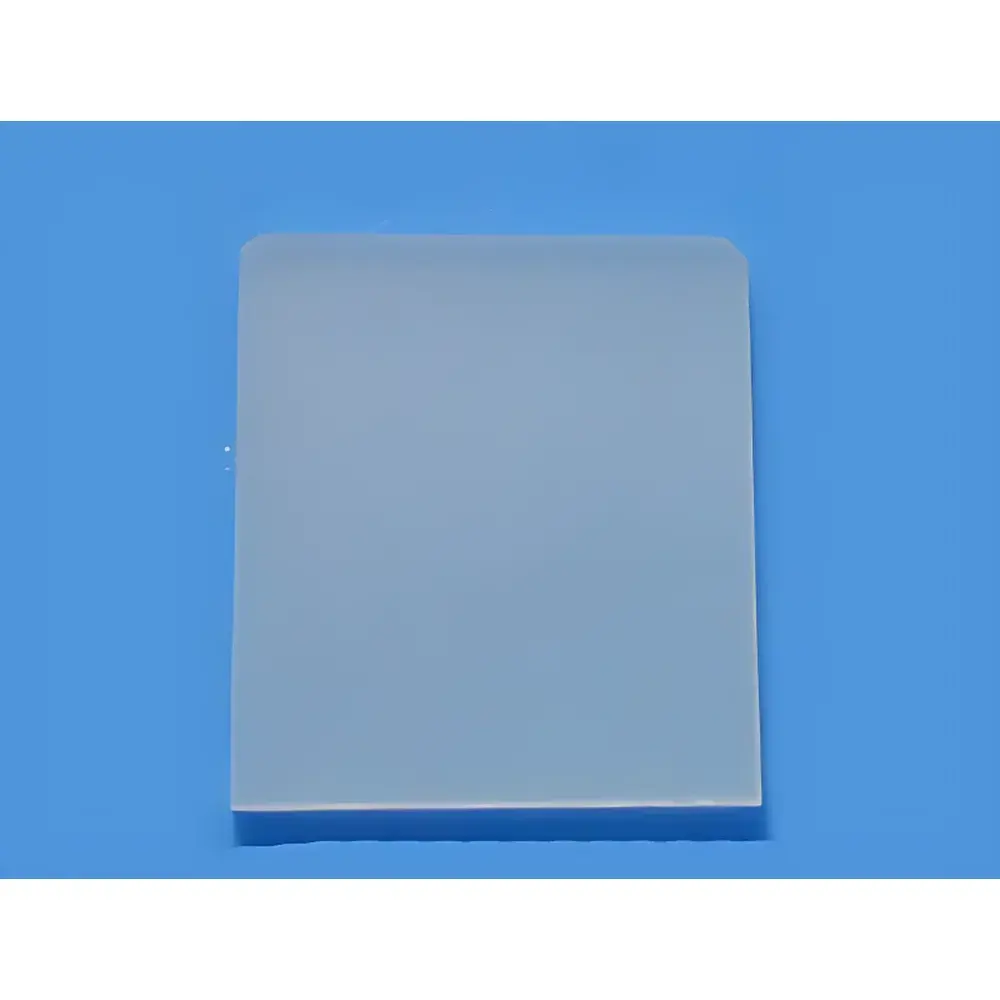
GdScO₃ Single Crystal Substrate Wafers
| Crystal Orientation | <110> ± 0.5° |
|---|---|
| Dimensions | 10 × 10 × 0.5 mm or 10 × 5 × 0.5 mm |
| Surface Finish | Single-side polished |
| Surface Roughness (Ra) | < 0.5 nm |
| Packaging | Vacuum-sealed in Class 100 cleanroom bags, stored and shipped from Class 1000 cleanroom environment |
| Material System | Perovskite-structured orthorhombic GdScO₃ |
Overview
GdScO₃ (gadolinium scandate) single-crystal substrates are engineered for high-precision epitaxial growth of complex oxide thin films—particularly perovskite-based superconductors, ferroelectrics, multiferroics, and oxide heterostructures. Its orthorhombic perovskite lattice (space group Pbnm) exhibits exceptional lattice matching with key functional oxides including YBCO (YBa₂Cu₃O₇₋δ), LCMO (La₀.₇Ca₀.₃MnO₃), and PZT (Pb(Zr,Ti)O₃), minimizing interfacial strain and enabling atomically coherent heterointerfaces. The substrate’s low thermal expansion anisotropy and high chemical stability under oxygen-rich annealing conditions further support reproducible MBE, PLD, and sputtering deposition processes. KEJING-supplied GdScO₃ wafers are cut and processed to meet stringent requirements for academic and industrial thin-film R&D laboratories engaged in quantum materials synthesis and device prototyping.
Key Features
- High-purity single-crystal GdScO₃ grown by the Czochralski method, verified by X-ray Laue diffraction and rocking curve FWHM ≤ 30 arcsec
- Precise orientation control: surface normal with angular tolerance of ±0.5°, critical for domain-aligned epitaxy of polar oxides
- Single-side polished finish with root-mean-square roughness Ra < 0.5 nm (measured by AFM over 5 × 5 µm² area)
- Controlled surface termination: Stoichiometric ScO₂–GdO surface layer confirmed via XPS and LEED
- Thermal stability up to 900 °C in O₂ ambient without decomposition or surface reconstruction
- Low dislocation density (< 1 × 10⁴ cm⁻²) as determined by etch-pit density analysis
Sample Compatibility & Compliance
These substrates are routinely used in ISO/IEC 17025-accredited thin-film characterization labs and comply with material traceability requirements for GLP-compliant oxide electronics development. They are compatible with standard semiconductor wafer handling protocols—including vacuum chucks, robotic transfer, and load-lock integration in UHV deposition systems. All batches undergo full certificate of conformance (CoC), including crystallographic orientation report, surface metrology summary, and cleanliness verification (particle count per SEM/EDS on representative samples). No halogenated solvents or organic residues are introduced during final cleaning; rinse steps employ ultra-pure DI water (18.2 MΩ·cm) and Class 10 cleanroom-grade nitrogen purge.
Software & Data Management
While GdScO₃ substrates are passive components, their integration into automated thin-film workflows is supported through standardized data exchange formats. KEJING provides batch-specific digital material passports in PDF and CSV formats, including Lot ID, growth date, orientation verification data, and AFM topography thumbnails. These files are structured to interface with LabVantage LIMS, Thermo Fisher SampleManager, and custom Python-based lab informatics pipelines using ASTM E2962-compliant metadata schemas. Audit trails for packaging validation (e.g., residual moisture content < 10 ppm, He-leak test records) are retained for ≥7 years per ISO 9001:2015 clause 8.5.2.
Applications
- Epitaxial growth of high-Tc cuprate superconductors (e.g., YBCO, SmBCO) for Josephson junctions and SQUID fabrication
- Template layers for strain-engineered ferroelectric HfO₂-based capacitors in sub-5 nm node memory devices
- Substrates for interfacial superconductivity studies in LaAlO₃/SrTiO₃ heterostructures
- Platform for probing spin-orbit coupling effects in SrIrO₃/GdScO₃ interfaces
- Reference standards in synchrotron-based X-ray standing wave (XSW) and resonant elastic X-ray scattering (REXS) experiments
FAQ
What is the typical off-axis angle for the orientation?
The nominal surface normal is aligned to the [110] crystallographic direction within ±0.5°, as measured by high-resolution X-ray diffractometry (HR-XRD) using a four-circle goniometer.
Can these substrates be reused after thin-film removal?
Re-use is not recommended due to irreversible surface damage from wet etching or ion milling; however, thermal desorption in O₂ at 750 °C may restore stoichiometry for limited re-growth cycles if surface roughness remains < 1 nm Ra.
Is there documentation for U.S. EAR99 export classification?
Yes—each shipment includes an Export Control Classification Number (ECCN) statement confirming EAR99 status and non-restricted end-use per Supplement No. 1 to Part 734.
Do you offer custom thicknesses or double-side polishing?
Custom specifications—including 0.3 mm thickness, e-beam transparent windows (≥ 90% transmission at 200 keV), and double-side polish (Ra < 0.3 nm)—are available under NRE agreement with minimum order quantity of 25 wafers.