
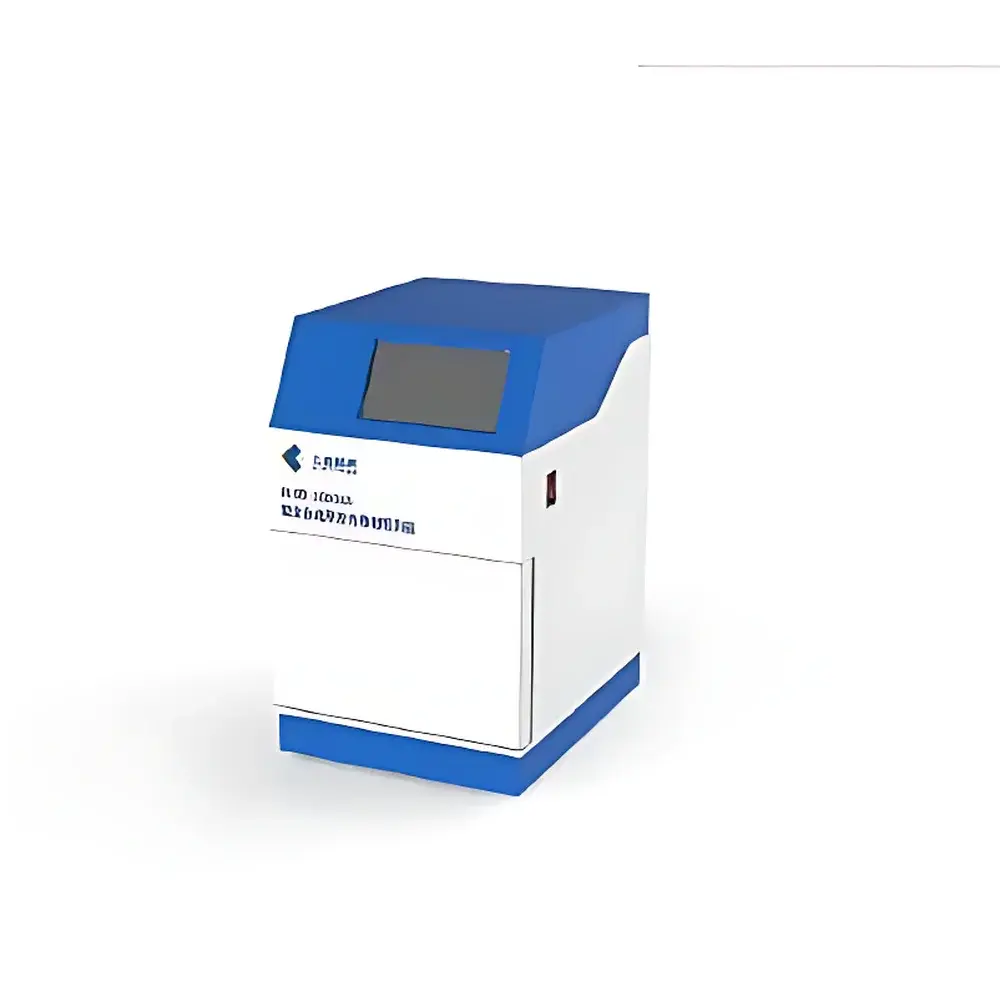
Kezhe ELSD-3000KS Evaporative Light Scattering Detector
| Brand | Kezhe / KEZHE SHANGHAI |
|---|---|
| Origin | Shanghai, China |
| Manufacturer Type | Original Equipment Manufacturer (OEM) |
| Product Category | Domestic |
| Model | ELSD-3000KS |
| Instrument Type | Evaporative Light Scattering Detector (ELSD) |
| Wavelength Range | 195–600 nm |
| Detection Method | Dual-beam |
| Light Source | Xenon Lamp |
Overview
The Kezhe ELSD-3000KS is a high-performance, fully automated evaporative light scattering detector engineered for universal compatibility with HPLC, UHPLC, and preparative chromatography systems. It operates on the fundamental principle of nebulization, solvent evaporation, and optical detection of non-volatile and semi-volatile analytes as discrete particles in a carrier gas stream. Unlike UV-Vis or refractive index detectors, the ELSD-3000KS provides mass-sensitive, gradient-compatible response independent of chromophore presence or molecular absorbance—making it indispensable for natural product analysis, polymer characterization, and pharmaceutical excipient quantification where conventional detection fails. Its design emphasizes robustness, reproducibility, and compliance-ready operation in regulated environments.
Key Features
- Fully electronic control and real-time digital display of nebulizer gas flow (0–5 L/min standard; up to 10 L/min optional), drift tube temperature (ambient to 150 °C standard; up to 300 °C optional), and pressure—enabling precise method transfer and system validation.
- Modular optical configuration: interchangeable light sources including 650 nm laser (standard), 670 nm laser, halogen lamp, or 470 nm LED—optimized for signal-to-noise ratio across diverse sample matrices.
- Detector options include silicon photodiode (for routine applications) and photomultiplier tube (PMT) for sub-pg detection limits (e.g., glucose, direct injection).
- Brewster-angle light trap minimizes background scatter, enhancing baseline stability and lowering detection thresholds.
- Stainless-steel evaporation tubing ensures chemical resistance, thermal stability, and mechanical durability under continuous operation.
- Self-calibrating gas flow and temperature modules reduce manual intervention during installation and routine maintenance.
- Specialized nozzle surface treatment prevents clogging and eliminates routine cleaning—extending uptime and reducing consumable dependency.
- Optional industrial-grade touch-screen PC integration supports operation in non-laboratory or GMP-aligned production environments.
- 24-bit analog-to-digital conversion delivers >10⁵ dynamic range, supporting both trace-level and high-concentration analyte detection within a single run.
Sample Compatibility & Compliance
The ELSD-3000KS detects compounds lacking strong UV absorption or refractive index contrast—including carbohydrates, lipids, surfactants, polymers, saponins, flavonoid glycosides, and peptide fragments. Its low-temperature nebulization and evaporation pathway preserves thermolabile species such as oligosaccharides and labile glycosides commonly found in herbal extracts. The instrument meets essential functional requirements for GLP-compliant laboratories: full audit trail support via integrated software logging, user-access level management, and timestamped parameter history. While not pre-certified to FDA 21 CFR Part 11, its architecture supports validation protocols required for regulated submissions (e.g., ICH Q5, Q6, Q2(R2)), particularly in botanical drug development aligned with USP , EP 2.2.46, and Chinese Pharmacopoeia general chapters for HPLC-ELSD methods.
Software & Data Management
The dedicated ELSD-3000KS Chromatography Workstation provides comprehensive instrument control, including real-time adjustment of drift tube temperature, gas flow setpoints, gain calibration, and peak integration parameters. It supports AIA/ANDI file export for cross-platform data exchange with third-party CDS (e.g., Waters Empower, Thermo Chromeleon, Agilent OpenLab). All instrument events—including hardware status, error codes, and method execution logs—are recorded with ISO 8601 timestamps. Software includes built-in tools for baseline correction, peak threshold optimization, and signal averaging—critical for low-abundance analyte identification in complex matrices like TCM extracts or fermentation broths.
Applications
- Quantitative profiling of polysaccharides, triterpene saponins, and iridoid glycosides in traditional Chinese medicine (TCM) raw materials and finished products (e.g., Ginkgo biloba extract, Radix Astragali, Fritillaria thunbergii).
- Analysis of synthetic and natural surfactants, PEG-based excipients, and lipid nanoparticles in formulation development.
- Characterization of oligomeric impurities and degradation products in antibiotics (e.g., aminoglycosides: gentamicin, tobramycin, netilmicin) without derivatization.
- Method development for preparative HPLC fraction collection, enabled by optional flow-splitting module and parallel/series coupling with UV or RID detectors.
- Stability-indicating assays for heat-sensitive APIs and biologics-related substances where UV detection is non-specific or insensitive.
FAQ
Is the ELSD-3000KS compatible with ultra-high-pressure liquid chromatography (UHPLC) systems?
Yes—it accepts inlet pressures up to 600 bar when equipped with appropriate capillary interfaces and is routinely deployed with sub-2-µm particle columns.
Can the detector be validated for use in GMP manufacturing environments?
Its modular architecture, digital parameter logging, and deterministic response enable full IQ/OQ/PQ protocol execution per ASTM E2500 and EU Annex 15 guidelines.
What carrier gases are supported, and is nitrogen required for optimal sensitivity?
Both compressed air and nitrogen are supported; nitrogen improves signal-to-noise ratio for low-mass analytes but is not mandatory for routine QC applications.
Does the instrument support multi-wavelength or spectral acquisition?
No—ELSD is inherently broadband scattering detection; wavelength selection affects only source intensity and PMT quantum efficiency, not spectral resolution.
How does the ELSD-3000KS handle gradient elution without baseline drift?
Its dual-beam compensation design, combined with active temperature stabilization and solvent vapor saturation control, suppresses mobile-phase-induced baseline fluctuations typical in gradient runs.




