
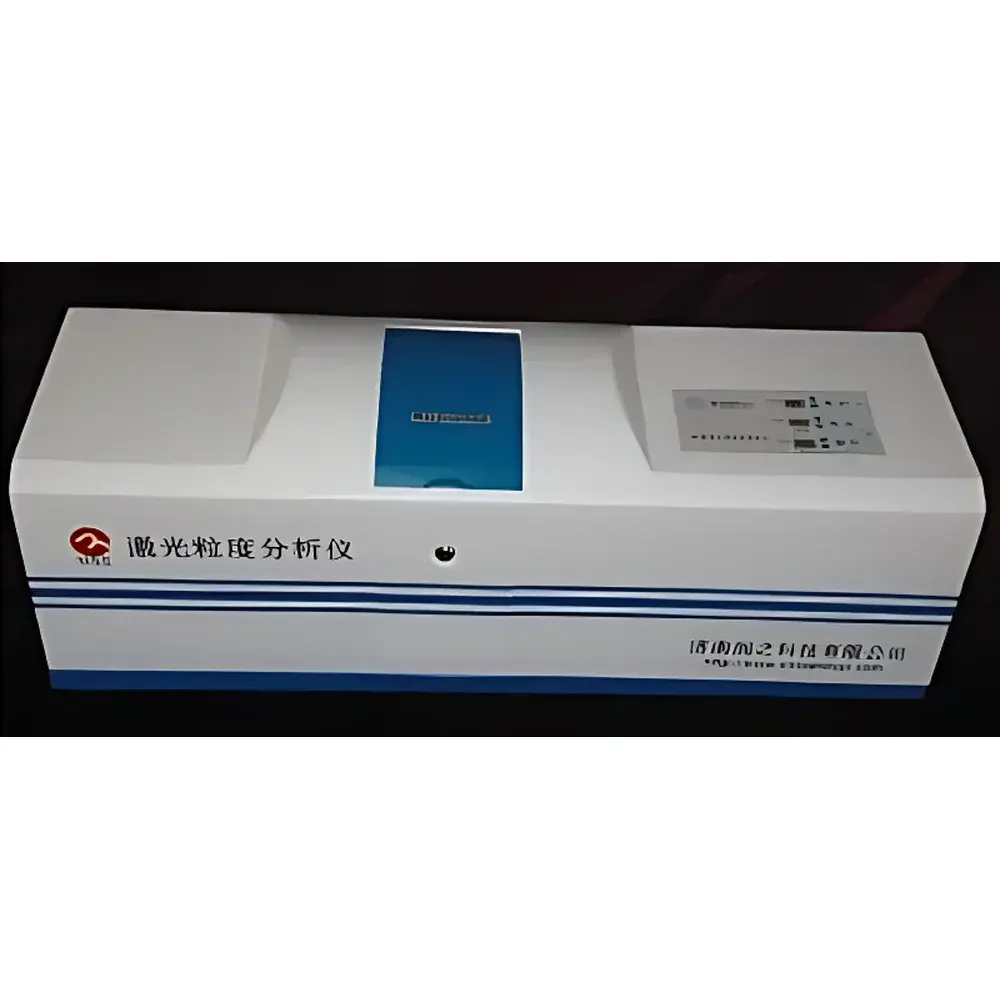
Rise-2208 Automated Laser Diffraction Particle Size Analyzer
| Measurement Range | 0.02–1200 µm |
|---|---|
| Accuracy Error | < ±1% (D50, NIST-traceable standard materials) |
| Repeatability | < ±1% (D50, same sample, 3 consecutive runs) |
| Laser Source | He-Ne, 632.8 nm, >25,000 h lifetime |
| Detector Array | Non-uniform 3D crossed fan-shaped matrix, max detection angle 135° |
| Dispersion System | Integrated 400 mL wet cell with 100 W ultrasonic probe, automatic degassing, circulation, rinsing & drainage |
| Power Supply | AC 220 V ±10%, 50 Hz, 200 W |
| Dimensions | 1000 × 330 × 320 mm |
| Weight | 39 kg |
Overview
The Rise-2208 Automated Laser Diffraction Particle Size Analyzer is a fully integrated wet-dispersion instrument engineered for high-precision, high-reproducibility particle size distribution (PSD) analysis across research laboratories, quality control environments, and industrial R&D settings. It operates on the principle of laser diffraction—specifically, Mie scattering theory—applied over the full measurement range. Unlike simplified Fraunhofer approximations, the Rise-2208 employs rigorous Mie-based inversion algorithms that incorporate user-defined or default optical parameters (e.g., particle refractive index, dispersion medium refractive index, and absorption coefficient), ensuring physically accurate interpretation of angular light scattering patterns. The system utilizes a single, fixed-optics convergent beam design—eliminating Fourier lens stacks and mechanical alignment dependencies—thereby delivering inherent optical stability, wide dynamic range, and maintenance-free optical path integrity. Its core architecture integrates fluidic automation, real-time signal validation, and traceable metrology to meet the analytical rigor expected in GLP-compliant and ISO/IEC 17025-accredited laboratories.
Key Features
- Automated wet dispersion workflow: Fully programmable sequence including auto-filling, degassing, ultrasonication (up to 100 W, user-timed), circulation, measurement, drainage, and cleaning—initiated with a single software command.
- High-fidelity optical detection: A proprietary non-uniform 3D crossed fan-shaped photodiode array with 135° maximum scattering angle coverage ensures comprehensive capture of forward- and back-scattered light intensities, critical for resolving submicron and coarse fractions simultaneously.
- Stable He-Ne laser source: 632.8 nm wavelength, narrow linewidth (25,000-hour operational lifetime provide long-term intensity stability and minimal mode-hopping—essential for baseline consistency across multi-day validation studies.
- Single-range convergent optical path: Eliminates moving parts, alignment drift, and range-switching artifacts; enables seamless measurement from 0.02 µm to 1200 µm without hardware reconfiguration.
- Intelligent data inversion: Implements unconstrained non-negative least-squares (NNLS) fitting—no prior assumptions about distribution shape—yielding physically meaningful PSDs validated against NIST-traceable reference materials (e.g., SRM 1963, SRM 2800).
- Robust mechanical construction: Manufactured per Q/01RZ01-2004 industrial standards; all critical optomechanical components sourced from certified suppliers; no consumable optical elements or field-serviceable lasers.
Sample Compatibility & Compliance
The Rise-2208 supports aqueous and organic dispersions—including water, ethanol, isopropanol, and other low-viscosity solvents—with compatibility verified for inorganic oxides (SiO₂, Al₂O₃), polymers, pharmaceutical actives, catalysts, pigments, and battery electrode slurries. Its 400 mL recirculating cell accommodates both low-concentration suspensions (0.1–0.5% w/v) and high-loading formulations (up to 15% w/v with extended sonication). All automated fluidic operations comply with ISO 13320:2020 requirements for laser diffraction instrumentation, including bubble elimination protocols, flow-rate stabilization, and signal-to-noise optimization. Data acquisition and reporting support audit trails, electronic signatures, and 21 CFR Part 11–compliant metadata logging when operated under validated software configurations.
Software & Data Management
The PADMAS (Particle Diameter Measure & Analysis System) software provides ISO 13320–aligned analysis workflows with dual-mode operation: standard mode for routine QC and expert mode for method development. It delivers D10, D50, D90, span, specific surface area (volume- and mass-based), and lognormal/Rosin-Rammler fit parameters. Distribution outputs include differential, cumulative, standardized, and user-defined binning schemes (1–130 adjustable channels within 0.02–2000 µm). Raw scattering data and processed PSDs export natively to CSV and Excel; graphical reports generate publication-ready PNG, TIFF, or PDF files. All report templates are customizable (headers, footers, logos), support bilingual (EN/CN) output, and retain full traceability—including instrument ID, operator, timestamp, dispersion parameters, and raw intensity profiles.
Applications
The Rise-2208 serves as a primary characterization tool in pharmaceutical solid dosage development (API crystallinity, milling endpoint control), advanced materials synthesis (nanoparticle batch release, ceramic sintering feedstock qualification), battery material production (cathode/anode active material grading), and environmental particulate monitoring (sediment grain-size classification). Its accuracy and repeatability meet ASTM D422, ISO 13320, and USP requirements for particle size testing in regulated environments. Universities utilize it for teaching fundamental light scattering principles and validating computational scattering models; industrial labs deploy it for SPC charting, supplier qualification, and DOE-driven process optimization.
FAQ
What optical model does the Rise-2208 use for particle size inversion?
It applies Mie scattering theory with user-configurable complex refractive indices—enabling accurate analysis of absorbing, anisotropic, or high-refractive-index particles.
Is the instrument compliant with regulatory data integrity standards?
Yes—when deployed with validated PADMAS configurations, it supports ALCOA+ principles, 21 CFR Part 11 audit trails, and electronic signature enforcement.
Can the system analyze dry powders directly?
No—it is a wet-dispersion-only platform; dry powder analysis requires optional pneumatic dispersion accessories (not included with base configuration).
How is measurement reproducibility verified?
Via repeated analysis of NIST SRM 1963 (10.0 µm polystyrene latex) and SRM 2800 (3.5 µm alumina), with acceptance criteria of ≤±1% RSD on D50 across ≥3 independent runs.
What maintenance is required beyond routine cleaning?
None—optical path is sealed and alignment-free; only periodic verification using reference standards and inspection of fluidic seals is recommended per ISO/IEC 17025 preventive maintenance schedules.
Related Products



