
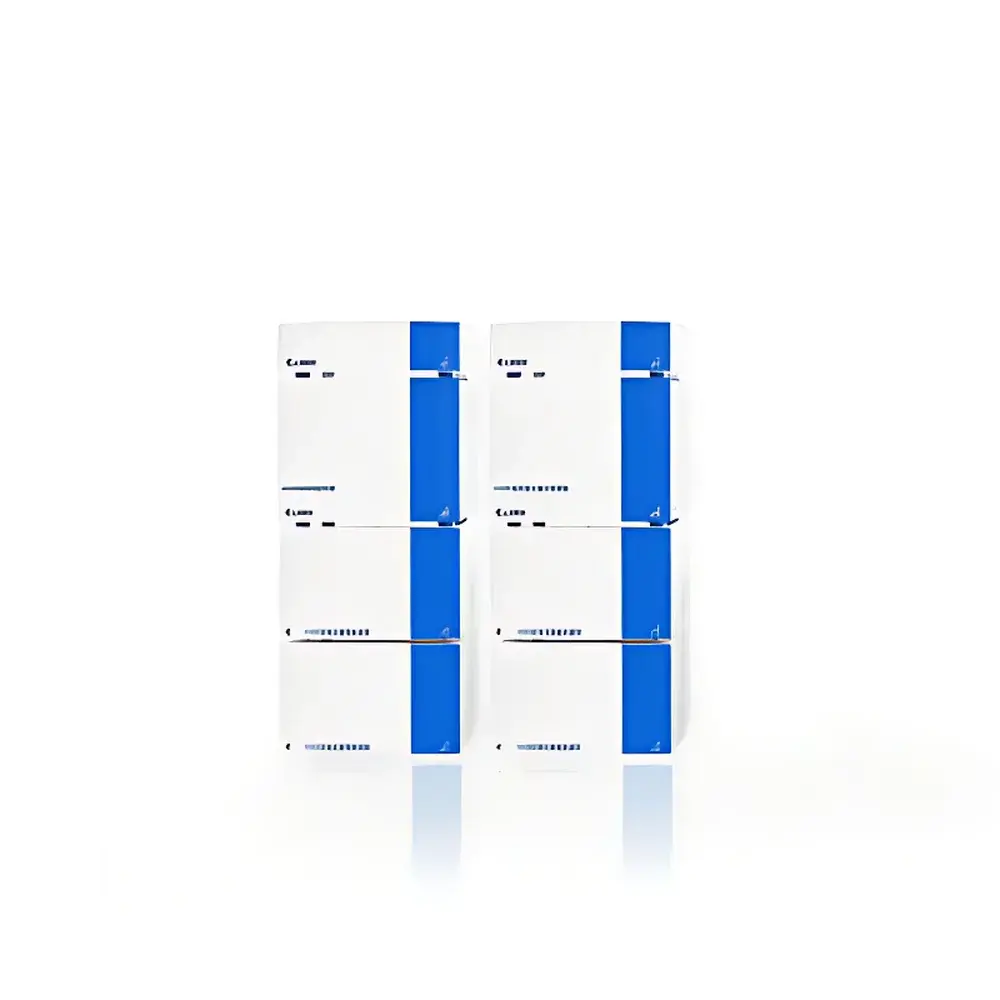
KEZHE SHANGHAI 2DMax1100A1/P1 Orthogonal Two-Dimensional Liquid Chromatography System
| Brand | KEZHE SHANGHAI |
|---|---|
| Origin | Shanghai, China |
| Manufacturer Type | Original Equipment Manufacturer (OEM) |
| Product Category | Domestic |
| Model | 2DMax1100A1 / 2DMax1100P1 |
| Flow Rate Range | 0–200 mL/min (customizable higher flow available) |
| Maximum Pressure | 0–4000 psi with overpressure protection |
| UV-Vis Detection Wavelength Range | 190–850 nm (quad-wavelength simultaneous detection), wavelength accuracy: ±0.2 nm |
| Light Source | Deuterium lamp + Tungsten lamp |
| Autosampler Capacity | 144 vials (sealed vial design with needle wash function) |
| Fraction Collector (2DMax1100P1 only) | 160 positions, 15 mm tube diameter |
| Software Platform | Windows 7/10 (64-bit) |
| Communication Interface | Ethernet |
Overview
The KEZHE SHANGHAI 2DMax1100A1/P1 Orthogonal Two-Dimensional Liquid Chromatography (2D-LC) System is engineered for high-resolution separation of chemically complex mixtures where conventional one-dimensional HPLC reaches its peak capacity limit. Unlike serial or heart-cutting 2D-LC configurations, this system implements a true comprehensive orthogonal separation architecture—utilizing two independent chromatographic dimensions with mutually incompatible mobile phases (e.g., normal-phase × normal-phase or normal-phase × reversed-phase), enabling enhanced orthogonality and peak capacity multiplication (ntotal ≈ n1 × n2). The system integrates modular high-pressure quaternary gradient pumping, quad-wavelength UV-Vis detection, and programmable valve-based fraction routing to support both analytical-scale characterization (2DMax1100A1) and preparative-scale isolation (2DMax1100P1). Its design reflects a deliberate convergence of thin-layer chromatography (TLC) operational logic—rapid scouting, visual band localization, and selective zone transfer—with the quantitative rigor, reproducibility, and automation of modern LC platforms. This hybrid paradigm is particularly suited to natural product analysis, traditional Chinese medicine (TCM) fingerprinting, synthetic reaction monitoring, and impurity profiling in pharmaceutical development.
Key Features
- Orthogonal dual-column architecture with independently controlled gradient programs per dimension, supporting NP×NP and NP×RP configurations to resolve co-eluting analytes across orthogonal selectivity mechanisms.
- High-integrity valve switching system with low-dead-volume actuation and precise timing control, minimizing carryover and ensuring reproducible fraction transfer between dimensions.
- Quad-wavelength UV-Vis detector (190–850 nm) with deuterium/tungsten dual-lamp source enables simultaneous multi-wavelength absorbance monitoring—critical for compound identification in heterogeneous matrices without spectral scanning delay.
- 144-position autosampler with sealed vial rack and integrated needle wash station ensures sample integrity and mitigates cross-contamination during high-throughput runs.
- Modular software-controlled operation allows seamless transition between 1D-LC, heart-cut 2D-LC, and full comprehensive 2D-LC modes—facilitating method development, validation, and routine QC execution within a single platform.
- 2DMax1100P1 variant includes an intelligent fraction collector with 160-position 15 mm tube rack and real-time trigger-based collection logic synchronized to detector signal thresholds or retention time windows.
Sample Compatibility & Compliance
The 2DMax1100 series accommodates a broad range of sample types—including crude plant extracts, fermentation broths, reaction mixtures, and purified intermediates—without requiring extensive pre-fractionation. Its solvent compatibility extends across hexane/ethyl acetate (normal-phase), methanol/water/acetonitrile (reversed-phase), and chlorinated solvents (e.g., chloroform, dichloromethane), subject to pump and column chemical resistance specifications. All hardware components comply with CE marking requirements for laboratory instrumentation. The system supports audit-trail-enabled data acquisition and processing in accordance with FDA 21 CFR Part 11 principles when deployed with validated software configuration and appropriate user access controls. Method parameters, instrument logs, and raw chromatograms are stored in vendor-neutral formats compatible with LIMS integration and GLP/GMP documentation workflows.
Software & Data Management
The modular liquid chromatography workstation provides a unified interface for instrument control, method building, real-time visualization, and post-run analysis. It supports IUPAC-compliant peak integration algorithms, retention time alignment across 2D contour plots, and export of 2D retention maps (tR1 vs. tR2) in CSV and image formats. Raw data files adhere to ANDI/NetCDF standards for long-term archival and third-party reprocessing. Software validation packages—including IQ/OQ documentation templates and electronic signature support—are available upon request. Remote monitoring via Ethernet enables centralized lab management and troubleshooting without physical access.
Applications
- Comprehensive profiling of herbal medicines and botanical extracts where matrix complexity exceeds 1D-LC resolution limits.
- Isolation of minor alkaloids, flavonoids, or terpenoids from multi-component fractions for structural elucidation by NMR or MS.
- Monitoring side-product formation and intermediate accumulation in multi-step organic syntheses.
- Stability-indicating assays for pharmaceutical formulations under forced degradation conditions.
- Impurity identification and quantification in API batches per ICH Q3B(R2) guidelines.
- Method development for regulatory submissions requiring orthogonal confirmation of peak purity (ICH Q5C).
FAQ
What distinguishes “orthogonal” 2D-LC from heart-cutting approaches?
Orthogonal 2D-LC samples the entire first-dimension effluent across multiple time segments into the second dimension, generating a full 2D separation space. Heart-cutting transfers only selected peaks, limiting information content and increasing method development time.
Can the system operate in 1D-LC mode for routine QC use?
Yes—the platform defaults to standard HPLC functionality and can be reconfigured for 2D operation via software-defined valve states and gradient tables.
Is the quad-wavelength detector capable of spectral deconvolution?
No; it provides fixed-wavelength absorbance at four user-selectable wavelengths simultaneously. Spectral acquisition requires a diode-array detector (DAD), which is not included in this configuration.
Does the system support GMP-compliant electronic records?
When installed with validated software settings, role-based user accounts, and enabled audit trail logging, it meets foundational requirements for electronic record integrity per 21 CFR Part 11.
What column chemistries are recommended for NP×NP operation?
Silica, cyano, and diol phases are commonly used in the first dimension; amino, silver-ion, or bare silica columns may be employed in the second dimension depending on analyte polarity and functional group interactions.
Related Products





