
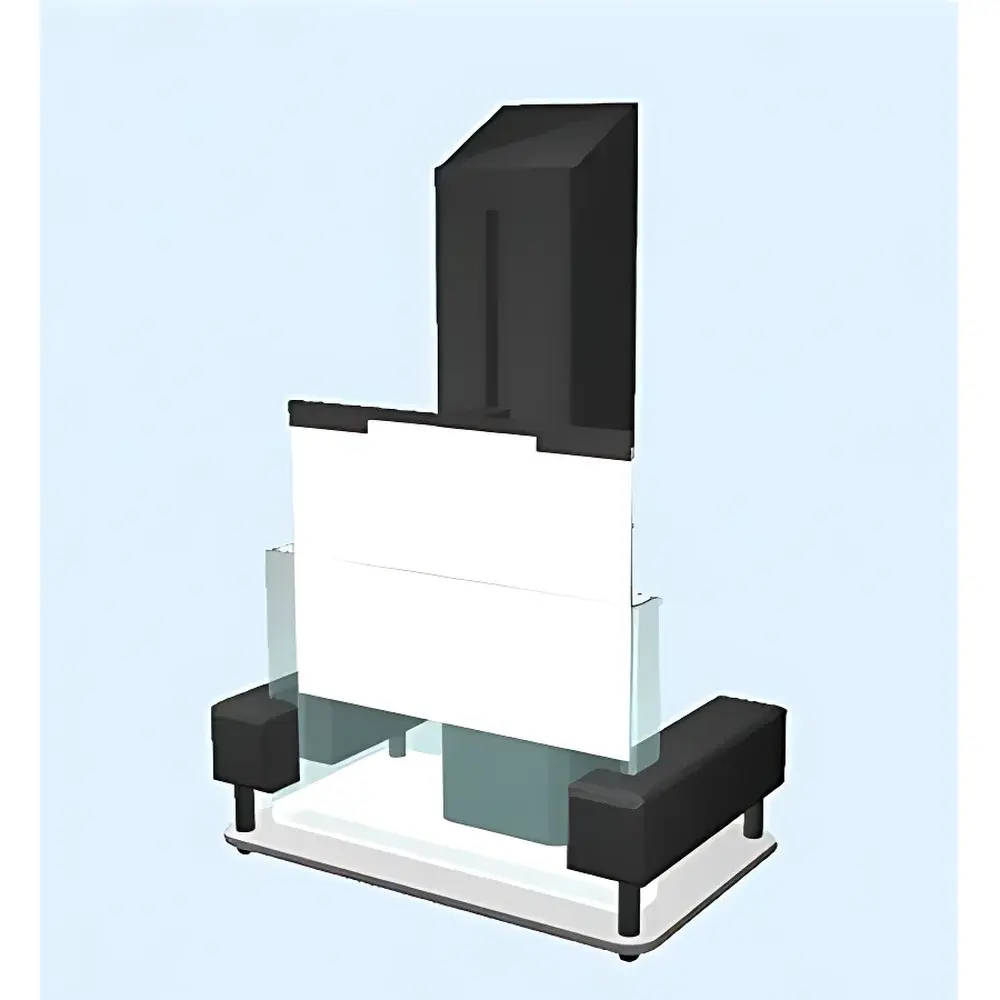
KEZHE SHANGHAI TY-10 Automatic Immersion Derivatizer for Thin-Layer Chromatography
| Brand | KEZHE SHANGHAI |
|---|---|
| Origin | Shanghai, China |
| Manufacturer Type | Direct Manufacturer |
| Product Origin | Domestic (China) |
| Model | TY-10 |
| Instrument Category | TLC Auxiliary Equipment |
| Maximum Plate Size | 200 × 100 mm (standard), 200 × 200 mm (customizable) |
| Immersion Speed | 0–10 mm/s (adjustable) |
| Configuration Includes | Reagent Reservoir Tank, Main Derivatization Unit, TLC Plate Holder Assembly, Dedicated Control Software |
Overview
The KEZHE SHANGHAI TY-10 Automatic Immersion Derivatizer is an engineered solution designed specifically for post-development derivatization of thin-layer chromatography (TLC) plates. Unlike spray-based or vapor-phase derivatization methods—where reagent distribution is subject to operator technique and environmental variability—the TY-10 employs a precisely controlled vertical immersion mechanism. This ensures uniform, reproducible contact between the stationary phase and derivatizing reagent across the entire plate surface. The system operates on the principle of gravity-assisted, motor-driven plate submersion into a thermostatically stabilized reagent bath, followed by programmable dwell time and controlled withdrawal speed. Its design supports routine analytical workflows in pharmaceutical QC labs, natural product research, forensic chemistry, and academic teaching laboratories where quantitative densitometric analysis of derivatized zones is required.
Key Features
- Programmable immersion speed (0–10 mm/s) with high-resolution stepper motor control, enabling optimization for viscous or volatile reagents.
- Standard compatibility with 200 × 100 mm TLC plates (ISO 7738-compliant dimensions); optional custom support for 200 × 200 mm plates upon request.
- Dedicated reagent reservoir tank constructed from chemically resistant polypropylene, accommodating up to 500 mL of common derivatizing agents (e.g., anisaldehyde/H2SO4, ninhydrin, p-anisaldehyde, or sulfuric acid–ethanol mixtures).
- Integrated plate holder with adjustable clamping force and anti-slip silicone pads to prevent lateral displacement during immersion and withdrawal.
- Embedded microcontroller with real-time feedback loop ensures consistent immersion depth (±0.2 mm tolerance) and repeatable dwell duration (1–120 s range).
- Compact footprint (W320 × D280 × H360 mm) suitable for benchtop integration alongside TLC development chambers and densitometers.
Sample Compatibility & Compliance
The TY-10 accommodates silica gel, alumina, cellulose, and reversed-phase (RP-18) TLC plates from major suppliers including Merck, Sorbent Technologies, and Whatman. It is compatible with both pre-coated and hand-cast plates, provided surface integrity remains intact after development and drying. No vacuum or inert gas purging is required, making it suitable for use in standard laboratory environments without specialized infrastructure. While the instrument itself does not fall under regulatory device classification (e.g., FDA 510(k) or CE IVD), its operational consistency supports adherence to GLP principles for documented derivatization steps in method validation protocols. All mechanical components meet RoHS Directive 2011/65/EU material restrictions.
Software & Data Management
The TY-10 is operated via KEZHE’s proprietary DerivaControl™ software (Windows 10/11 compatible), providing a GUI for defining and saving method parameters—including immersion speed, dwell time, number of cycles (for multi-step derivatization), and plate identification tags. Each run generates a timestamped log file (.csv) containing execution metadata (start/end time, actual speed profile, error flags), supporting audit trails per ISO/IEC 17025:2017 clause 7.10.2. Software updates are delivered via secure HTTPS download; no cloud connectivity or remote telemetry is implemented, preserving data sovereignty in regulated environments.
Applications
- Quantitative densitometry of alkaloids, flavonoids, steroids, and amino acids following acidic or oxidative derivatization.
- High-throughput screening of reaction mixtures in medicinal chemistry, where >20 plates/day must undergo identical derivatization conditions.
- Standardized visualization of low-UV-absorbing compounds (e.g., carbohydrates, glycosides) prior to scanning at 366 nm or 254 nm.
- Method transfer between R&D and QC labs where manual derivatization introduces unacceptable inter-operator variance (CV >15%).
- Educational use in undergraduate chromatography laboratories to demonstrate the impact of uniform derivatization on spot intensity linearity (R² >0.995 over 3-log concentration range).
FAQ
Is the TY-10 compatible with corrosive reagents such as concentrated sulfuric acid?
Yes—the reagent tank and internal guide rails are fabricated from PP and PTFE-coated stainless steel, rated for continuous exposure to ≤70% H2SO4 at ambient temperature.
Can the immersion depth be adjusted for partial-plate derivatization?
No—immersion is full-plate only; however, users may mask regions using inert tape prior to loading.
Does the system support temperature-controlled derivatization?
Not natively; ambient operation is standard. For thermally activated reactions, pre-warm reagent externally and load into the reservoir within 5 minutes of preparation.
What maintenance is required for long-term reliability?
Monthly cleaning of the reagent tank and plate guides with isopropanol; annual calibration of the immersion speed encoder using certified reference weights and optical timing sensors.
Is validation documentation available for GMP environments?
Yes—KEZHE provides IQ/OQ templates aligned with ASTM E2500-13 and USP guidelines; PQ protocol development support is offered under separate service agreement.





