
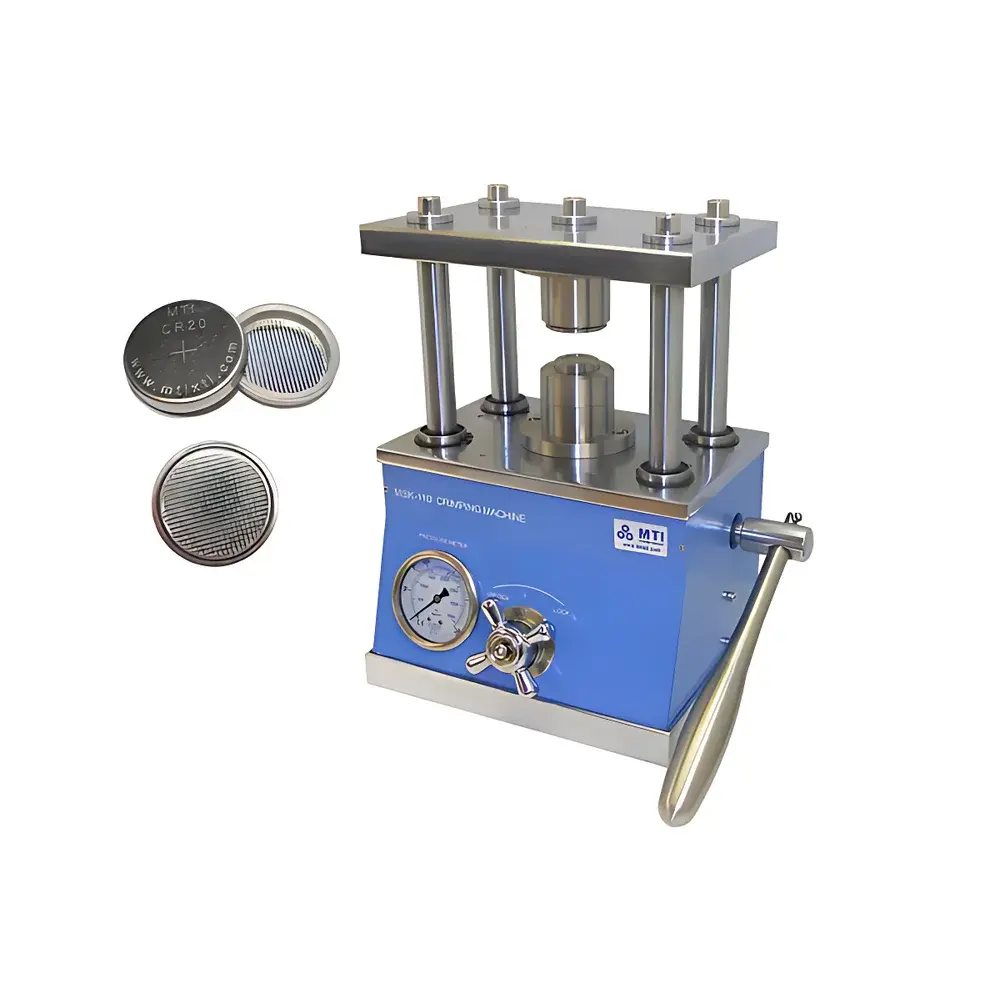
Hefei Kejing MSK-110 Benchtop Hydraulic Button Cell Crimping Press
| Brand | Hefei Kejing |
|---|---|
| Origin | Anhui, China |
| Model | MSK-110 |
| Crimping Force Range | 50–200 kg/cm² (≈1.8–7.2 kN) |
| Standard Cell Compatibility | CR2016, CR2032 |
| Optional Cell Compatibility | CR2450, CR2012 (with accessory die sets) |
| Handwheel Operating Force | <6 kg |
| Die Material | Imported Japanese stainless steel & specialty tool steel |
| Frame Material | Alloy aluminum & high-strength chrome steel with eco-friendly electroplating and powder coating |
| Dimensions (L×W×H) | 228 × 176 × 310 mm |
| Net Weight | 24.8 kg |
| Factory-Preset Crimping Pressure | ~100 kg/cm² |
| Built-in Pressure Gauge | Analog, calibrated for real-time monitoring |
| Safety Features | Integrated pressure relief valve, adjustable upper pressure limit |
| Warranty | 12 months standard, lifetime technical support |
Overview
The Hefei Kejing MSK-110 Benchtop Hydraulic Button Cell Crimping Press is a precision-engineered mechanical crimping system designed specifically for laboratory-scale fabrication of coin-type electrochemical cells. Unlike electrochemical workstations—which perform potentiostatic/galvanostatic measurements—the MSK-110 serves a critical pre-analytical function: applying controlled, repeatable mechanical force to hermetically seal button cell assemblies (e.g., CR20xx series) during R&D prototyping. Its operation relies on a manually actuated hydraulic amplification mechanism, converting modest handwheel input force (<6 kg) into precise axial crimping loads (50–200 kg/cm²), enabling consistent electrode-electrolyte-can interface formation essential for reliable cycling and impedance characterization. The unit’s compact footprint (228 × 176 × 310 mm) and glovebox-compatible design make it ideal for inert-atmosphere battery material development workflows—particularly in solid-state, lithium-metal, or air-sensitive chemistries where contamination control is paramount.
Key Features
- Compact benchtop architecture engineered for integration inside argon-filled gloveboxes (O₂/H₂O < 0.1 ppm)
- Hydraulic force multiplication system delivering high reproducibility across crimping cycles (±2% pressure stability under steady load)
- Integrated analog pressure gauge with 0–250 kg/cm² scale for real-time, operator-visible force monitoring and endpoint verification
- Modular die set design: Standard tooling supports CR2016 and CR2032 cells; optional dies enable CR2450 and CR2012 configurations without frame modification
- Dual-material construction: Structural frame fabricated from anodized alloy aluminum and hardened chrome steel; corrosion-resistant surface finish via RoHS-compliant electroplating and thermal-cured powder coating
- Fail-safe hydraulic circuit featuring a factory-calibrated pressure relief valve and user-adjustable upper pressure limit to prevent over-crimping damage to cell cans or electrodes
- Ergonomic handwheel with low-effort mechanical advantage—enabling consistent operation without operator fatigue during extended batch processing
Sample Compatibility & Compliance
The MSK-110 is validated for use with commercially standardized coin cell formats compliant with IEC 60086-3 and ANSI C18.1M specifications. Its precision-machined dies ensure concentric alignment and uniform radial compression, minimizing can deformation and electrolyte leakage risks associated with inconsistent sealing. While not an analytical instrument subject to ISO/IEC 17025 accreditation, the press supports GLP-aligned documentation practices: pressure gauge calibration certificates are provided upon request, and crimping parameters (target pressure, dwell time, die type) can be logged alongside cell assembly records for traceability in DOE-driven battery material studies. All structural materials meet EU REACH Annex XIV restrictions and carry RoHS 2.0 compliance documentation.
Software & Data Management
The MSK-110 operates as a standalone mechanical device with no embedded firmware, microcontroller, or digital interface. This analog architecture eliminates electromagnetic interference (EMI) concerns near sensitive potentiostats or impedance analyzers and ensures long-term operational reliability without software obsolescence. Pressure data acquisition requires external instrumentation (e.g., digital pressure transducers with USB/RS-232 output); Hefei Kejing provides mechanical mounting interfaces and dimensional drawings to facilitate third-party sensor integration. For audit readiness, users may pair the press with LIMS-compatible lab notebooks or ELN platforms (e.g., LabArchives, Benchling) to record crimping parameters alongside electrochemical test metadata—supporting 21 CFR Part 11–aligned electronic record integrity when combined with appropriate signature workflows.
Applications
- R&D-scale fabrication of Li-ion, Li-S, and solid-state battery prototypes using layered oxide, spinel, or sulfide-based cathodes
- Electrode optimization studies requiring systematic variation of crimping force to assess impact on interfacial resistance (via EIS) and cycle life
- Quality assurance in academic and industrial labs producing reference cells for half-cell vs. full-cell validation
- Manufacturing process development for novel current collector coatings or gel polymer electrolytes requiring precise can-sealing dynamics
- Training platforms for graduate students and technicians mastering safe, reproducible coin cell assembly protocols per ASTM D1500-22 guidelines
FAQ
What is the maximum safe crimping pressure the MSK-110 can deliver?
The hydraulic system is rated for up to 200 kg/cm² (~7.2 kN), equivalent to approximately 8 metric tons of axial force. However, routine operation is recommended at 50–80 kg/cm² for standard CR2032 cells. Exceeding 100 kg/cm² requires explicit consultation with Hefei Kejing engineering support to verify die integrity and pressure relief valve calibration.
Can the MSK-110 be used outside a glovebox?
Yes—its sealed hydraulic circuit and corrosion-resistant construction permit ambient-air operation. However, for lithium-based chemistries, glovebox integration remains strongly advised to prevent moisture/oxygen exposure during cell assembly.
Is calibration service available for the built-in pressure gauge?
Hefei Kejing provides NIST-traceable calibration certificates for the analog gauge upon request (additional fee applies). Users may also validate gauge accuracy using certified deadweight testers per ISO 4042:2022 requirements.
Does the unit include dies for all supported cell types?
The standard configuration includes CR2016 and CR2032 die sets only. CR2450 and CR2012 dies are available as optional accessories (order codes: MSK-110-DIE-CR2450, MSK-110-DIE-CR2012).
What maintenance is required to ensure long-term performance?
Monthly visual inspection of hydraulic seals and die surfaces; annual replacement of hydraulic fluid (ISO VG 32 mineral oil); biannual torque verification of frame fasteners per manufacturer-specified values. No scheduled lubrication of the handwheel mechanism is required due to sealed bearing design.



