
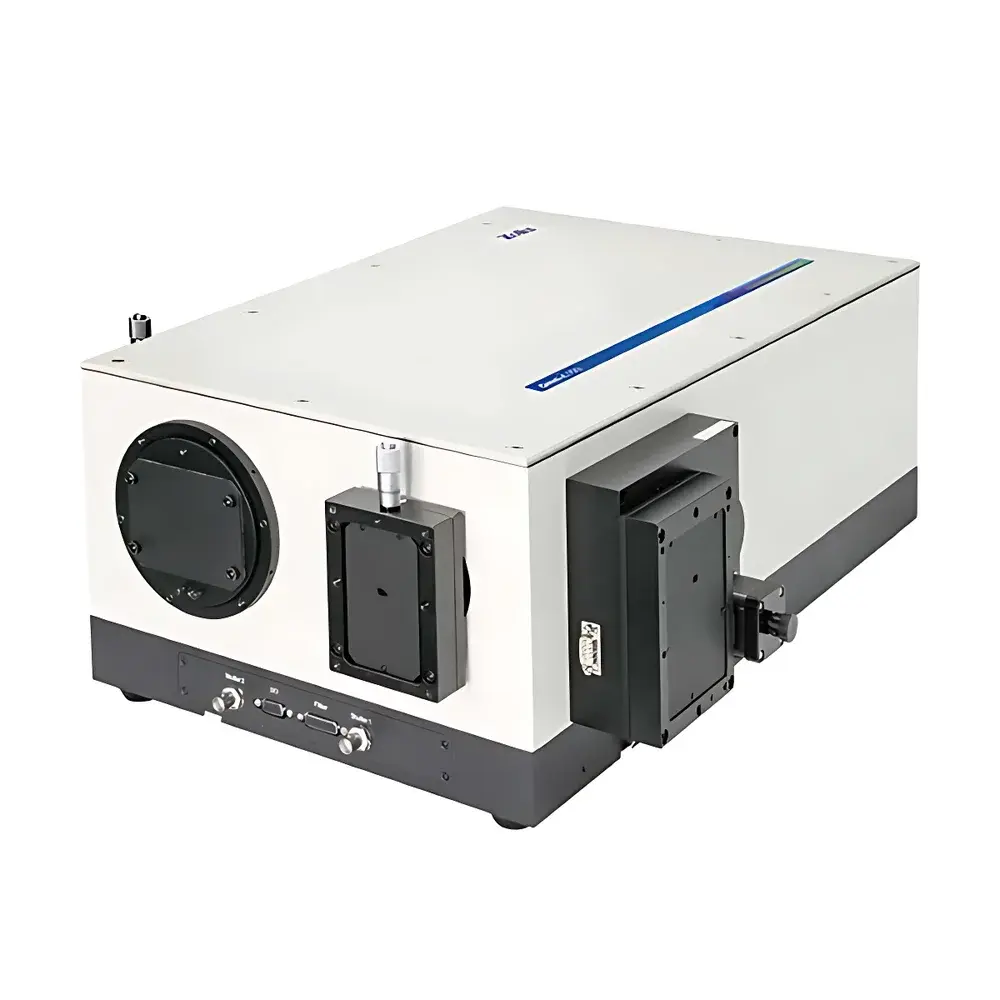
ZOLIX Omni-λ500i Imaging-Corrected Czerny-Turner Grating Spectrometer Monochromator
| Brand | ZOLIX |
|---|---|
| Origin | Beijing, China |
| Manufacturer Type | Direct Manufacturer |
| Product Origin | Domestic (China) |
| Model | Omni-λ500i |
| Application System | Universal |
| Number of Gratings | Triple-grating turret |
| Focal Length | 500 mm |
| Optical Design | Czerny-Turner with toroidal imaging correction |
| Stray Light Level | 1×10⁻⁵ |
| Grating Size | 68×68 mm (or 68×84 mm optional) |
| Entrance/Exit Configuration | Side entrance, dual出口 (CCD + slit), configurable multi-port options |
| Slit Width Range | 0.01–3 mm (manual standard |
| Slit Height Options | 2 mm, 4 mm, or 14 mm |
| Focal Plane Dimensions | 30 mm (W) × 14 mm (H) |
| Optical Axis Height | 146 mm |
| Weight | 22 kg |
| Power Consumption | ≤100 W @ 24 V DC |
| Communication Interface | USB 2.0 (standard), RS-232 (optional) |
| Control Architecture | DSP-based motorized turret & port selection |
| Wavelength Accuracy | ±0.1 nm to ±3.2 nm (dependent on grating) |
| Wavelength Repeatability | 0.015–0.8 nm (grating-dependent) |
| Spectral Resolution (with point detector) | 0.03–0.8 nm |
| Spectral Resolution (with 15 µm-pixel CCD) | 0.045–1.97 nm |
| Linear Dispersion (@435.83 nm) | 0.6–26.05 nm/mm |
| Mechanical Scan Range | 0–19,200 nm (grating-dependent) |
| Minimum Step Size | 0.0025–0.08 nm (grating-dependent) |
| CCD Single-Capture Spectral Range (@30 mm sensor) | 18–781.5 nm (grating-dependent) |
Overview
The ZOLIX Omni-λ500i is a high-performance, imaging-corrected Czerny-Turner grating spectrometer monochromator engineered for precision spectral analysis across the ultraviolet (UV), visible (VIS), and near-to-mid infrared (NIR/MIR) wavelength ranges (190 nm – 16 µm). Its optical architecture integrates toroidal mirror-based aberration correction to minimize astigmatism and coma—critical for maintaining spatial fidelity across the focal plane when coupled with array detectors such as scientific-grade CCDs or CMOS sensors. Designed around a robust triple-grating turret platform, the Omni-λ500i enables rapid, software-controlled switching among up to three independently mounted diffraction gratings—each optimized for specific spectral regions and resolution requirements. This modular flexibility supports both monochromatic light isolation (monochromator mode) and broadband spectral acquisition (spectrometer mode), making it suitable for integration into custom optical systems including fluorescence, Raman, photoluminescence, transmission/reflection, absorbance, and emission spectroscopy platforms.
Key Features
- Imaging-optimized Czerny-Turner optical layout with toroidal collimating and focusing mirrors for flat, distortion-minimized focal planes
- Triple-grating turret with precise, repeatable positioning via DSP-driven stepper motor control
- Large-format 68 × 68 mm (or 68 × 84 mm) ruled or holographic gratings to maximize throughput and signal-to-noise ratio
- Stray light suppression down to 1 × 10⁻⁵ — achieved through optimized baffling, blackened internal surfaces, and gold-coated optics for IR-enhanced variants (e.g., Omni-λ5015i/5017i)
- Dual-output configuration supporting simultaneous connection of a CCD array and slit-based single-point detector
- Side-entry port with optional electronic shutter interface and configurable dual-input capability (Omni-λ5024i/5027i/5028i variants)
- USB 2.0 digital interface replacing legacy RS-232, enabling faster command execution, improved noise immunity, and plug-and-play compatibility with modern Windows/Linux hosts
- Manual slit (0.01–3 mm width, 2/4/14 mm height); motorized slit available as an upgrade for automated line-shape optimization
- Standard optical axis height of 146 mm ensures mechanical compatibility with industry-standard optical tables and modular light sources
Sample Compatibility & Compliance
The Omni-λ500i is not a sample-contacting instrument but serves as a core dispersive element within larger analytical configurations. As such, its compliance framework focuses on optical performance traceability, electromagnetic compatibility (EMC), and integration readiness for regulated environments. All models meet CE marking requirements for EMC Directive 2014/30/EU and Low Voltage Directive 2014/35/EU. When integrated into GxP-compliant spectroscopic systems (e.g., UV-Vis quantitation per USP or ASTM E275), the spectrometer’s wavelength accuracy (±0.1 nm at 435.83 nm with 2400 g/mm grating) and repeatability (≤0.015 nm) support calibration protocols aligned with ISO/IEC 17025 laboratory accreditation. Optional audit-trail-capable software drivers enable 21 CFR Part 11–compliant operation when paired with validated host applications. Gold-coated variants (e.g., Omni-λ5015i) are specifically designed for NIR/MIR applications where reflectance >98% above 1 µm is required—consistent with ASTM E1421 standards for infrared spectrophotometer qualification.
Software & Data Management
ZOLIX provides the OmniStudio™ control suite—a native 64-bit application for Windows 10/11 supporting full instrument parameterization: grating selection, wavelength scanning (continuous or step), slit control, port routing, and real-time spectrum acquisition. The SDK includes C/C++, Python, and LabVIEW APIs for OEM integration and custom automation workflows. Spectral data export adheres to ANDI/MSD and JCAMP-DX v6 formats for interoperability with chemometric tools (e.g., MATLAB, Unscrambler, Pirouette). All firmware updates are delivered via signed binary packages with SHA-256 verification. For laboratories requiring electronic records integrity, optional timestamped log files capture every command execution, motor position, and environmental sensor reading (if external temperature/humidity modules are attached)—facilitating GLP/GMP audit readiness.
Applications
- Steady-state and time-resolved photoluminescence spectroscopy of quantum dots, perovskites, and 2D materials
- Confocal Raman microspectroscopy with spatially resolved spectral mapping
- High-throughput UV-Vis-NIR absorbance/transmission screening of thin films and optical coatings
- Plasma emission diagnostics in semiconductor process chambers (OES)
- Calibration source characterization (e.g., deuterium, tungsten-halogen, LED, laser diodes)
- FTIR complementary dispersive validation in mid-IR gas-phase analysis (using 75–300 g/mm gratings)
- Custom hyperspectral imaging systems integrating with cooled InGaAs or MCT array detectors
FAQ
What wavelength range can the Omni-λ500i cover?
The usable spectral range depends on grating selection and detector compatibility: from 190 nm (with UV-enhanced coatings) to 16 µm (with 75 g/mm gold-coated gratings and appropriate IR detectors).
Is the instrument compatible with third-party CCDs and software?
Yes—standard SMA905 or F-mount interfaces allow direct coupling to most scientific CCD/CMOS cameras; SDK support enables full remote control from custom applications.
How is wavelength calibration performed?
Factory calibration uses Hg/Ar/Ne spectral lamp lines; users may perform secondary calibration using built-in polynomial or spline fitting routines with reference sources.
Can I upgrade from manual to motorized slits post-purchase?
Yes—motorized slit assemblies are field-installable and fully supported by existing firmware and OmniStudio software.
Are optical alignment tools included?
A collimation alignment kit (including HeNe laser pointer, crosshair target, and alignment eyepiece) is available as an optional accessory—not shipped standard.
Related Products




