
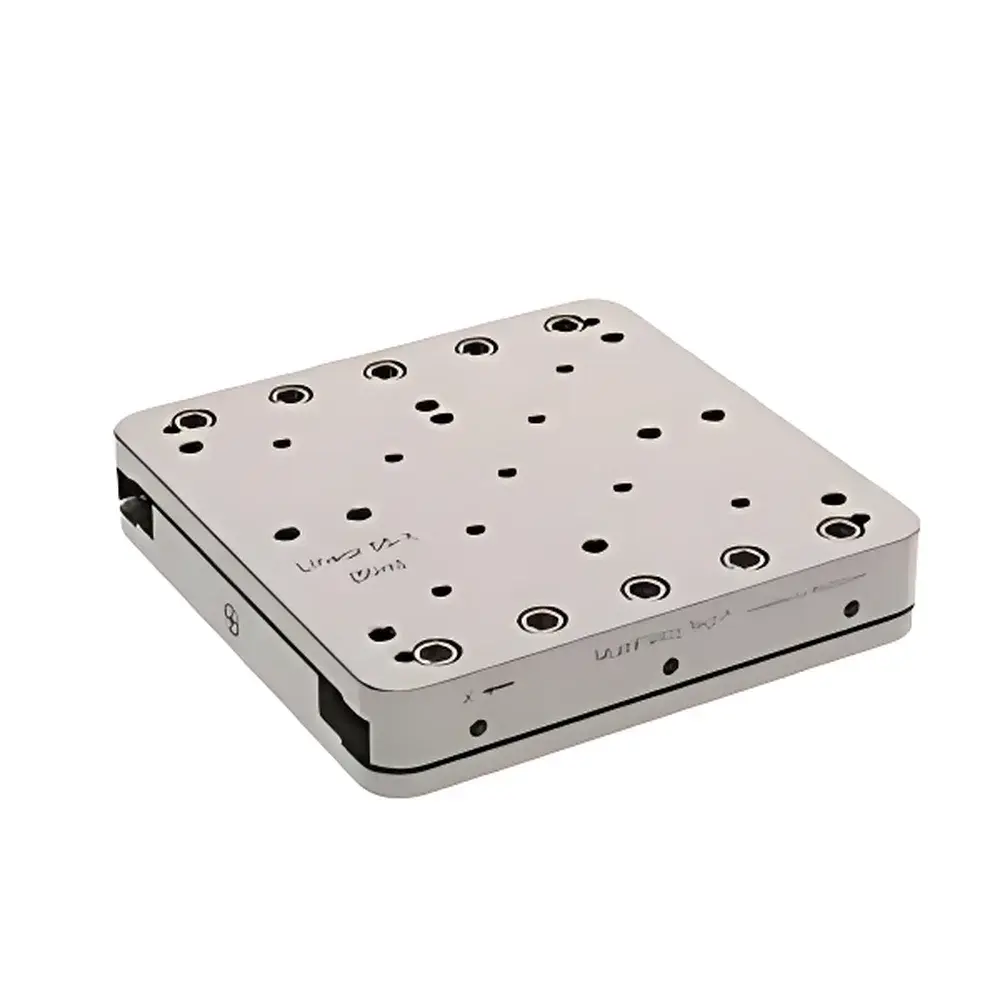
ZOLIX Linear55-x-Slim Piezoelectric Nanopositioning Stage
| Brand | ZOLIX |
|---|---|
| Model | Linear55-x-Slim |
| Type | Motorized Translation Stage |
| Dimensions | 55 × 55 × 10.5 mm |
| Mass | 130 g |
| Travel Range | 30 mm |
| Closed-Loop Position Resolution | 0.1 µm |
| Sensor Resolution | ~150 nm |
| Repeatability | 1–2 µm |
| Max. Load | 2500 g |
| Max. Thrust Force | 3 N |
| Operating Temperature | 1.4–400 K (optional down to 30 mK) |
| Vacuum Compatibility | UHV up to 2 × 10⁻¹¹ mbar |
| Magnetic Field Tolerance | ≤18 T |
| Actuation Voltage | ≤200 V |
| Max. Speed at 300 K | ~2 mm/s |
| Construction Materials | Pure Titanium (Ti), Beryllium Copper (BeCu) |
| Cable | Phosphor Bronze Twisted Pair, 20 cm |
| Connector Pins | BeCu/Polyetheretherketone (PEEK) or BeCu/Glass-Filled Polyester |
| Drive Pins | 2, Sensor Pins: 3 |
Overview
The ZOLIX Linear55-x-Slim is a compact, high-performance piezoelectric nanopositioning stage engineered for extreme experimental environments—specifically ultra-high vacuum (UHV), cryogenic temperatures down to 30 mK, and high magnetic fields up to 18 Tesla. Unlike conventional stepper- or servo-driven translation stages, the Linear55-x-Slim employs direct piezoelectric actuation with integrated resistive position sensing, enabling sub-micrometer closed-loop control without mechanical backlash or hysteresis-induced drift. Its core architecture leverages the inverse piezoelectric effect: applied voltage induces precise lattice deformation in the actuator stack, translating into nanoscale linear displacement along a single axis (x-direction). This principle ensures deterministic motion response, high stiffness (>1.2 N/µm), and exceptional thermal stability—critical for applications requiring long-term positional fidelity under thermal cycling or electromagnetic perturbation.
Key Features
- Ultra-compact footprint: 55 × 55 × 10.5 mm, mass of only 130 g—ideal for space-constrained optical tables, dilution refrigerator inserts, and multi-axis nanopositioning assemblies.
- Material-compliant construction: Entire structural body fabricated from pure titanium and beryllium copper—non-magnetic, low-outgassing, and compatible with UHV bake-out protocols (≤2 × 10⁻¹¹ mbar base pressure).
- Cryogenic readiness: Validated operation across 1.4 K to 400 K; optional ULT configuration certified for integration with 3He refrigerators and dilution refrigerators.
- High-force actuation: Delivers up to 3 N thrust while supporting static loads of 2500 g—enabling stable positioning of heavy optics, detectors, or sample holders without creep or settling delay.
- Closed-loop feedback: Integrated resistive position sensor with 30 mm full-scale range and ~150 nm intrinsic resolution; system-level closed-loop resolution maintained at 0.1 µm via external controller interpolation.
- Robust electrical interface: 2-pin drive + 3-pin sensor configuration with phosphor bronze twisted-pair cabling (20 cm standard); connector pins constructed from BeCu/PEEK or BeCu/glass-filled polyester for low thermal conductivity and vacuum compatibility.
Sample Compatibility & Compliance
The Linear55-x-Slim meets stringent requirements for use in quantum transport, scanning probe microscopy (SPM), and synchrotron beamline instrumentation. Its material selection and surface finish comply with ASTM E595-23 outgassing specifications for space-qualified components. The UHV-rated version conforms to ISO 10100:2022 standards for vacuum chamber component qualification and supports bake-out temperatures up to 150 °C. For cryogenic installations, the stage satisfies IEC 60068-2-10 (cold testing) and demonstrates no delamination or sensor signal degradation after repeated thermal cycling between 30 mK and 300 K. Magnetic compatibility has been verified per IEEE Std 280-2021 for non-magnetic instrumentation in MRI-adjacent and high-field superconducting magnet environments.
Software & Data Management
The stage operates with industry-standard piezo controllers (e.g., Thorlabs KPZ101, PI E-727, or Newport ESP300) supporting analog voltage input (0–10 V) and sensor feedback readout. Digital communication is supported via USB, RS-232, or Ethernet interfaces depending on controller selection. All motion sequences—including ramp profiles, dwell times, and trigger-synchronized step-and-hold routines—can be scripted using Python (via PyVISA), LabVIEW, or MATLAB. Controller firmware includes audit-trail logging compliant with FDA 21 CFR Part 11 requirements when paired with validated software environments. Position data streams are timestamped with microsecond precision and exportable in HDF5 or CSV format for post-acquisition analysis in Igor Pro, OriginLab, or custom Python pipelines.
Applications
- Quantum device alignment: Precise positioning of gate electrodes, microwave antennas, or Josephson junctions inside dilution refrigerators.
- Low-temperature scanning tunneling microscopy (LT-STM): Sub-nanometer tip-sample approach control under 10 mK and 15 T conditions.
- Free-space optical cavity stabilization: Active length tuning of Fabry–Pérot resonators in UHV-compatible laser cooling setups.
- In-situ electron microscopy: Integration into TEM/SEM specimen holders for real-time nanomechanical testing under controlled thermal and magnetic fields.
- Synchrotron X-ray nano-focusing: Coarse/fine motion coupling with piezo scanners for active beamline mirror alignment at 0.1 µrad angular stability.
FAQ
What vacuum level is the Linear55-x-Slim rated for?
The standard UHV version is qualified for continuous operation at pressures as low as 2 × 10⁻¹¹ mbar, with helium leak rate <1 × 10⁻¹² mbar·L/s per ISO 20484.
Can this stage operate at 30 mK in a dilution refrigerator?
Yes—the ULT variant is fully characterized for thermal contraction matching, thermal EMF minimization, and sensor linearity down to 30 mK when installed with appropriate thermal anchoring and low-thermal-conductance cabling.
Is the position sensor compatible with third-party controllers?
Yes—resistive sensor output is ratiometric and linear over full travel; it requires a 4-wire Kelvin connection and excitation current of 1 mA ±0.1%, supported by most commercial piezo controllers with analog sensor inputs.
Does the stage require active cooling during operation?
No—piezoelectric actuation generates negligible Joule heating; thermal management is passive and relies solely on conductive heat sinking through mounting surfaces.
How is mechanical hysteresis compensated in closed-loop mode?
Hysteresis is suppressed by the resistive sensor’s direct physical coupling to the moving carriage; real-time feedback enables dynamic correction within the controller’s PID loop bandwidth (typically ≤100 Hz), achieving repeatability of 1–2 µm over full stroke.




