
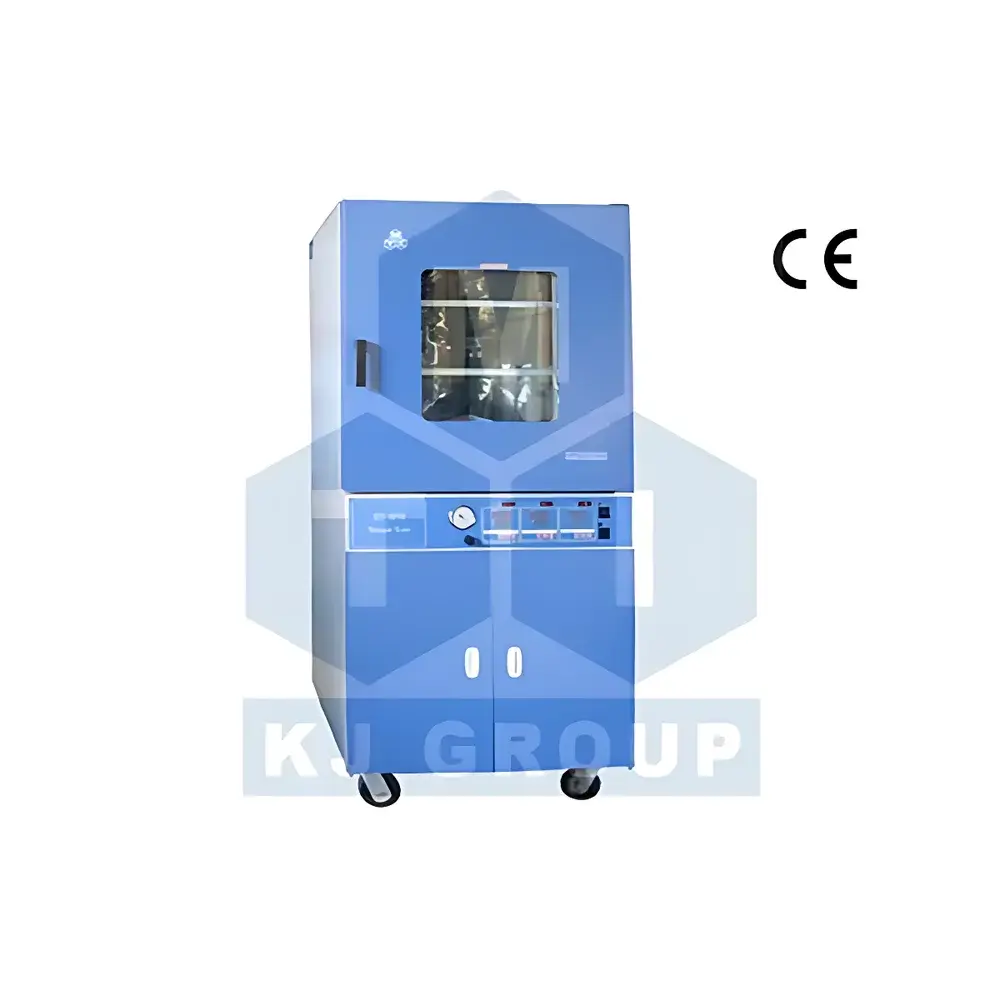
Ketjim DZF-6210 Vertical Vacuum Drying Oven (215 L, 250 °C Max)
| Brand | Ketjim |
|---|---|
| Model | DZF-6210 |
| Max Operating Temperature | 250 °C |
| Chamber Volume | 215 L |
| Internal Dimensions | 560 × 640 × 600 mm |
| External Dimensions | 720 × 820 × 1750 mm |
| Vacuum Level | <133 Pa |
| Heating Power | 2500 W |
| Voltage | 208–240 V AC, 50/60 Hz |
| Chamber Material | Powder-coated Q235 Steel |
| Door | Double-layer tempered glass with adjustable silicone gasket |
| Temperature Control | Microprocessor-based PID controller with 28-segment programmable ramp-soak profile |
| Display | Dual digital readout (setpoint & actual temperature) |
| Certifications | CE compliant |
| Warranty | 12 months standard, lifetime technical support |
Overview
The Ketjim DZF-6210 is a vertically oriented, high-vacuum drying oven engineered for precise thermal processing of moisture-, oxygen-, or heat-sensitive materials under reduced pressure. Designed for laboratory-scale dehydration, solvent removal, pre- and post-baking of electronic components, and stabilization of hygroscopic powders, the unit operates on the principle of vacuum-assisted evaporation—lowering the boiling point of volatile substances to enable drying at significantly reduced temperatures while minimizing thermal degradation. Its maximum operating temperature of 250 °C, combined with a certified vacuum level below 133 Pa (1 Torr), ensures effective removal of residual solvents, adsorbed water, and low-volatility contaminants from pharmaceutical intermediates, battery electrode coatings, ceramic precursors, and polymer composites. The vertical configuration optimizes floor space utilization in regulated lab environments and supports ergonomic loading/unloading of tall or stacked samples.
Key Features
- Robust chamber construction using thick-gauge Q235 carbon steel with electrostatic powder coating for long-term corrosion resistance and thermal stability.
- Double-layer tempered glass observation door with anti-shatter properties and integrated argon-filled interlayer for enhanced thermal insulation and real-time process monitoring without vacuum break.
- Adjustable compression mechanism for the one-piece molded silicone door gasket, enabling repeatable sealing performance across multiple thermal cycles and maintaining vacuum integrity over extended dwell periods.
- Microprocessor-based temperature controller with 28-segment programmable ramp-soak capability, supporting complex thermal profiles required for annealing, outgassing, or stepwise solvent removal protocols.
- Independent dual digital display showing both setpoint and real-time chamber temperature, with auto-tuning PID algorithm ensuring ±1.0 °C temperature uniformity (per ASTM E2207) across the working volume.
- Proportional heating power modulation—enabling fine-grained thermal control at low setpoints (<50 °C) without overshoot or cycling instability—critical for drying biological matrices or thin-film substrates.
Sample Compatibility & Compliance
The DZF-6210 accommodates a wide range of sample formats including Petri dishes, crucibles, quartz boats, aluminum trays, and custom jigs mounted on three removable stainless-steel shelves. Its chamber geometry (560 × 640 × 600 mm) allows upright orientation of cylindrical cells, battery pouches, or fiber spools. All internal surfaces are non-reactive and compatible with common organic solvents (e.g., NMP, DMF, acetone) and aqueous solutions. The unit complies with CE marking requirements under the EU Machinery Directive 2006/42/EC and Low Voltage Directive 2014/35/EU. While not inherently 21 CFR Part 11–compliant, its programmable controller supports audit-ready operation when paired with external data loggers meeting GLP/GMP documentation standards. Vacuum performance aligns with ISO 2740:2019 guidelines for vacuum drying equipment validation.
Software & Data Management
The embedded controller does not include native PC connectivity; however, optional RS-485 or USB-to-serial interfaces (available as accessories) enable integration with third-party SCADA systems or LabVIEW-based acquisition platforms. Temperature and vacuum status can be logged externally via analog 0–10 V or 4–20 mA outputs. For regulated environments, users may implement manual record-keeping per SOPs or deploy validated external chart recorders. Firmware supports password-protected parameter locking to prevent unauthorized changes during qualification runs (IQ/OQ/PQ). All program sequences—including soak duration, ramp rate, and hold temperature—are stored in non-volatile memory with timestamped execution history.
Applications
- Drying of lithium-ion battery cathode/anode slurries prior to calendaring, minimizing binder migration and particle agglomeration.
- Outgassing of optical components and vacuum chamber parts to reduce hydrocarbon contamination in UHV systems.
- Stabilization of metal-organic frameworks (MOFs) and porous coordination polymers without framework collapse.
- Moisture removal from pharmaceutical excipients (e.g., microcrystalline cellulose, lactose monohydrate) prior to direct compression.
- Thermal conditioning of PCB assemblies and MEMS devices to eliminate trapped moisture before hermetic sealing.
- Pre-treatment of silica aerogel monoliths to preserve nanostructure during ambient-pressure solvent exchange.
FAQ
What vacuum pump is recommended for optimal performance with the DZF-6210?
A two-stage oil-sealed rotary vane pump (e.g., 4–6 m³/h capacity, ultimate vacuum ≤5 Pa) is recommended. Dry scroll pumps may be used but require careful evaluation of vapor load tolerance.
Can the DZF-6210 be used for inert gas purging instead of vacuum operation?
Yes—the chamber includes dedicated inlet/outlet ports compatible with nitrogen or argon purge configurations; however, no built-in gas flow regulation is provided.
Is the temperature uniformity validated per industry standards?
Uniformity testing per ASTM E2207 is user-performed during installation qualification; typical results show ±1.0 °C deviation at 100 °C and ±1.5 °C at 250 °C across nine designated test points.
Does the unit support remote monitoring or Ethernet connectivity?
No native Ethernet or Wi-Fi interface is included; remote supervision requires optional serial-to-Ethernet converters and custom middleware integration.
How often should the silicone door gasket be replaced?
Under normal use (≤5 cycles/day), replacement is recommended every 18–24 months or immediately upon visible cracking, compression set, or vacuum decay exceeding 5 Pa/min at 133 Pa base pressure.



