
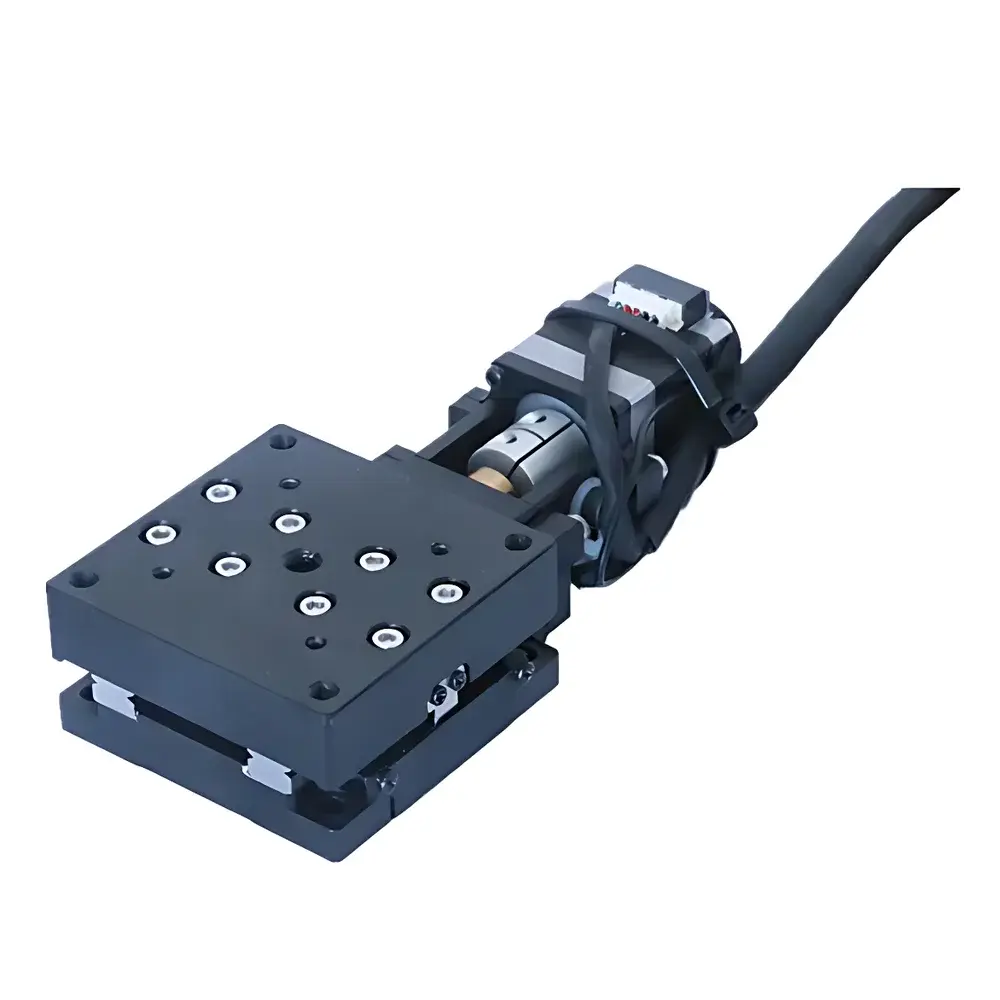
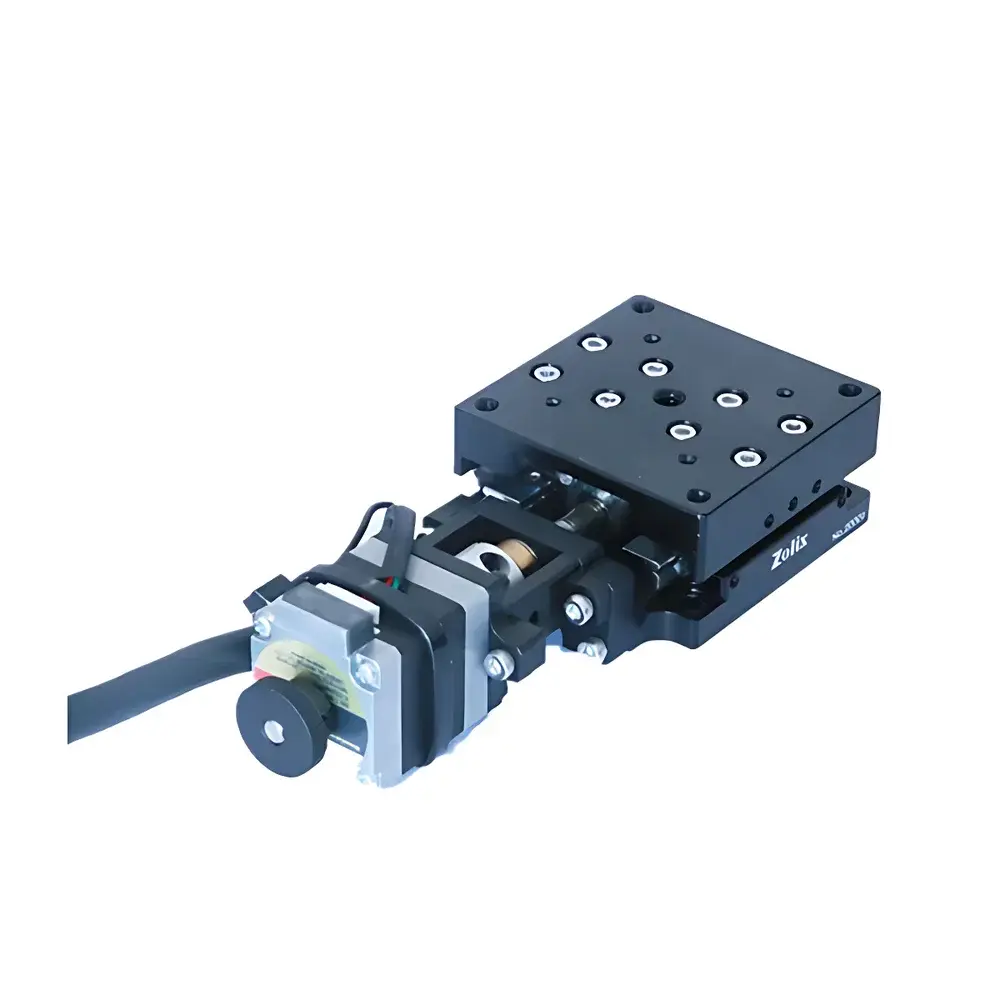
ZOLIX LAK20-60 High-Precision Motorized Linear Translation Stage
| Brand | ZOLIX |
|---|---|
| Origin | Beijing, China |
| Manufacturer | ZOLIX Optics |
| Product Type | Motorized Translation Stage |
| Model | LAK20-60 |
| Travel | 20 mm |
| Top Plate Dimensions | 60 × 60 mm |
| Drive Mechanism | Imported C3-grade ball screw (Φ6 × 1 pitch) |
| Guide System | Linear motion slider rail |
| Body Material | Anodized black aluminum alloy |
| Weight | 0.58 kg |
| Resolution (full/half step) | 2 / 1 µm |
| Microstepping resolution (200x) | 0.1 µm |
| Max Speed | 20 mm/s |
| Unidirectional Positioning Accuracy | ≤20 µm |
| Repeatability | ≤±1 µm |
| Backlash | ≤1 µm |
| Static Parallelism | ≤0.05 mm |
| Straightness | ≤10 µm |
| Pitch/Yaw | ≤30″ / ≤25″ |
| Allowable Moment Load (roll/pitch/yaw) | 9.31 / 9.8 / 9.31 N·m |
| Torque Rigidity (pitch/yaw) | ≤6 µm per 90 N·cm |
| Motor | Five-phase hybrid stepper, 0.72° step angle, Oriental Motor PKP523N12B-L, holding torque 52.5 mN·m, rated current 1.2 A |
| Limit & Home Sensors | OMRON EE-SX4320 (2 limit + 1 home), NPN open-collector output, DC5–24 V ±10%, max load 8 mA |
| Load Capacity | Horizontal 8 kg / Vertical 3 kg / Inverted 4 kg |
| Connector | 10-pin industrial header |
| Cable | 0.2 m motion-rated cable |
Overview
The ZOLIX LAK20-60 is a compact, high-repeatability motorized linear translation stage engineered for integration into space-constrained optical benches, automated alignment systems, and precision metrology platforms. It operates on the principle of precise mechanical translation via a preloaded C3-grade ball screw driven by a five-phase hybrid stepper motor—ensuring minimal thermal drift, high positional fidelity, and deterministic motion control. The stage’s rigid aluminum body, finished with hard-anodized black oxide coating, provides excellent dimensional stability and corrosion resistance while maintaining low mass—a critical requirement for dynamic optical path adjustments in interferometry, spectroscopy, and laser cavity alignment applications. Its 20 mm travel range, sub-micron repeatability (≤±1 µm), and <1 µm backlash are achieved through proprietary rail surface finishing techniques and kinematic coupling between the slider block and guide rails. Designed for continuous-duty operation in controlled laboratory environments, the LAK20-60 complies with standard mechanical interface protocols used across OEM instrumentation ecosystems.
Key Features
- High-resolution positioning: 0.1 µm effective resolution under 200× microstepping, enabling fine focus and nanoscale sample rastering.
- Linear motion slider rail system with optimized preload and surface finish—delivers smooth, low-friction travel with straightness ≤10 µm and parallelism ≤10 µm over full stroke.
- C3-precision ball screw (Φ6 mm, 1 mm pitch) with anti-backlash nut assembly ensures consistent torque transmission and long-term accuracy retention.
- Five-phase 0.72° stepper motor (Oriental Motor PKP523N12B-L) offers high holding torque (52.5 mN·m), low vibration, and inherent immunity to resonance at mid-range speeds.
- Integrated OMRON EE-SX4320 optical sensors provide reliable homing and end-of-travel detection with NPN open-collector outputs compliant with standard motion controller I/O specifications.
- Compact footprint (60 × 60 mm top plate, 0.58 kg mass) facilitates multi-axis stacking and modular system design without compromising rigidity or load capacity.
Sample Compatibility & Compliance
The LAK20-60 is compatible with standard 60 mm × 60 mm optical mounts, kinematic bases, and breadboard-integrated optical carriers. Its horizontal load capacity of 8 kg, vertical capacity of 3 kg, and inverted mounting capability (4 kg) support diverse payloads including fiber couplers, micro-lenses, photodetectors, and miniature spectrometer modules. Mechanical interfaces conform to common ISO 10360-2 geometric tolerance benchmarks for linear stages. While not certified to specific regulatory frameworks (e.g., CE or UL), its electrical design adheres to IEC 61000-6-2/6-4 immunity and emission guidelines for laboratory equipment. Sensor logic complies with IEC 61131-2 Type 1 input standards. All materials meet RoHS Directive 2011/65/EU requirements.
Software & Data Management
The stage is driver-agnostic and fully compatible with industry-standard motion control environments including LabVIEW (NI Motion), MATLAB (Instrument Control Toolbox), Python (PySerial + custom ASCII protocol), and third-party controllers (e.g., Thorlabs Kinesis, Zaber T-NA, or Oriental Motor CVD512BR-K). Communication occurs via TTL-level serial commands over a 10-pin D-sub interface; no proprietary firmware or closed API is required. Position feedback is open-loop, but repeatability data (≤±1 µm) supports traceable calibration workflows under GLP-aligned lab procedures. When integrated into FDA-regulated analytical instrument platforms, audit trails and parameter logs must be managed externally via host software—no built-in 21 CFR Part 11 compliance features are embedded.
Applications
- Laser beam steering and collimation adjustment in ultrafast optics setups.
- Automated wavelength scanning in tunable filter-based hyperspectral imaging systems.
- Position-critical alignment of fiber pigtails in telecom component testing rigs.
- Multi-point spectral acquisition in Raman or fluorescence microspectroscopy.
- Dynamic focus correction in adaptive optical microscopy and confocal scanning.
- OEM integration into portable FTIR or UV-Vis spectrophotometers requiring miniaturized actuation.
FAQ
What is the maximum recommended acceleration for optimal lifetime performance?
For sustained operation exceeding 10⁶ cycles, acceleration should remain below 0.5 g when loaded at 50% of rated horizontal capacity.
Can this stage be operated in vacuum environments?
No—standard anodization and lubricants are not vacuum-compatible; custom vacuum-grade variants require engineering consultation.
Is backlash compensation supported in firmware?
Backlash is mechanically minimized (<1 µm); electronic compensation is unnecessary and not implemented in standard drivers.
What is the thermal coefficient of position drift per °C?
Typical drift is <0.3 µm/°C over the 15–25 °C ambient range, primarily due to aluminum expansion and screw thermal elongation.
Are mounting holes standardized to ISO metric patterns?
Yes—four M3 threaded holes at 52 mm × 52 mm center-to-center spacing conform to ISO 8015 general tolerancing principles.





