
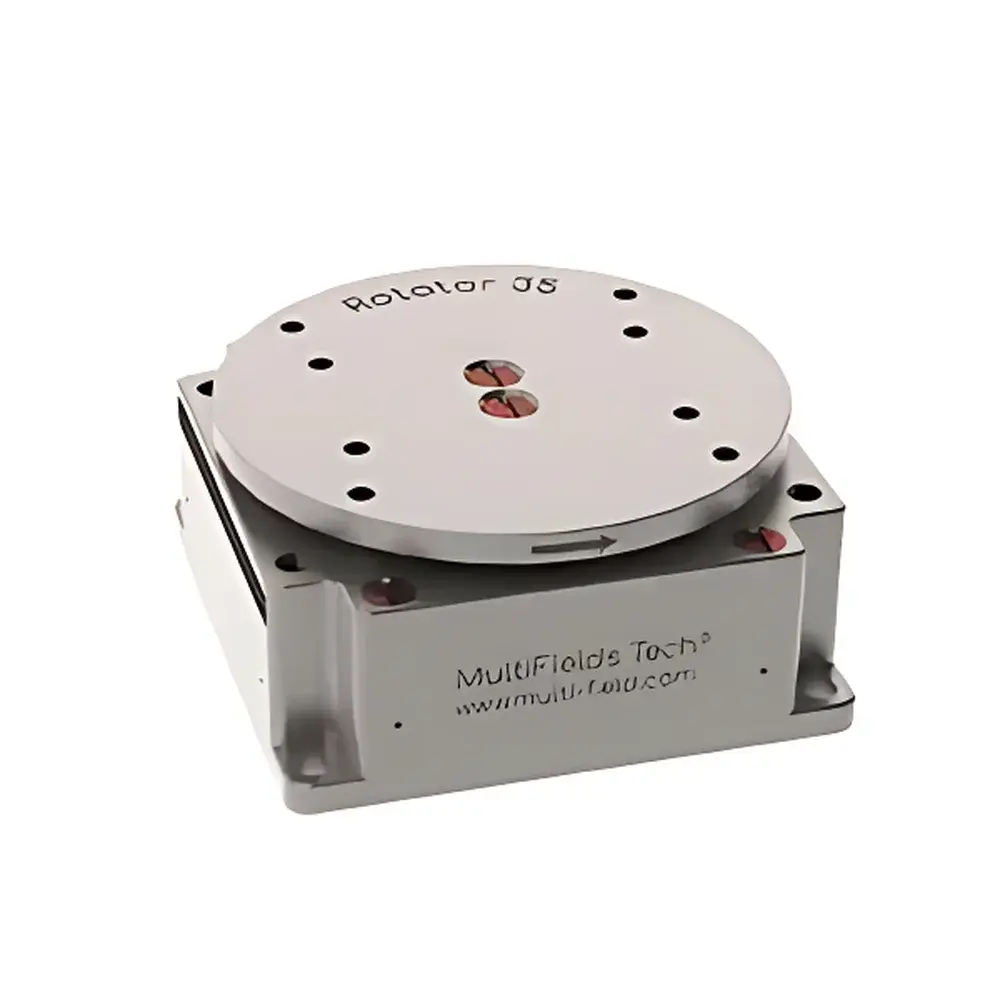
ZOLIX Rotator35 Piezo-Driven Rotary Stage
| Brand | ZOLIX |
|---|---|
| Model | Rotator35 |
| Type | Piezoelectric Rotary Translation Stage |
| Dimensions | 35 × 35 × 16.5 mm |
| Mass | 45 g |
| Operating Temperature Range | 1.4–400 K (optional down to 30 mK) |
| Vacuum Compatibility | Up to 2×10⁻¹¹ mbar (UHV) |
| Magnetic Field Tolerance | Up to 18 T |
| Material | Pure Titanium & Beryllium Copper |
| Max Load | 500 g |
| Max Torque | 2.5 N·cm |
| Rotation Range | Continuous 360° |
| Drive Voltage | ≤200 V |
| Max Speed @300 K | ~10 °/s |
| Sensor Type | Resistive Position Sensor |
| Sensor Range | 320° |
| Sensor Resolution | 10 m° |
| Repeatability | ~50 m° |
| Cable | Phosphor Bronze Twisted Pair, 20 cm |
| Connector Pins | 2 drive + 3 sensor |
| Compliance Options | HV / ULT / UHV variants |
Overview
The ZOLIX Rotator35 is a high-precision, piezoelectrically actuated rotary stage engineered for demanding cryogenic, ultra-high vacuum (UHV), and high-magnetic-field environments. Unlike conventional stepper- or servo-based rotation stages, the Rotator35 employs direct piezo inertia-drive technology—eliminating gears, belts, or magnetic components—to deliver continuous 360° motion with sub-arcminute resolution and zero backlash. Its operational principle relies on controlled micro-impulse actuation of piezoceramic elements coupled with inertial frictional coupling to the rotor, enabling precise angular positioning without mechanical hysteresis or thermal drift. Designed specifically for integration into quantum measurement setups, scanning probe microscopy (SPM) systems, synchrotron beamline endstations, and dilution refrigerator payloads, the Rotator35 maintains metrological integrity across extreme physical boundary conditions: from 1.4 K to 400 K, under vacuum down to 2×10⁻¹¹ mbar, and within static magnetic fields up to 18 Tesla.
Key Features
- Compact monolithic architecture: 35 × 35 × 16.5 mm footprint, mass of only 45 g—optimized for space-constrained cryostat inserts and multi-axis nanopositioning stacks.
- Material-compliant construction: Entire moving and structural body fabricated from pure titanium (Ti) and beryllium copper (BeCu), ensuring non-magnetic behavior, low outgassing, and coefficient-of-thermal-expansion (CTE) matching at cryogenic temperatures.
- Multi-environment certification: Factory-tested and qualified for simultaneous operation in ultra-low temperature (≤30 mK), ultra-high vacuum (≤2×10⁻¹¹ mbar), and high-field (≤18 T) regimes—fully compatible with He-3 refrigerators, dilution refrigerators, and superconducting magnet systems.
- Closed-loop angular control: Integrated resistive position sensor with 320° sensing range and 10 millidegree (m°) resolution enables real-time feedback and correction, achieving repeatability of ±50 m° over full rotation.
- High-torque, low-inertia drive: Delivers 2.5 N·cm stall torque while supporting axial loads up to 500 g—suitable for mounting optical mounts, fiber couplers, waveplate holders, and miniature interferometric optics.
- Modular electrical interface: Standard 5-pin LEMO-compatible connector (2 drive + 3 sensor), supplied with 20 cm phosphor bronze twisted-pair cable; optional low-thermal-conductivity cabling available for sub-Kelvin applications.
Sample Compatibility & Compliance
The Rotator35 meets stringent requirements for use in regulated and physics-critical experimental infrastructure. Its all-metal, non-outgassing construction complies with ISO 10110-7 (optical component cleanliness) and ASTM E595 (outgassing testing for space applications). The UHV variant conforms to ESA PSS-01-702 and CERN’s vacuum material specifications for surface vapor pressure <1×10⁻¹² mbar at 20°C. For cryogenic deployment, the device satisfies the thermal contraction compatibility criteria defined in ISO 20482 (cryogenic positioning systems) and has been validated per IEC 60068-2-4 cold shock testing protocols. No organic adhesives, epoxies, or lubricants are used—ensuring long-term stability under repeated thermal cycling between 1.4 K and 300 K.
Software & Data Management
The Rotator35 operates via analog voltage input (0–200 V) and outputs linearized resistance values corresponding to angular position. It is fully compatible with industry-standard motion controllers supporting piezo stage interfaces—including Newport ESP302, Thorlabs Kinesis, and PI E-712—with optional digital converter modules for USB/RS-485 integration. All closed-loop data streams support timestamped acquisition at ≥1 kHz sampling rates, enabling synchronization with external triggers (e.g., laser pulses, RF gates, or detector frames). When deployed in GLP/GMP-aligned laboratories, the system supports audit-trail-capable software logging through compliant SCADA platforms; raw sensor output is traceable to NIST-calibrated reference standards via documented calibration certificates (available upon request).
Applications
- Quantum computing hardware alignment: Precise rotational adjustment of superconducting qubit packages, Josephson junction arrays, and microwave antenna couplers inside dilution refrigerators.
- Low-temperature spectroscopy: Angular scanning of polarizers, retarders, and grating mounts in Fourier-transform infrared (FTIR) and terahertz time-domain spectroscopy (THz-TDS) cryostats.
- Beamline instrumentation: Motorized rotation of X-ray mirrors, monochromator crystals, and sample goniometers in synchrotron and free-electron laser facilities requiring UHV+high-field compatibility.
- Nanoscale imaging: Integration into multi-axis SPM stages for azimuthal sample orientation during spin-polarized STM or atomic force microscopy under magnetic fields >10 T.
- Space-qualified optical bench testing: Deployment in thermal-vacuum chambers simulating deep-space conditions, where magnetic immunity and zero outgassing are mandatory.
FAQ
Is the Rotator35 compatible with standard motion controller interfaces?
Yes—it accepts 0–200 V analog drive signals and provides a 3-wire resistive sensor output. Controllers from Newport, Thorlabs, Physik Instrumente, and Attocube can be configured for direct integration using appropriate voltage amplifiers and ADC modules.
What is the difference between the ULT and UHV variants?
The ULT version prioritizes thermal performance: optimized thermal anchoring, low-conductivity cabling, and enhanced cold-head compatibility for ≤30 mK operation. The UHV variant emphasizes vacuum integrity: electropolished surfaces, vacuum-brazed joints, and certified low-outgassing materials meeting 2×10⁻¹¹ mbar base pressure requirements.
Can the stage be operated in open-loop mode?
Yes—open-loop operation is supported, though closed-loop feedback is strongly recommended for repeatable positioning, especially below 4 K where piezo response exhibits increased hysteresis and creep.
Does the device require active cooling or heating during operation?
No—no internal power dissipation beyond drive signal leakage current (<1 µA). Thermal management is passive and relies entirely on the host cryostat or vacuum chamber interface.
Is calibration data provided with each unit?
Each Rotator35 ships with a factory-generated calibration report documenting sensor linearity error, repeatability across three full rotations, and temperature-dependent drift characteristics measured at 4 K, 77 K, and 300 K.



