
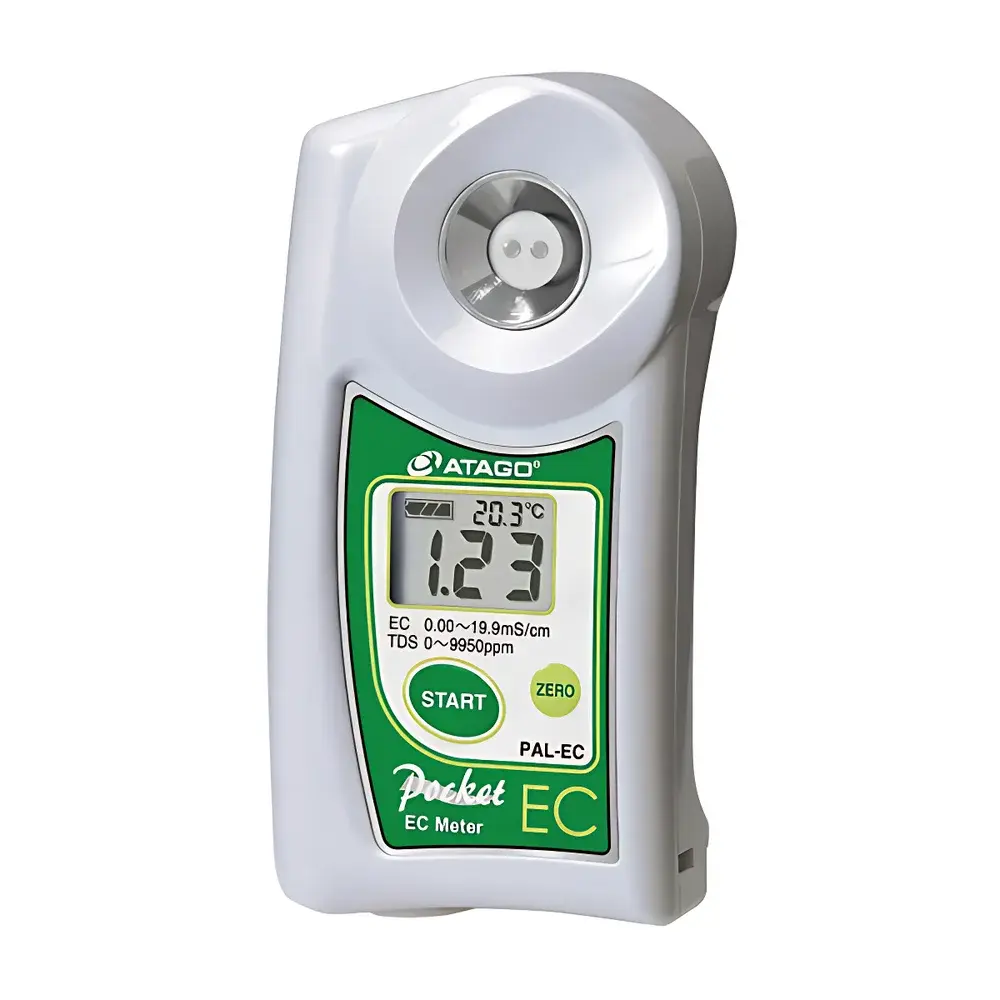
ATAGO PAL-EC Portable Dual-Scale Conductivity & TDS Meter
| Brand | ATAGO |
|---|---|
| Origin | Japan |
| Model | PAL-EC |
| Portability | Portable |
| Application Environment | Laboratory & Field |
| Conductivity Range | 0.00–19.9 mS/cm |
| TDS Range | 0–9950 ppm |
| Temperature Range | 10–40 °C |
| Accuracy | ±0.04 mS/cm (EC), ±20 ppm (TDS) |
| Resolution | 0.01 mS/cm, 5 ppm |
| Sample Volume | 0.6 mL |
| Calibration Standard | 12.9 mS/cm solution |
Overview
The ATAGO PAL-EC is a compact, handheld dual-scale conductivity and total dissolved solids (TDS) meter engineered for rapid, field-deployable electrochemical analysis of aqueous solutions. It operates on the principle of two-electrode conductometric measurement, where electrical conductivity is determined by applying an alternating current across platinum electrodes and measuring the resulting conductance—directly proportional to ion concentration in solution. The instrument automatically converts conductivity readings to TDS values using a fixed 0.50–0.70 conversion factor (user-selectable via calibration protocol), conforming to standard industry practice for non-specific ionic matrices. Designed for minimal sample consumption (just 0.6 mL), the PAL-EC eliminates the need for volumetric dilution or flow-cell integration, making it ideal for spot-checking heterogeneous or volume-limited samples encountered in agricultural, environmental, and industrial process monitoring.
Key Features
- True dual-scale digital display showing simultaneous real-time readings in mS/cm (electrical conductivity) and ppm (TDS), with automatic temperature compensation (ATC) referenced to 25 °C.
- Integrated temperature sensor (10–40 °C range) ensures accurate EC/TDS correlation without external thermometry or manual correction tables.
- Robust, ergonomic housing rated IP65 for dust and water resistance—suitable for humid greenhouses, outdoor soil testing, and wet industrial environments.
- One-point calibration using supplied 12.9 mS/cm standard solution; calibration verification traceable to NIST-traceable reference materials per ISO/IEC 17025 laboratory practice.
- Battery-powered operation (4 × AAA, ~10,000 measurements per set) with auto-power-off after 10 minutes of inactivity to extend service life.
- No moving parts or consumable membranes—low-maintenance architecture optimized for long-term reliability in resource-constrained settings.
Sample Compatibility & Compliance
The PAL-EC is validated for use with low-to-moderate ionic strength aqueous solutions, including nutrient solutions (hydroponics), irrigation water, leachate extracts, cleaning bath effluents, and soil saturation extracts prepared per ASTM D4292 and ISO 11265. It is not intended for high-salinity brines (>20 mS/cm), organic solvents, or suspensions containing particulates >50 µm. While not FDA 21 CFR Part 11 compliant (lacking electronic audit trail or user access controls), its calibration procedure supports GLP-aligned documentation when paired with lab notebook entries and dated calibration logs. Measurement uncertainty complies with ISO 7888 for conductivity determination in natural waters, and TDS reporting aligns with USP guidance for purified water quality screening.
Software & Data Management
The PAL-EC is a standalone, non-connectable instrument—no Bluetooth, USB, or PC interface is provided. All data are displayed and retained only on the integrated LCD screen during active measurement; no internal memory or export functionality exists. Users must manually record results in paper-based or LIMS-integrated spreadsheets. This design prioritizes operational simplicity, electromagnetic immunity in electrically noisy environments (e.g., near pumps or VFDs), and compliance with facilities restricting wireless devices in classified zones. For regulated workflows requiring data integrity, pairing with a validated digital logging system (e.g., LabArchives or ELN platforms) is recommended to satisfy ALCOA+ principles.
Applications
- Agriculture & Horticulture: Monitoring nutrient solution EC in hydroponic systems; assessing soil salinity via saturated paste extract (ECe) per USDA Handbook 60 protocols.
- Environmental Fieldwork: Rapid screening of surface water, groundwater, and wastewater effluent for regulatory pre-clearance prior to lab submission.
- Industrial Process Control: Verifying rinse water purity in semiconductor cleaning lines; tracking conductivity drift in closed-loop cooling towers.
- Education & Training: Demonstrating ionic dissociation principles and calibration traceability in undergraduate analytical chemistry labs.
- Food & Beverage: Preliminary assessment of brine concentration in pickling or fermentation tanks—complementary to titrimetric or refractometric methods.
FAQ
Does the PAL-EC support multi-point calibration?
No. It is factory-configured for single-point calibration using the included 12.9 mS/cm standard. Multi-point calibration is not supported due to fixed slope and offset algorithms.
Can it measure seawater or brackish water?
Not reliably. Its upper limit of 19.9 mS/cm falls below typical seawater conductivity (~50 mS/cm at 25 °C); readings above range will saturate and display “OL” (overload).
Is temperature compensation adjustable?
Yes—temperature coefficient (β) is fixed at 2.0 %/°C per default, consistent with NaCl-based standards; no user adjustment is available.
How often should the electrode be cleaned?
After each use in viscous, oily, or particulate-laden samples—rinse thoroughly with deionized water and gently wipe with lint-free tissue. Avoid abrasive cleaners or ultrasonic baths.
Does ATAGO provide calibration certification?
The unit ships with a manufacturer’s calibration certificate referencing the 12.9 mS/cm standard; full ISO 17025 accreditation requires third-party verification.



