
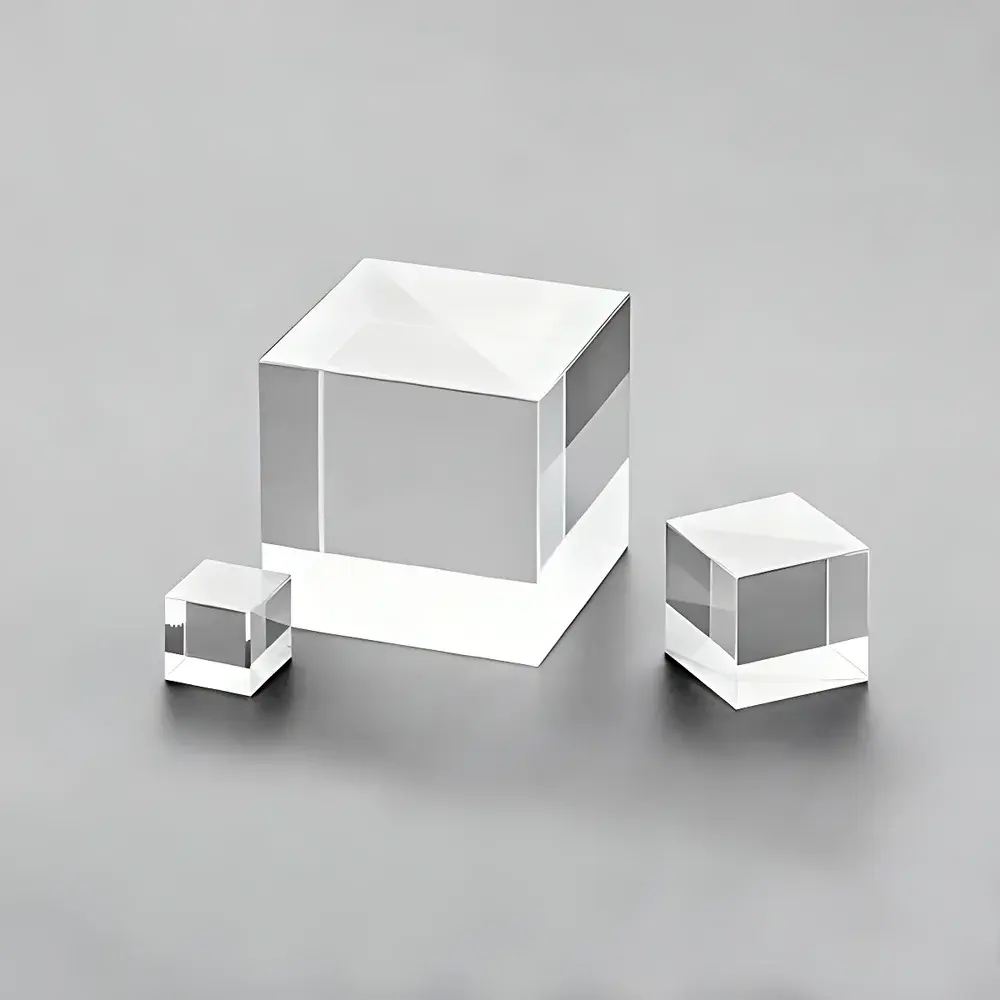
ZOLIX PBS12 & PBS25 Series Polarizing Beam Splitter Cubes
| Brand | ZOLIX |
|---|---|
| Origin | Beijing, China |
| Manufacturer Type | OEM Manufacturer |
| Product Category | Optical Component |
| Model | PBS12 / PBS25 Series |
| Dimensions | 12.7 mm × 12.7 mm × 12.7 mm (PBS12) |
| Material | UV-Fused Silica |
| Coating | Broadband AR (Rₐᵥg < 0.5%) or Laser-Line V-Coating (Rₐᵥg < 0.25% @ design wavelength) |
| Polarization Extinction Ratio | Tp:Ts > 3000:1 (laser-line variants), > 2000:1 (high-power variants) |
| Surface Flatness | λ/4 @ 633 nm |
| Wavefront Distortion (transmission) | λ/4 @ 633 nm |
| Surface Quality | 40/20 scratch-dig |
| Clear Aperture | ≥80% |
| Deviation Angle | Transmission: 0° ± 5 arcmin |
| Reflection | 90° ± 5 arcmin |
Overview
ZOLIX PBS12 and PBS25 Series Polarizing Beam Splitter Cubes are precision optical components engineered for high-fidelity separation of orthogonally polarized light in demanding laser and interferometric applications. Based on the principle of dielectric thin-film interference at the hypotenuse interface of two optically contacted right-angle prisms, these cubes exploit the differential reflectivity of s- and p-polarized light at non-normal incidence to achieve deterministic spatial separation: s-polarized light is reflected at ~90°, while p-polarized light is transmitted collinearly. Constructed from UV-grade fused silica, the cubes exhibit low thermal expansion (5.5 × 10⁻⁷ K⁻¹), high laser-induced damage threshold (LIDT), and excellent transmission stability across ultraviolet to near-infrared spectral bands. The monolithic cube architecture ensures mechanical rigidity, alignment stability, and compatibility with vacuum and cleanroom environments—critical for quantum optics, metrology, and industrial laser systems requiring long-term polarization fidelity.
Key Features
- Three dedicated product families: broadband PBS (420–1600 nm), high-power laser-line PBS (optimized for CW/pulsed operation), and standard laser-line PBS (highest extinction ratio)
- UV-fused silica substrate with ≤0.2 mm dimensional tolerance (±0.0/−0.2 mm) and ≥80% clear aperture
- Laser-line variants feature V-coated AR layers with average reflectance <0.25% per surface at specified wavelengths (e.g., 405, 532, 633, 780, 808, 1064, 1550 nm)
- Broadband variants employ multi-layer AR coatings achieving Rₐᵥg < 0.5% across four defined bands: 420–680 nm, 620–1100 nm, 900–1300 nm, and 1200–1600 nm
- Polarization extinction ratio exceeding 3000:1 (Tp:Ts) for laser-line models and 2000:1 for high-power configurations, verified under standard 6° AOI conditions
- Optimized beam deviation control: transmitted beam deviation ≤5 arcmin; reflected beam deviation ≤5 arcmin from nominal 90°
- Permanent tactile marking on the incident face (coated prism) to ensure correct orientation—critical for minimizing energy deposition in optical adhesive and sustaining LIDT performance
- Surface quality compliant with MIL-PRF-13830B (40/20 scratch-dig); wavefront distortion ≤λ/4 @ 633 nm (transmission path)
Sample Compatibility & Compliance
ZOLIX PBS cubes are designed for integration into ISO-standard optical mounts and kinematic platforms. Their fused silica construction ensures compatibility with UV photolithography, ultrafast Ti:sapphire amplifiers (800 nm), fiber laser systems (1030/1064 nm), and telecom-band sources (1310/1550 nm). All coatings are deposited via ion-assisted e-beam evaporation, meeting ISO 9211-3 specifications for environmental durability (damp heat, abrasion, adhesion). The cubes conform to RoHS Directive 2011/65/EU and are suitable for use in GLP-compliant laboratories where traceable optical component qualification is required. While not certified to specific FDA or IEC standards as standalone devices, their material purity and coating integrity support compliance with laser safety standards (IEC 60825-1) when integrated into Class 3B/4 laser systems.
Software & Data Management
As passive optical components, ZOLIX PBS cubes do not incorporate embedded electronics or firmware. However, comprehensive technical documentation—including spectral reflectance/transmittance curves, polarization extinction data, LIDT test reports (per ISO 21254), and mounting recommendations—is provided in English PDF format with each shipment. Calibration certificates (traceable to NIM, China) are available upon request for metrology-critical installations. For system-level validation, users may import manufacturer-supplied Zemax .ZAR files or Synopsys CODE V prescription data to model polarization-dependent throughput, ghost reflection paths, and wavefront error contributions within optical design workflows.
Applications
- Optical isolation and unidirectional signal routing in fiber amplifiers and cavity-dumped oscillators
- Polarization multiplexing/demultiplexing in coherent communications and quantum key distribution (QKD) setups
- Beam combining/splitting in interferometric sensors (e.g., Michelson, Mach–Zehnder) and gravitational wave detection prototypes
- Polarization state analysis and calibration in ellipsometry and Mueller matrix polarimetry systems
- High-precision laser machining heads requiring polarization-controlled energy delivery (e.g., crystalline silicon dicing, glass ablation)
- Ultra-cold atom trapping and manipulation where polarization purity directly impacts magnetic sublevel selection and decoherence rates
FAQ
What is the recommended angle of incidence for optimal extinction ratio?
The specified extinction ratio (>3000:1) is measured at a nominal 6° angle of incidence (AOI) relative to the input face normal. Deviations beyond ±1° significantly degrade s/p discrimination due to phase shift variations in the thin-film stack.
Can these cubes be used with femtosecond pulses?
Yes—UV-fused silica substrate and low-dispersion dielectric coatings minimize group delay dispersion (GDD). For pulses <100 fs, consult ZOLIX application engineering for GDD characterization data at your central wavelength.
Is cleaning procedure documented?
Yes—ISO 10110-7 compliant cleaning protocol (acetone → IPA → dry nitrogen purge) is included in the user manual. Ultrasonic cleaning is strictly prohibited due to risk of delamination.
Are custom coating designs available?
ZOLIX offers OEM coating customization—including dual-wavelength AR, AOI-tuned stacks, or high-LIDT multilayer designs—for minimum order quantities of 50 units.
How is orientation verified during installation?
A permanent matte-finish mark on the incident face (coated prism) aligns with the manufacturer’s designated “input” direction. Misorientation increases absorption in the epoxy layer and reduces effective LIDT by up to 40%.





