
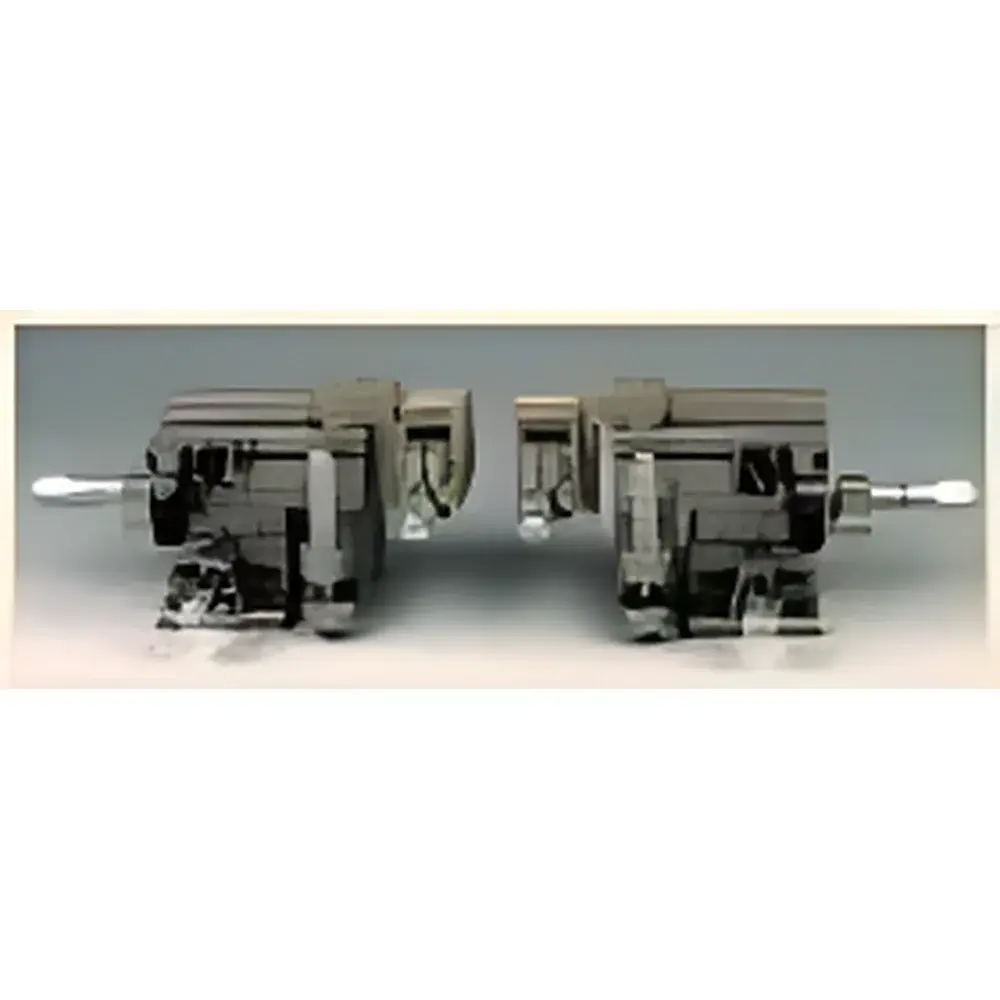
ZOLIX NFP-6561 / NFP-6561L Six-Axis Ultra-Precision Manual Translation and Tilting Stage
| Brand | ZOLIX |
|---|---|
| Origin | Beijing, China |
| Manufacturer Type | Direct Manufacturer |
| Model | NFP-6561 / NFP-6561L |
| Linear Travel (X/Y) | 13 mm |
| Linear Travel (Z) | 6 mm |
| Angular Range (θx) | ±10° |
| Angular Range (θy) | −2° to +4° |
| Angular Range (θz) | −4° to +4° |
| Sensitivity | 1 µm |
| Straightness (X/Y/Z axes) | < 3 µm |
Overview
The ZOLIX NFP-6561 and NFP-6561L are six-degree-of-freedom (6-DOF) ultra-precision manual positioning stages engineered for demanding optical alignment, interferometric setup, and micro-optomechanical assembly applications. Unlike standard XYZ translation stages or stacked gimbal mounts, these integrated platforms combine orthogonal linear motion (Tx, Ty, Tz) with independent rotational degrees of freedom (θx, θy, θz) in a monolithic, thermally stable aluminum alloy structure. The design adheres to classical kinematic principles—employing preloaded crossed-roller bearings, hardened stainless-steel lead screws with micron-pitched threads, and friction-reduced differential micrometer drives—to achieve sub-micron repeatability and angular stability under static load. These stages are not motorized; they are optimized for tactile, high-resolution manual adjustment where electronic actuation introduces vibration, latency, or electromagnetic interference—common constraints in laser cavity alignment, fiber coupling, and quantum optics experiments.
Key Features
- Six-axis simultaneous adjustability: Independent fine control over three orthogonal translations and three non-coupled rotations enables precise collimation, beam steering, and focal plane registration without iterative repositioning.
- Micron-level sensitivity: Differential micrometer heads with 1 µm graduation and 0.5 µm effective resolution allow deterministic positioning down to the limit of mechanical hysteresis and thermal drift.
- Sub-3 µm straightness across all linear axes: Achieved via precision-ground guide rails, symmetric preload distribution, and finite-element-validated structural rigidity—critical for maintaining wavefront fidelity in high-numerical-aperture optical paths.
- Dual variant configuration: The NFP-6561 features standard-height base mounting; the NFP-6561L variant incorporates extended low-profile legs for improved center-of-gravity alignment and reduced moment arm during large-angle θy/θz tilts.
- Black anodized aluminum housing with non-outgassing surface treatment: Compliant with UHV-compatible cleanroom handling protocols and suitable for integration into Class 1000+ optical enclosures.
- Modular mounting interface: Standard M4 and M6 tapped holes on top and bottom surfaces support direct attachment to optical breadboards, cage systems (e.g., Thorlabs 30 mm), and custom kinematic bases.
Sample Compatibility & Compliance
These stages are designed for passive optical components weighing up to 2.5 kg—including lens mounts, mirror holders, fiber launchers, and miniaturized interferometer cubes—with no active cooling or power requirements. Mechanical compatibility is verified per ISO 10110-7 (optical element mounting tolerances) and aligned with common laboratory infrastructure per ANSI/BHMA A156.19 (precision motion hardware dimensional standards). While not certified to specific regulatory frameworks (e.g., FDA or CE for medical use), the stage’s construction materials, surface finish, and dimensional stability meet GLP-aligned lab equipment criteria for traceable optical alignment workflows. No RoHS exemptions apply—the aluminum alloy, stainless steel, and brass components fully comply with Directive 2011/65/EU.
Software & Data Management
As fully manual instruments, the NFP-6561/NFP-6561L do not incorporate embedded electronics, firmware, or digital interfaces. Consequently, no proprietary software, drivers, or API libraries are provided or required. Position documentation relies on external metrology tools: users routinely integrate these stages with laser trackers (e.g., Leica AT960), digital autocollimators (e.g., TRIOPTICS OptiCentric), or coordinate measuring arms (e.g., FARO Quantum S) for closed-loop verification. For audit-trail compliance in regulated environments, position logs may be recorded manually in ELN systems (e.g., LabArchives, Benchling) or exported from third-party metrology software supporting ASTM E2500-13 data integrity guidelines.
Applications
- Laser cavity alignment in Ti:sapphire, dye, and diode-pumped solid-state oscillators requiring simultaneous control of pump beam incidence angle and resonator mode overlap.
- Fiber-to-chip coupling in silicon photonics packaging, where sub-microradian angular tuning of input/output facets directly impacts insertion loss and back-reflection.
- Interferometric null testing of aspheric mirrors using computer-generated holograms (CGHs), where θx/θy corrections compensate for residual figure errors beyond Zernike polynomial fitting.
- Alignment of multi-axis scanning galvanometers in ultrafast laser micromachining workstations to ensure spatiotemporal overlap of pump and probe pulses at the sample plane.
- Calibration reference platforms for optical encoder verification, where the stage’s known straightness and angular repeatability serve as traceable mechanical benchmarks.
FAQ
Is the NFP-6561 compatible with vacuum environments?
Yes—when specified with optional vacuum-rated lubricants and sealed bearing variants, it supports operation in pressures down to 1×10⁻⁶ mbar. Standard units are rated for ambient and dry nitrogen-purged enclosures only.
What is the maximum payload for maintaining specified angular repeatability?
At ≤1.8 kg centered load, angular repeatability remains within ±2 arcsec over 1000 adjustment cycles; above 2.5 kg, θy and θz hysteresis increases measurably due to elastic deformation of the tilt flexure hinges.
Can the stage be retrofitted with motorized actuators?
No—its mechanical architecture lacks provisions for stepper/servo integration. Motorization would compromise stiffness, introduce resonance modes, and violate the design’s fundamental assumption of zero-vibration manual control.
Does ZOLIX provide calibration certificates with NIST-traceable uncertainty statements?
Upon request and additional fee, third-party calibration (per ISO/IEC 17025) can be arranged through accredited metrology labs; factory verification reports include raw dial indicator and autocollimator measurement data but are not NIST-traceable by default.
How does thermal drift affect long-term positional stability?
Coefficient of thermal expansion (CTE) mismatch between aluminum body and stainless-steel leadscrews results in <0.8 µm/°C axial drift and <1.2 arcsec/°C angular drift—mitigated by operating within ±1°C of initial thermal equilibration temperature.




