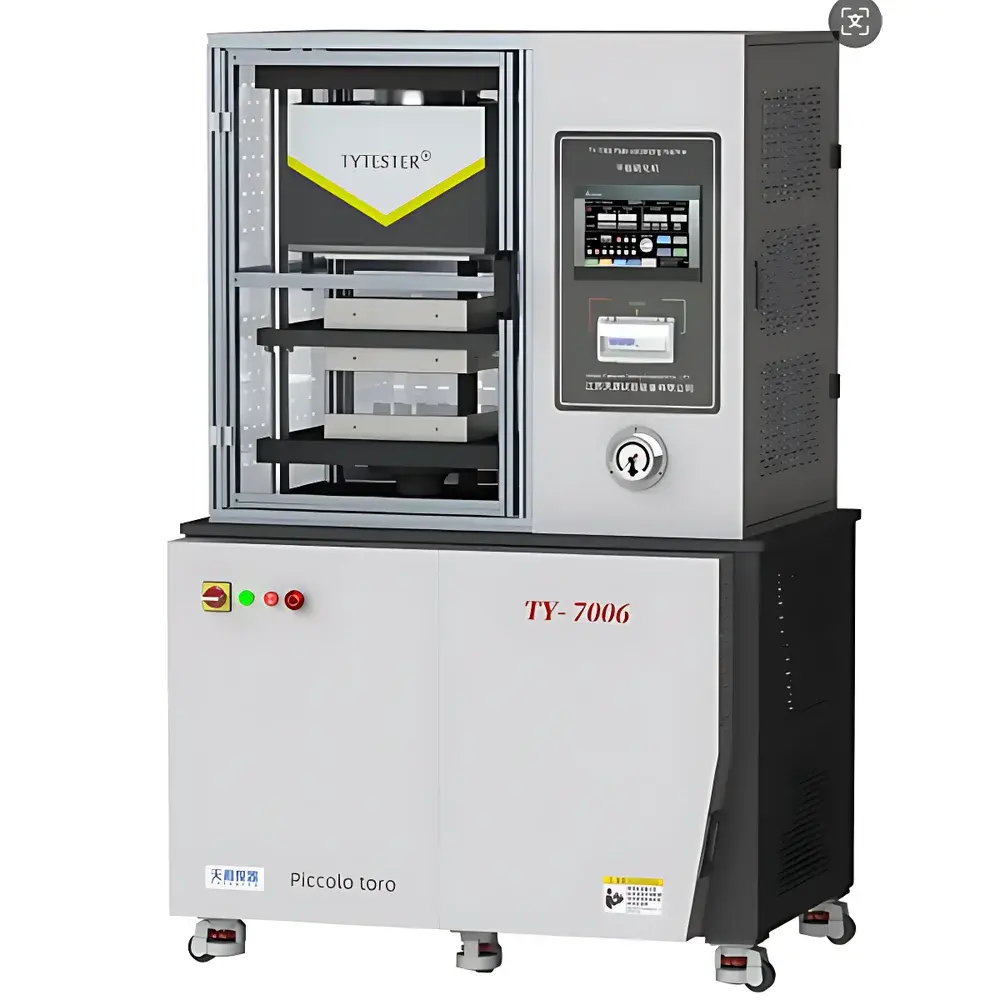
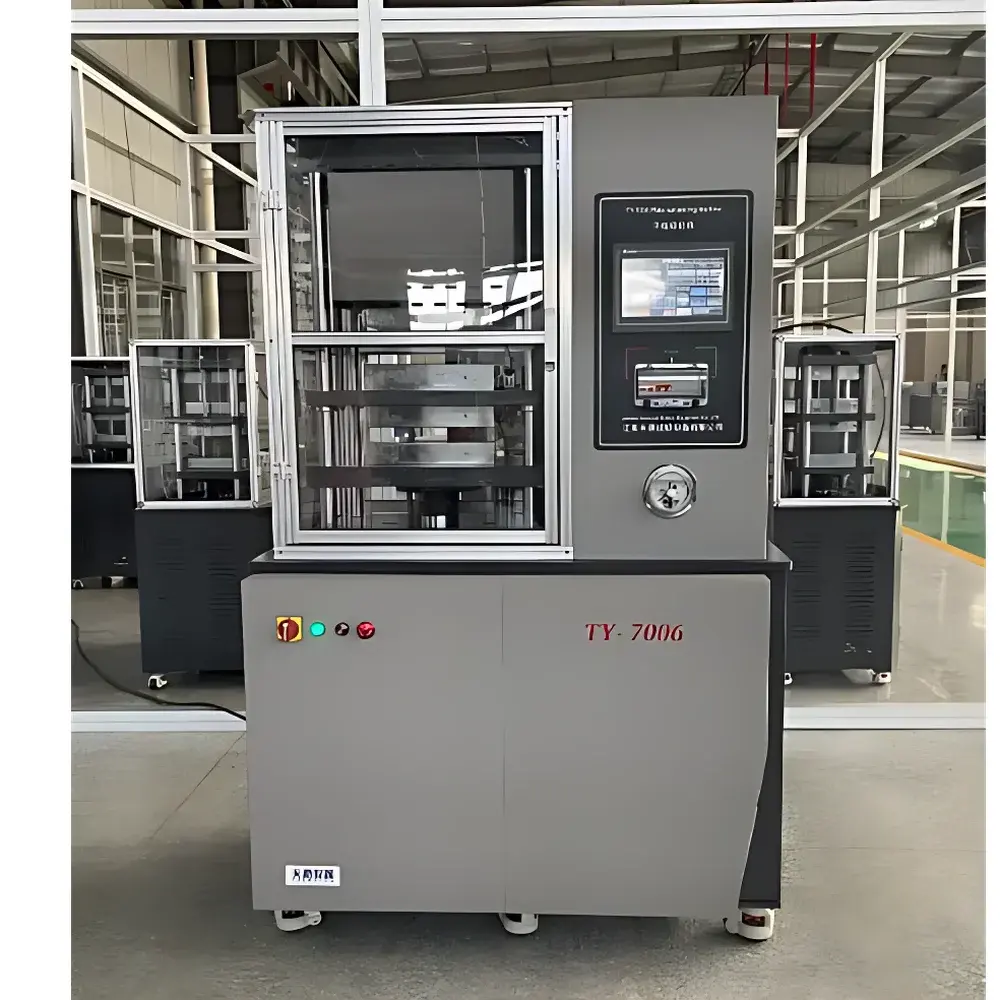
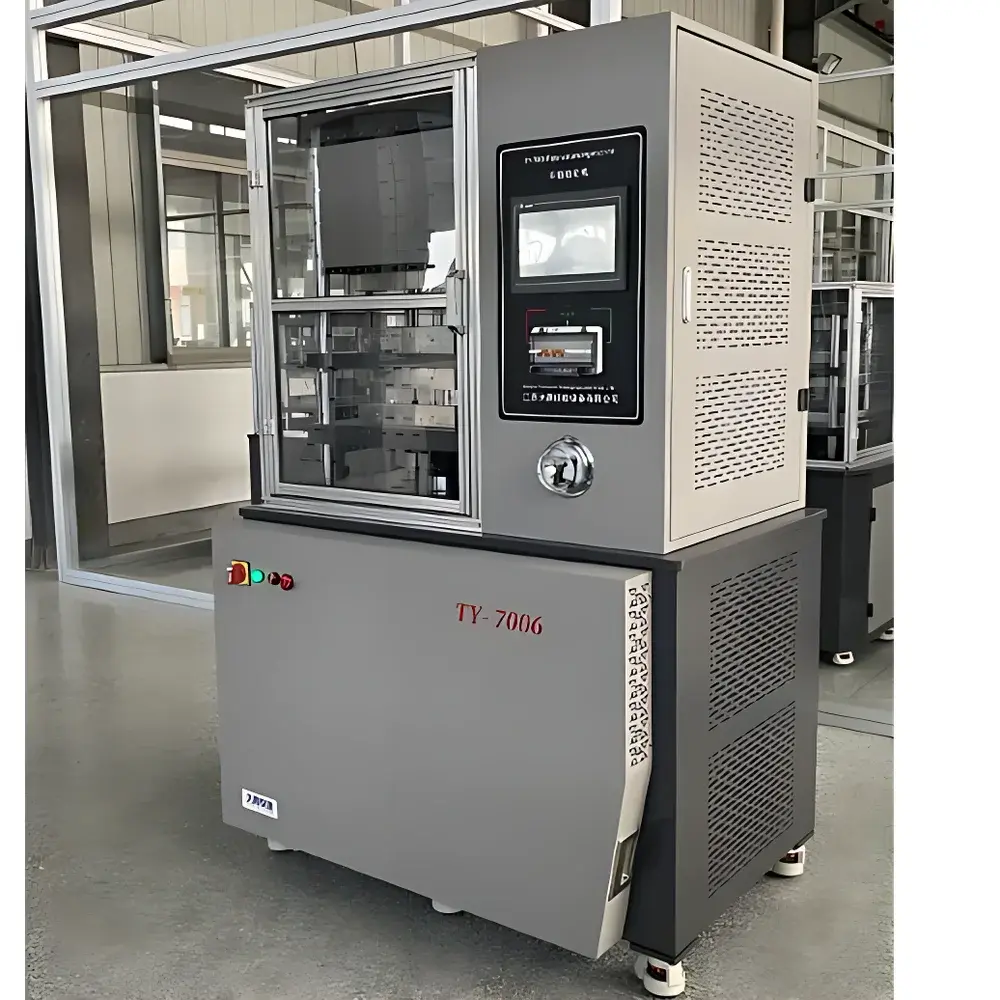
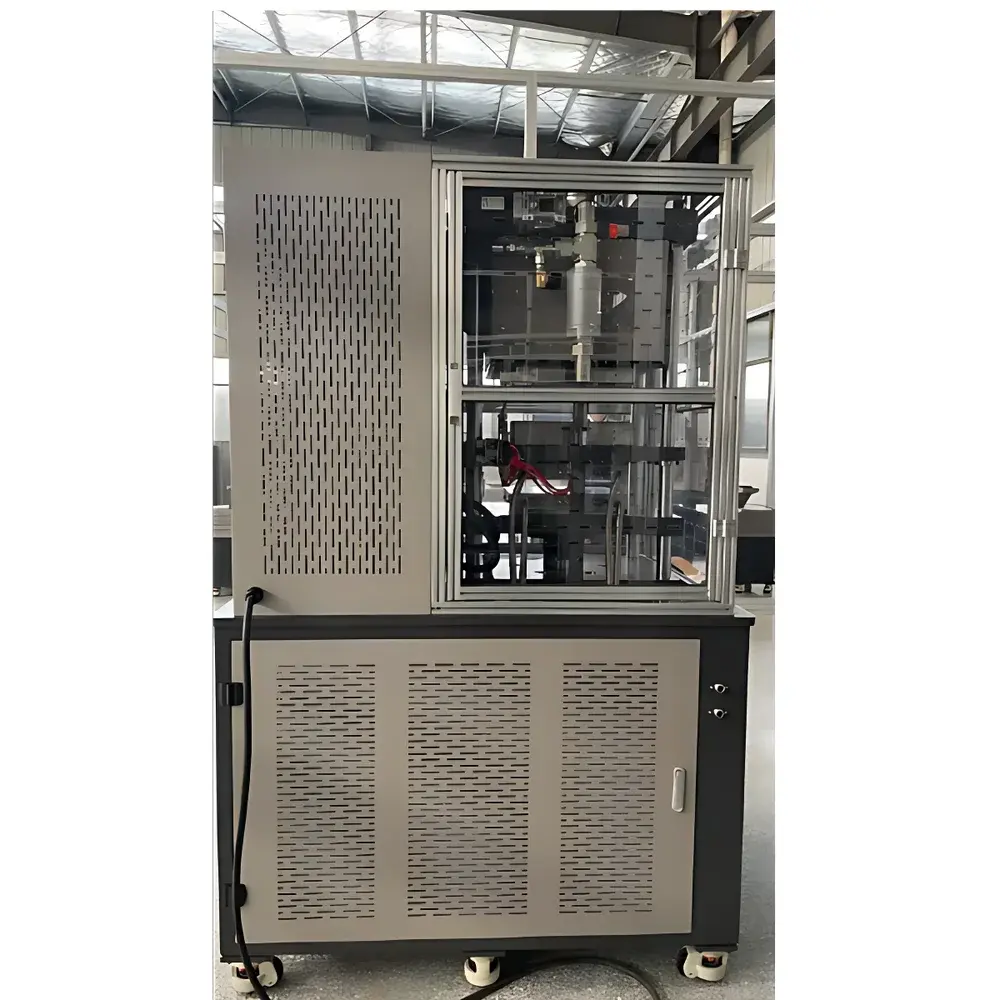
TianYuan TY-7006Z-30 Vacuum Flat-Plate Heat Press for Polymer Sample Preparation
| Brand | TianYuan |
|---|---|
| Origin | Jiangsu, China |
| Manufacturer Type | Direct Manufacturer |
| Country of Origin | China |
| Model | TY-7006Z-30 |
| Pressure Range | 0–30 metric tons (0–294 kN) |
| Platen Stroke | 75 mm |
| Platen Dimensions | 300 × 300 mm or 400 × 400 mm (selectable) |
| Operating Mode | Vacuum-assisted thermal compression molding |
| Control System | PLC with color touchscreen HMI |
| Heating Configuration | Star-connected (Y-type) three-phase resistive heating |
| Temperature Control | Linear voltage regulation module for precise ramp/soak profiles |
| Cooling Option | Bottom platen water-cooled (standard) or dual-heated configuration available |
| Tooling | Through-hardened alloy steel platens with deep-carburized surface (HRC ≥ 58) |
| Automation Features | Programmable exhaust cycles, pressure hold with pump motor auto-compensation and post-cycle dwell, dual manual/automatic operation modes |
Overview
The TianYuan TY-7006Z-30 Vacuum Flat-Plate Heat Press is an industrial-grade sample preparation system engineered for reproducible thermal compression molding of thermoplastic and thermosetting polymer compounds under controlled vacuum, temperature, and pressure conditions. It operates on the principle of constrained melt flow: polymer granules or pellets are placed between heated platens inside a vacuum chamber; upon evacuation, air pockets are removed to prevent void formation, while simultaneous application of uniform pressure and precise thermal energy induces molecular rearrangement, fusion, and consolidation into dimensionally stable sheets or plaques. This process is essential for eliminating entrapped volatiles, minimizing porosity, and achieving homogeneous morphology—critical prerequisites for subsequent mechanical testing (e.g., tensile, impact, flexural), rheological characterization, or spectroscopic analysis. Designed for R&D laboratories and QC departments in compounding, masterbatch production, and material certification facilities, the TY-7006Z-30 supports ASTM D3182, ISO 293, ISO 178, and GB/T 9341-compliant specimen fabrication.
Key Features
- PLC-based control architecture with 7-inch color touchscreen HMI enabling full parametric programming: vacuum level (down to ≤10 mbar), heating rate (0.1–10 °C/min), target temperature (ambient to 250 °C), dwell time (1 s–999 min), pressure ramp profile (0–30 t), and multi-stage exhaust sequencing (up to 9 cycles)
- Linear voltage regulation module ensures proportional power delivery to heating elements, eliminating overshoot and improving thermal stability (±0.5 °C over 30-min dwell at 200 °C)
- Star-connected (Y-type) three-phase resistive heating system balances electrical load across phases, reducing harmonic distortion and extending heater service life by ≥40% versus conventional on/off cycling designs
- Dual-platen construction with through-hardened alloy steel (AISI H13 equivalent), surface-carburized to ≥0.8 mm depth and Rockwell C hardness ≥58, ensuring long-term flatness retention (<0.02 mm/m) and thermal distortion resistance
- Hydraulic system with auto-compensating oil pump and programmable post-compression hold (0–300 s), maintaining set pressure within ±1.5% during cooling phase to prevent warpage
- Vacuum chamber integrated with stainless-steel gasketed door, pneumatic actuation, and digital vacuum gauge with data logging capability
Sample Compatibility & Compliance
The TY-7006Z-30 accommodates raw materials including polyolefins (PP, PE), engineering plastics (PC, PA6/66, PBT), thermoplastic elastomers (TPE, TPU), filled composites (glass-, mineral-, carbon-reinforced), and reactive systems (epoxy pre-pregs, phenolic resins). It supports standardized specimen geometries per ASTM D638 Type I–V, ISO 527-2, and ISO 178 flexural bars. All operational parameters—including vacuum decay rate, temperature ramp fidelity, and pressure linearity—are traceable via internal audit logs compliant with GLP documentation requirements. The system’s programmable logic controller stores up to 100 user-defined recipes with timestamped execution records, satisfying basic FDA 21 CFR Part 11 data integrity expectations when paired with networked backup.
Software & Data Management
The embedded HMI firmware provides real-time graphical display of temperature vs. time, pressure vs. time, and vacuum level vs. time curves during each cycle. All process variables are logged at 1-second intervals to internal flash memory (≥10,000 cycles retained) and exportable via USB to CSV format. Optional Ethernet/IP interface enables integration with LIMS or MES platforms using Modbus TCP protocol. No proprietary software installation is required on host PCs; exported datasets are natively compatible with MATLAB, JMP, and Minitab for statistical process analysis.
Applications
- Preparation of void-free test plaques for ASTM D638 tensile testing and ISO 178 flexural evaluation
- Production of color-matched reference sheets for spectrophotometric calibration and pigment dispersion assessment
- Controlled gelation studies of crosslinking systems (e.g., EPDM, silicone rubber) via timed compression under inert atmosphere
- Elimination of “fish eyes”, gels, and carbon specks in recycled polymer streams prior to rheological screening
- Development of laminated multilayer structures (e.g., barrier films) using sequential vacuum-pressure cycles
- Validation of melt flow index (MFI) correlation with compression-molded sheet density and crystallinity
FAQ
What vacuum level can the TY-7006Z-30 achieve, and how is it maintained during heating?
The system achieves ≤10 mbar absolute pressure using a two-stage rotary vane vacuum pump; a solenoid-controlled isolation valve maintains vacuum integrity during platen closure and heating.
Is the bottom platen actively cooled, and what is the typical cooldown rate?
Yes—the standard configuration includes water-cooled bottom platens with adjustable flow (2–8 L/min); from 200 °C to 60 °C, average cooldown is 1.8 °C/min with 6 L/min deionized water at 25 °C inlet.
Can the machine be validated for IQ/OQ protocols?
Yes—factory-supplied validation templates include temperature mapping (9-point grid), pressure transducer calibration certificates, vacuum leak rate verification (≤0.5 mbar/min), and HMI audit trail demonstration.
What maintenance intervals are recommended for hydraulic and vacuum subsystems?
Hydraulic oil replacement every 2,000 operating hours; vacuum pump oil change every 500 hours or quarterly—whichever occurs first.
Does the system support external PC-based recipe management?
Yes—via USB mass storage mode or optional Ethernet connection; recipe files (.prg) are plain-text XML with checksum validation.