
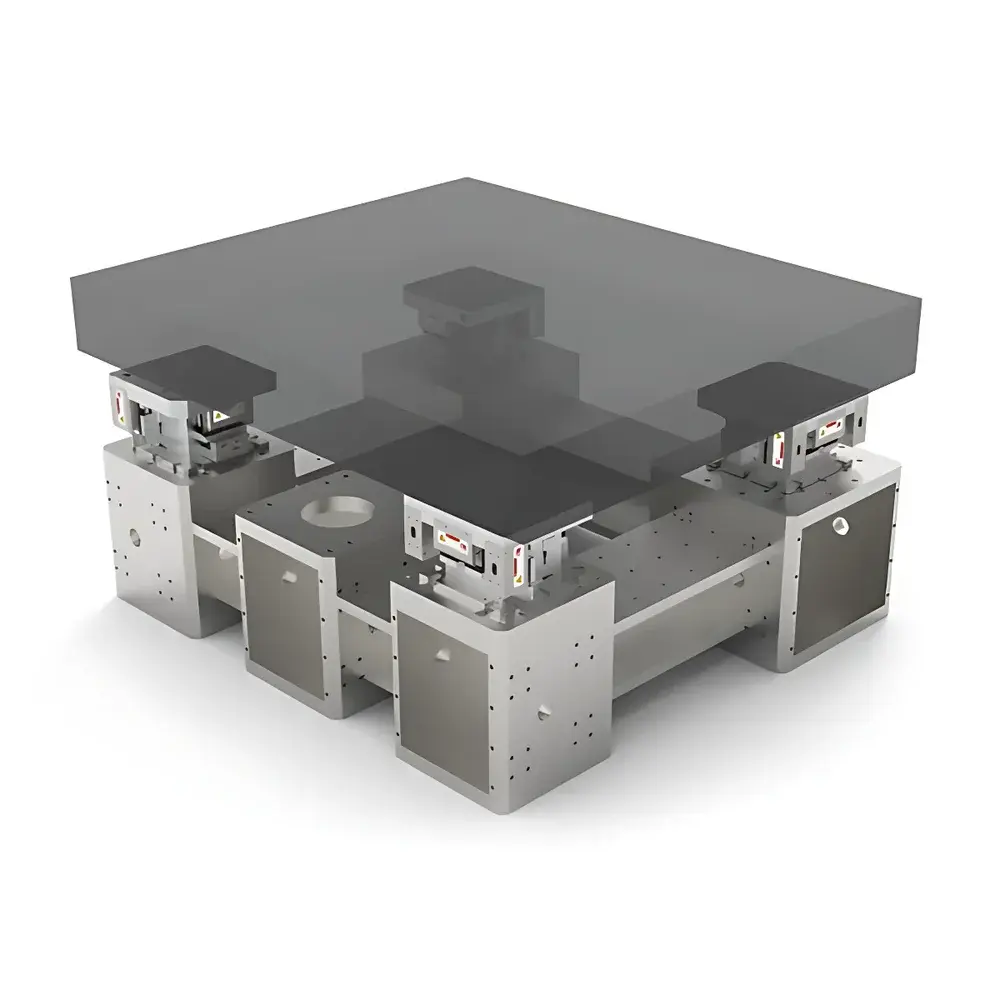
ZOLIX ZVI-VB Series Vacuum-Compatible Active Vibration Isolation Platform
| Brand | ZOLIX |
|---|---|
| Origin | Beijing, China |
| Manufacturer | Yes |
| Product Type | Domestic |
| Model | ZVI-VB Series |
| Pricing | Upon Request |
| Load Capacity (Standard) | Up to 7000 kg |
| Active Isolation Bandwidth | 0.5–150 Hz |
| Horizontal Motor Peak Thrust | 160 N (standard), up to 270 N (enhanced) |
| System Power Rating | ≤400 W |
| Table Flatness | NTBP 0.02–0.05 mm / 600 mm × 600 mm |
| Granite Surface Grade | Grade 0/1/2/3 per GB/T 20428–2006 |
| Table Thickness Options | 100 / 200 / 300 mm |
| Mounting Hole Pattern | Customizable diameter and pitch |
| Single Leg Max Load | 1800 kg |
| Platform Stability | ≤±5 µm |
| Transmissibility | ≤−20 dB @ 2 Hz, ≤−35 dB @ 5 Hz, ≤−50 dB @ 10 Hz |
Overview
The ZOLIX ZVI-VB Series Vacuum-Compatible Active Vibration Isolation Platform is an engineered solution for ultra-stable optical and nanofabrication instrumentation operating under high-vacuum conditions (down to 1×10⁻⁴ Pa). Unlike conventional passive or hybrid platforms, the ZVI-VB integrates a fully active 6-degree-of-freedom (6-DOF) control architecture with vacuum-rated mechanical components—including air-spring supports and magnetically actuated negative-stiffness mechanisms—enabling real-time compensation of ground-borne and equipment-induced disturbances across a bandwidth spanning 0.5 Hz to 150 Hz. Its core design principle follows the parallel combination of positive-stiffness (air springs) and mechanically inverted pendulum-based negative-stiffness elements, achieving ultra-low static stiffness while maintaining structural integrity and thermal stability in vacuum environments. This architecture directly addresses the stringent stability requirements of lithographic tools, electron-beam writers, scanning probe microscopes, and interferometric metrology systems where sub-micron positional drift or nanoradian angular jitter compromises process fidelity.
Key Features
- Vacuum-compliant construction rated for continuous operation at ≤1×10⁻⁴ Pa, with outgassing-tested seals, non-lubricated actuators, and stainless-steel fasteners meeting ASTM E595 standards.
- Proprietary 6-DOF active control system featuring fully domesticated signal processing hardware, real-time FPGA-based feedback loops, and adaptive notch filtering for resonant mode suppression.
- Modular air-spring + magnetic negative-stiffness isolation units delivering <±5 µm platform stability under dynamic loading and thermal transients.
- Horizontal-axis electromagnetic actuators with peak thrust options of 160 N (standard) and 270 N (high-force configuration), calibrated for linear force response within ±1.5% full scale.
- Granite tabletop available in Grade 0 to Grade 3 per GB/T 20428–2006, with flatness tolerances as tight as NTBP 0.02 mm over 600 mm × 600 mm measurement area.
- Customizable mechanical interface: hole pattern geometry, diameter, depth, and positional tolerance (±0.05 mm) defined per customer drawing or SEMI E10 specification.
Sample Compatibility & Compliance
The ZVI-VB platform accommodates optical tables, lithography steppers, reactive ion etch (RIE) chambers, and ultra-high-vacuum (UHV) surface analysis tools requiring simultaneous vibration attenuation and vacuum integrity. It complies with mechanical interface requirements outlined in ISO 10816-1 (vibration severity assessment) and supports integration into GLP/GMP-aligned cleanroom facilities. All control electronics meet IEC 61000-6-2 (immunity) and IEC 61000-6-4 (emission) standards. Vacuum-rated cabling and feedthroughs conform to NASA-STD-6012B for outgassing performance. Platform structural validation includes finite element modal analysis (up to 500 Hz) and experimental transmissibility mapping per ISO 2041:2008.
Software & Data Management
The platform is operated via ZOLIX’s proprietary VIBRA-OS™ control software, supporting Windows 10/11 and Linux (Ubuntu LTS). The software provides real-time spectrum analysis (FFT resolution ≤0.1 Hz), time-domain waveform logging (16-bit ADC, 10 kHz sampling), and automated compliance reporting for FDA 21 CFR Part 11 audit trails—including electronic signatures, change history, and user role-based access control. Remote monitoring and configuration are enabled via TLS-secured Ethernet (TCP/IP) or optional fiber-optic link to eliminate ground-loop interference. Export formats include CSV, HDF5, and MATLAB .mat for post-processing in MATLAB, Python (SciPy), or LabVIEW.
Applications
- Photolithography systems: Stabilizes mask alignment and wafer stage motion during exposure, reducing CD variation and overlay error in sub-10 nm node fabrication.
- Plasma etch and deposition tools: Mitigates low-frequency acoustic coupling from RF generators and turbomolecular pumps, preserving critical dimension uniformity across 300 mm wafers.
- Atomic force microscopy (AFM) and scanning tunneling microscopy (STM): Enables sub-angstrom Z-resolution and long-term scan stability under UHV or glovebox conditions.
- Gravitational wave detector prototype benches and quantum optics testbeds: Provides broadband isolation essential for phase-sensitive interferometry with coherence lengths exceeding 1 km.
- Calibration laboratories: Serves as reference-grade support for primary length standards (e.g., laser interferometers traceable to SI meter definition) under ISO/IEC 17025 accreditation.
FAQ
What vacuum level is the ZVI-VB platform certified for?
The platform is validated for continuous operation at pressures down to 1×10⁻⁴ Pa. Optional UHV variants (≤1×10⁻⁷ Pa) are available with bake-out compatible materials and all-metal seals.
Can the platform be integrated with existing facility vacuum plumbing?
Yes—vacuum ports (KF40 or CF63 configurable) are provided on each isolation leg housing, allowing direct connection to main chamber manifolds without compromising structural damping performance.
Is remote diagnostics supported?
All ZVI-VB units include embedded Ethernet connectivity with SNMP v3 and Modbus TCP interfaces for integration into factory-wide SCADA or MES systems.
How is calibration traceability maintained?
Each unit ships with a NIST-traceable calibration certificate for accelerometer sensitivity, force transducer linearity, and table flatness verification, updated annually per ISO/IEC 17025 procedures.
Does the system support third-party motion controllers?
Yes—the platform exposes a documented API (RESTful + shared memory) and supports synchronization pulses (TTL/RS422) for phase-locked operation with stages from Aerotech, PI, or Newport.





