
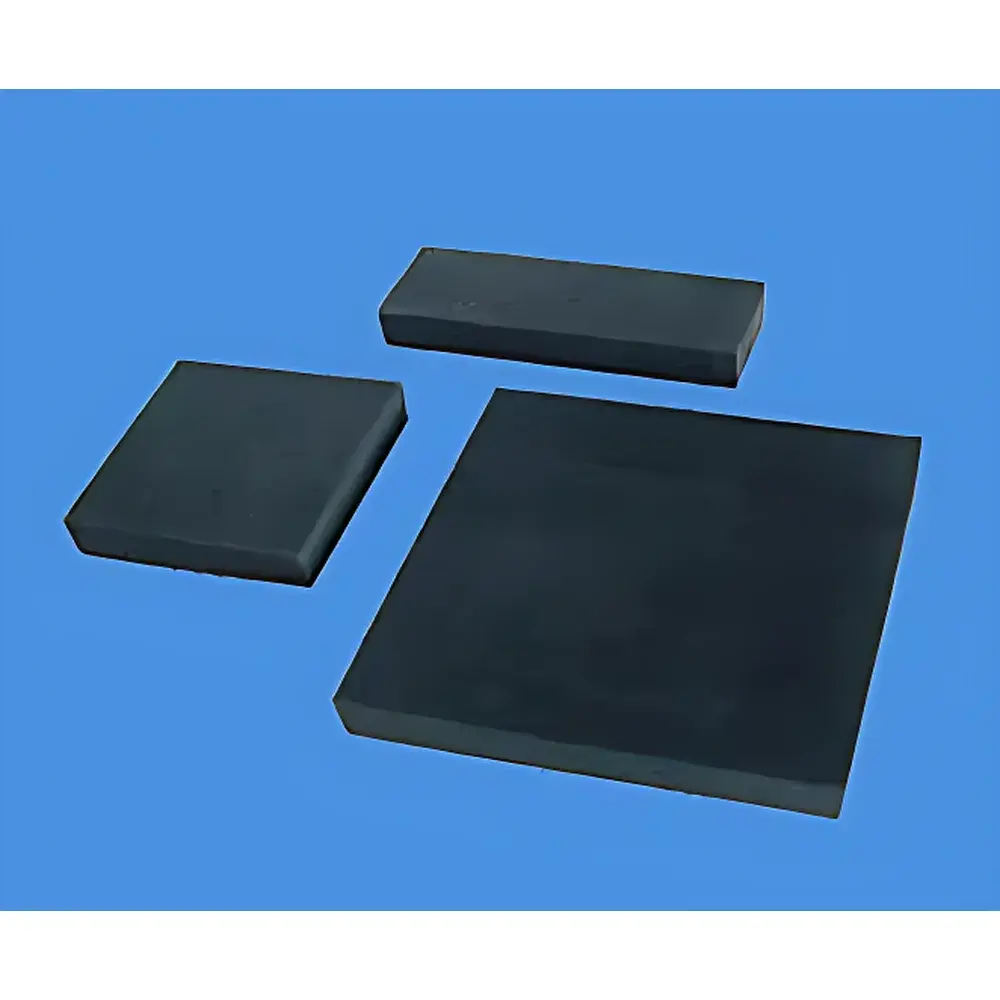
Quartz Crystal Microbalance (QCM) Substrate: SPI-2 Grade Highly Oriented Pyrolytic Graphite (HOPG) from合肥科晶
No specifications available.
Overview
The SPI-2 grade Highly Oriented Pyrolytic Graphite (HOPG) is a precision-engineered crystalline carbon substrate specifically optimized for use as an electrode or sensing surface in quartz crystal microbalance (QCM) systems. HOPG exhibits exceptional basal-plane alignment, with mosaic spread typically < 0.4°, enabling highly reproducible electrochemical and interfacial mass-sensing measurements. Its layered hexagonal lattice structure provides atomically flat terraces after cleavage, facilitating well-defined electron transfer kinetics and uniform adsorption behavior—critical for quantitative QCM-D (QCM with dissipation monitoring), in situ electrochemistry, scanning probe microscopy (SPM), and surface-sensitive spectroscopic studies. Unlike polycrystalline graphite or glassy carbon, HOPG’s low defect density and high carrier mobility support stable baseline response and minimal non-faradaic background interference in real-time mass tracking applications.
Key Features
- Ultra-low mosaic spread (< 0.4°), ensuring consistent crystallographic orientation across the entire cleaved surface
- Atomically flat terraces with step heights of 0.2–0.3 nm (single graphene layer) and multi-layer steps (2–10 atomic layers), verified by AFM and STM
- Surface roughness < 0.8 nm RMS (8 Å RMS) on freshly cleaved surfaces—compatible with sub-nanogram mass resolution in QCM systems
- Density of 2.27 g·cm⁻³, consistent with theoretical graphite density and indicative of high structural integrity
- Supplied in Class 1000 cleanroom environment and double-bagged in ISO Class 5 (Class 100) static-dissipative clean bags to prevent particulate and hydrocarbon contamination
- Standard geometry: 5 mm × 5 mm × 1.0 mm; custom dimensions available upon request (e.g., 10 mm × 10 mm for extended electrode area or enhanced signal-to-noise ratio)
Sample Compatibility & Compliance
HOPG substrates are compatible with standard AT-cut quartz crystals (5–10 MHz) used in commercial QCM platforms (e.g., Q-Sense, Biolin Scientific; EQCM-100, Gamry; or custom-built resonator cells). The material demonstrates excellent adhesion stability under aqueous, non-aqueous, and vacuum environments—enabling long-duration kinetic experiments without delamination or surface reconstruction. All batches undergo rigorous Raman spectroscopy verification (G-band FWHM < 12 cm⁻¹) and XRD rocking-curve analysis to confirm crystallinity and orientation conformity. While not certified to ISO/IEC 17025, the manufacturing and packaging protocols align with GLP-compliant laboratory practices. For regulated environments (e.g., pharmaceutical QC labs), documentation packages—including lot-specific certificates of analysis (CoA), cleavage date, and cleanroom handling logs—are available upon request.
Software & Data Management
When integrated into QCM instrumentation, HOPG substrates do not require proprietary software but fully support industry-standard data acquisition and analysis workflows. Raw frequency (Δf) and dissipation (ΔD) time-series data exported from instrument control software (e.g., QTools, EC-Lab, or MATLAB-based custom scripts) remain fully interpretable using Sauerbrey, Voigt, or bulk viscoelastic modeling frameworks. The substrate’s low intrinsic damping ensures high Q-factor (>10⁴ in air, >2×10⁴ in liquid at 5 MHz), which directly improves measurement sensitivity and reduces noise floor—facilitating robust statistical treatment of replicate datasets. For audit-trail compliance in regulated settings, raw sensor data files may be archived alongside metadata (substrate lot ID, cleavage timestamp, mounting procedure) in accordance with FDA 21 CFR Part 11–aligned electronic lab notebook (ELN) systems.
Applications
- In situ electrochemical QCM (EQCM) for studying ion insertion, polymer film growth, and redox-driven mass changes in battery materials and conductive polymers
- Label-free biosensing via immobilized antibodies, aptamers, or DNA monolayers—leveraging HOPG’s inert basal plane for controlled thiol- or π-stacking-based anchoring
- Model electrode studies in fundamental corrosion science, particularly for evaluating passivation layer formation kinetics in chloride-containing electrolytes
- Substrate for van der Waals heterostructure assembly in 2D material transfer experiments requiring atomically flat, chemically stable supports
- Calibration reference for AFM tip sharpness assessment and force-distance curve standardization
FAQ
How should HOPG be cleaved prior to QCM mounting?
Cleavage is performed ex situ using adhesive tape (e.g., Nitto Denko SPV-224) under ambient conditions. A single perpendicular peel yields a fresh, contaminant-minimized basal plane. Cleavage must occur immediately before mounting to minimize atmospheric adsorption.
Is HOPG compatible with acidic or alkaline electrolytes?
Yes—HOPG exhibits electrochemical stability from −1.0 V to +1.2 V vs. Ag/AgCl in pH 1–13 aqueous solutions. Prolonged anodic polarization above +0.8 V may induce edge oxidation; basal-plane-dominated electrodes mitigate this effect.
Can HOPG substrates be reused after cleaning?
No. Mechanical cleavage is irreversible. Each use requires a new cleaved surface. Re-cleaving the same chip degrades terrace continuity and increases step-edge density, compromising measurement reproducibility.
What is the shelf life of packaged HOPG?
When stored sealed in Class 100 clean bags at 20–25°C and 30–50% RH, unopened units retain cleavage quality for up to 6 months. Exposure to ambient air post-opening necessitates immediate use.






