
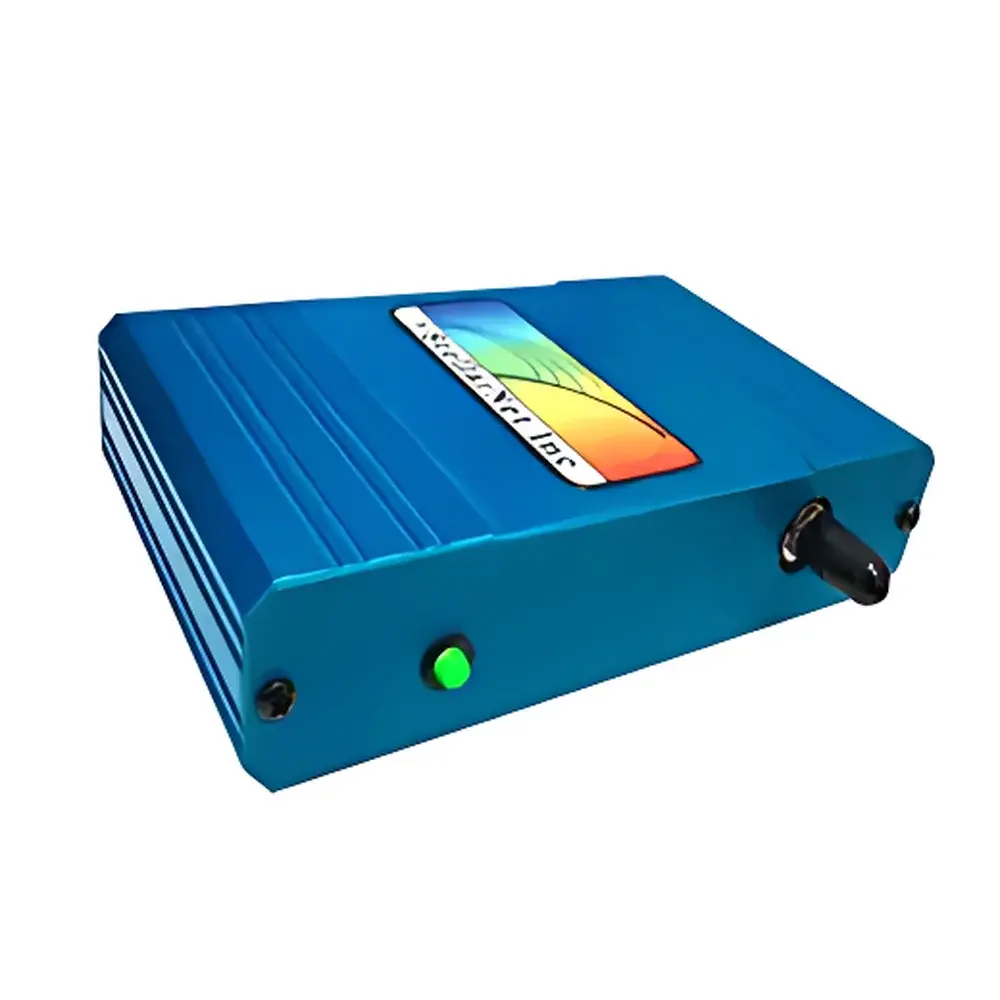
Ocean Insight Blue Series Fiber Optic Spectrometer
| Origin | USA |
|---|---|
| Manufacturer Type | Authorized Distributor |
| Origin Category | Imported |
| Model | Blue Series |
| Spectral Range | 200–1100 nm |
| Detector | CCD (2048-pixel linear array) |
| Optical Resolution (FWHM) | 0.13–6.0 nm (dependent on grating and slit configuration) |
| Sensitivity | 100 photons/count at 400 nm |
| Signal-to-Noise Ratio | 1000:1 (full well, 1 s integration) |
| Dynamic Range | 2000:1 (6 decades) |
| Stray Light | <0.1% at 435 nm |
| Interface | USB 2.0, SMA905 fiber input, 16-bit ADC |
| Integration Time | 1 ms – 65 s |
| Grating Options | 300–2400 g/mm (holographic & ruled) |
| Slit Options | 14–200 µm |
| Focal Ratio | f/4 |
| Optical Design | Symmetric Czerny–Turner with crossed-beam geometry |
| Power Supply | <100 mA via USB port |
| Dimensions | 25.4 × 76.2 × 127 mm (1 × 3 × 5 in) |
| Weight | 397 g (14 oz) |
Overview
The Ocean Insight Blue Series Fiber Optic Spectrometer is a compact, high-performance benchtop and field-deployable spectroscopic instrument engineered for precision wavelength-resolved intensity measurement across the ultraviolet, visible, and near-infrared (UV-VIS-NIR) spectral domains (200–1100 nm). Built upon a symmetric Czerny–Turner optical platform with crossed-beam architecture, the Blue Series minimizes aberrations and ensures consistent spectral fidelity across all configurations. Its core optical engine integrates a 2048-pixel linear CCD detector, selectable holographic or ruled diffraction gratings (300–2400 g/mm), and interchangeable entrance slits (14–200 µm), enabling users to optimize resolution, throughput, and stray light rejection for application-specific requirements. Designed for robustness in non-laboratory environments, the spectrometer features a monolithic aluminum housing with passive thermal stabilization and mechanical damping—making it suitable for process monitoring, mobile environmental sensing, OEM integration, and remote field deployments where vibration resistance and thermal drift mitigation are critical.
Key Features
- Compact form factor (25.4 × 76.2 × 127 mm) with lightweight aluminum chassis optimized for portability and mechanical stability
- USB 2.0 plug-and-play interface compliant with Windows XP through Windows 10; no external power supply required (<100 mA draw)
- 16-bit analog-to-digital conversion enabling high dynamic range acquisition (2000:1 over six decades)
- Configurable spectral resolution from 0.13 nm (FWHM) to 6.0 nm, determined by grating line density and slit width selection
- Low stray light performance: <0.1% at 435 nm and <0.05% at 600 nm—critical for quantitative absorbance and fluorescence measurements
- Wide integration time range (1 ms to 65 s) supporting both transient event capture and low-light signal averaging
- SMA905 fiber optic input (0.22 NA) compatible with standard silica-core UV-VIS-NIR fibers and collimating optics
- Thermally stable optical bench with minimized sensitivity to ambient temperature fluctuations (±0.05 nm/°C typical)
Sample Compatibility & Compliance
The Blue Series supports direct coupling to liquid cuvettes, gas cells, integrating spheres, reflectance probes, and fiber-coupled light sources via standardized SMA905 interfaces. Its broad spectral coverage enables applications spanning UV absorbance of nucleic acids (260 nm), chlorophyll quantification (650–680 nm), NIR moisture analysis (970 nm), and LED/CVD emission profiling (365–1100 nm). The instrument complies with IEC 61326-1 (EMC for laboratory equipment) and meets RoHS 2 directive requirements. While not certified for Class I medical device use, its hardware and firmware architecture support traceable calibration workflows aligned with ISO/IEC 17025 quality management systems. Spectral data generated using factory-calibrated wavelength and intensity references may be used in GLP-compliant environments when paired with documented calibration certificates and version-controlled software (SpectraWiz v5.12+).
Software & Data Management
Ocean Insight provides the SpectraWiz desktop application—a modular, cross-platform suite supporting real-time spectral acquisition, baseline correction, peak identification, multivariate analysis (PCA), and custom scripting via Python API (oceanoptics-python). All spectral datasets are stored in vendor-neutral HDF5 format with embedded metadata (wavelength array, integration time, grating ID, slit width, calibration coefficients). Audit trail functionality logs user actions, parameter changes, and calibration events—enabling compliance with FDA 21 CFR Part 11 when deployed on validated Windows systems. Firmware updates preserve backward compatibility with legacy configurations and support synchronized multi-spectrometer triggering via TTL pulse inputs—essential for hyperspectral imaging or dual-beam referencing setups.
Applications
- Real-time process analytical technology (PAT) for pharmaceutical blending, chemical reaction monitoring, and bioreactor OD tracking
- Environmental field spectroscopy: water quality (COD, nitrate, turbidity), soil reflectance, and atmospheric gas detection (O3, NO2)
- OEM integration into handheld analyzers, portable Raman systems, and embedded colorimetric sensors
- Academic teaching labs for fundamental spectroscopy experiments—including Beer–Lambert law verification and emission line mapping
- LED and laser diode characterization: spectral centroid, FWHM, and side-mode suppression ratio (SMSR) analysis
- Thin-film thickness measurement via interference fringe analysis in reflectance mode
FAQ
What calibration options are available for the Blue Series?
Factory-installed NIST-traceable radiometric and wavelength calibrations are included. Optional annual recalibration services include irradiance, absorbance, and fluorescence intensity standards (e.g., STAN-FL-1).
Can multiple Blue spectrometers be synchronized for parallel acquisition?
Yes—via external TTL trigger input and master/slave clock distribution using the optional SYNC-BOX accessory.
Is the spectrometer compatible with Linux or macOS?
Native drivers and Python API support Linux (Ubuntu 18.04+, kernel 5.4+) and macOS (12 Monterey+); GUI functionality requires Windows.
How does resolution vary with slit and grating selection?
Resolution is determined empirically by the product of pixel size, focal length, and grating dispersion. Example: 1200 g/mm grating + 25 µm slit yields ~0.5 nm FWHM at 500 nm; 600 g/mm + 200 µm yields ~3.2 nm.
What is the typical thermal drift behavior during extended integrations?
Drift remains within ±0.05 nm over 30 minutes at constant ambient temperature (23 ± 1 °C); active cooling is not required but recommended for >60 s integrations in variable environments.




