
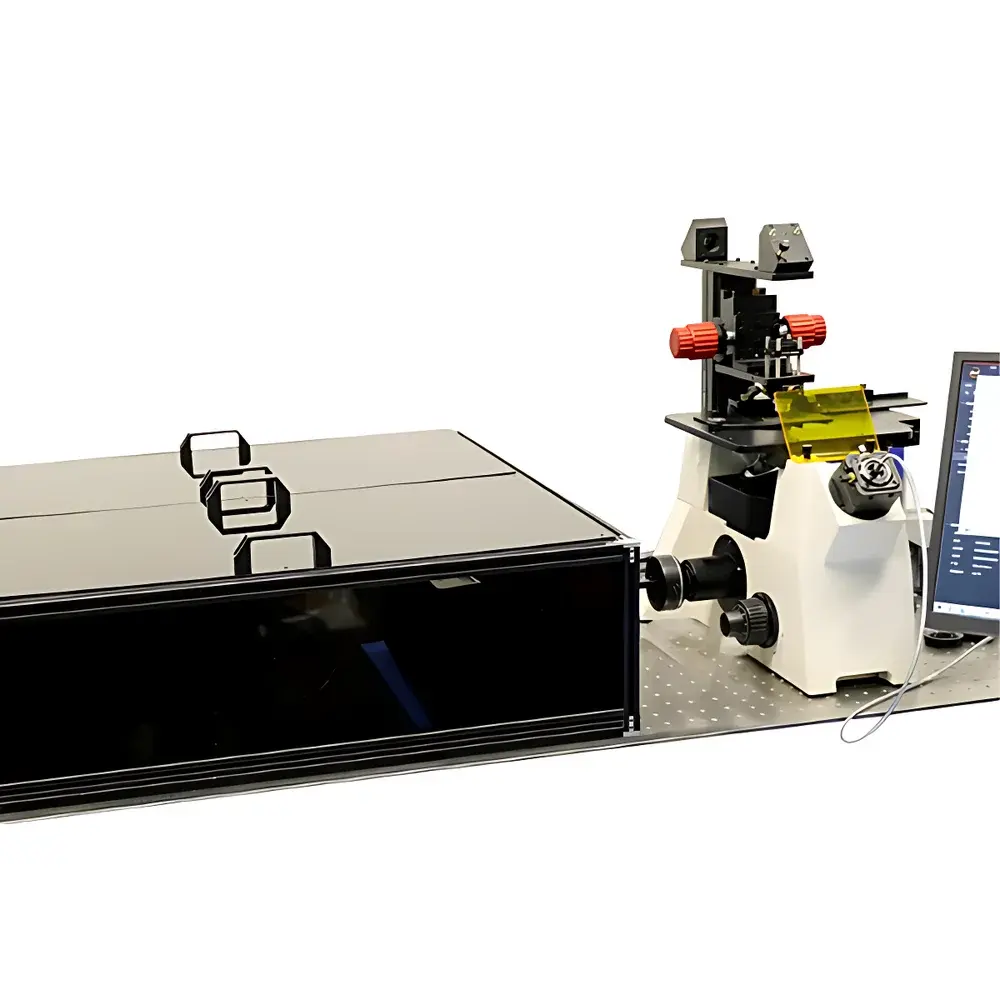
ZOLIX Omni-fs-TA Femtosecond Transient Absorption Spectrometer
| Brand | ZOLIX |
|---|---|
| Origin | Beijing, China |
| Manufacturer Type | Original Equipment Manufacturer (OEM) |
| Product Category | Domestic |
| Model | Omni-fs-TA |
| Instrument Type | Transient Absorption Spectrometer |
| Temporal Resolution | 1.5 × Laser Pulse Width |
| Sensitivity | 0.1 ΔmOD (broadband), 0.01 ΔmOD (single-wavelength) |
| Pump Wavelength Ranges | 240–480 nm, 475–1160 nm, 1160–1600 nm, 1600–2600 nm |
| Probe Wavelength Ranges | 300–700 nm |
| Detection Time Window | 4 ns / 8 ns |
| Laser Sources | 800 ± 10 nm, 1030 ± 3 nm |
| Sample Formats | Liquid, Powder, Thin Film |
| Measurement Modes | Transmission, Reflection, Back-Excitation |
| Software Features | Probe Stability Monitoring, Real-Time Spectral Preview, Spectral Calibration, Smoothing, Global & Target Data Fitting |
| Optional Modules | Micro-area Spectroscopy, Wide-field Transient Absorption Imaging, TCSPC (2 ps min. time step, 100 ps min. lifetime range, 0.08 nm spectral resolution), Femtosecond Kerr-Gated Time-Resolved Fluorescence (400–900 nm, 50 fs pulse width, 4 ns window) |
Overview
The ZOLIX Omni-fs-TA Femtosecond Transient Absorption Spectrometer is a turnkey pump-probe system engineered for ultrafast photophysical and photochemical dynamics characterization on the femtosecond-to-nanosecond timescale. Based on the well-established transient absorption (TA) methodology, the system employs a split-beam optical configuration: one ultrashort laser pulse serves as the pump to initiate non-equilibrium electronic excitation, while a spectrally broadened white-light continuum—generated via filamentation or nonlinear crystal—acts as the broadband probe. By precisely controlling the temporal delay between pump and probe pulses using an optomechanical delay stage with sub-femtosecond jitter, the instrument records differential absorbance (ΔA or ΔOD) spectra across user-selectable wavelength windows. This enables direct observation of excited-state population evolution, including charge transfer, energy migration, intersystem crossing, vibrational relaxation, and conformational isomerization. The system’s architecture supports both transmission and reflection geometries, accommodating solid-state thin films, colloidal suspensions, and molecular solutions—making it suitable for fundamental studies in photochemistry, photophysics, and materials science.
Key Features
- Integrated dual-output femtosecond laser platform (800 ± 10 nm and 1030 ± 3 nm) with synchronized pump and probe beam paths
- Multi-range probe spectral coverage: configurable UV-Vis-NIR detection from 300–1700 nm across eight discrete bands
- Pump wavelength flexibility: four independently tunable pump arms covering 240–2600 nm via optical parametric amplification (OPA) and harmonic generation
- Temporal resolution defined by 1.5 × input laser pulse width—enabling reliable capture of sub-100 fs dynamics when paired with <50 fs Ti:sapphire or Yb-based oscillators
- Dual-beam balanced detection scheme to suppress intensity noise and eliminate false signals induced by probe beam fluctuations
- Real-time probe stability monitoring and automatic background subtraction to isolate genuine transient ΔOD signals
- Modular design supporting optional upgrades: micro-area spectroscopy (≤10 µm spot size), wide-field transient imaging, TCSPC module (2 ps timing resolution), and femtosecond Kerr-gated fluorescence detection
Sample Compatibility & Compliance
The Omni-fs-TA accommodates standard spectroscopic sample formats—including cuvettes (1–10 mm pathlength), spin-coated thin films on quartz or ITO substrates, powder pellets, and gas-phase cells—without requiring vacuum or cryogenic environments. All optical components are mounted on vibration-isolated breadboards with kinematic alignment capability, ensuring long-term mechanical stability during extended acquisition sessions. The system meets ISO 17025-relevant optical alignment and calibration traceability requirements. Data acquisition workflows support audit-trail logging and user-access control, aligning with GLP-compliant laboratory practices. While not FDA 21 CFR Part 11-certified out-of-the-box, raw data export (HDF5, ASCII) and metadata tagging enable integration into validated LIMS or ELN platforms for regulated environments.
Software & Data Management
Control and analysis are performed via ZOLIX TAStudio—a modular, Python-based software suite supporting real-time spectral preview, automated wavelength calibration using Hg/Ne lamps, dark-current and reference-beam correction, Savitzky-Golay smoothing, and multi-exponential global fitting (target and sequential models). The software exports fully annotated datasets compliant with FAIR principles (Findable, Accessible, Interoperable, Reusable), including timestamps, laser energy logs, environmental sensor readings (temperature/humidity), and instrument configuration snapshots. Batch processing scripts can be exported for reproducible analysis pipelines. All raw and processed data files are timestamped and checksummed, facilitating version-controlled archiving and cross-laboratory comparison.
Applications
The Omni-fs-TA delivers quantitative insight into ultrafast processes critical to next-generation optoelectronic materials. It has been applied to map charge carrier lifetimes in perovskite-MOF heterostructures, resolve triplet formation pathways in organic photovoltaic blends, and track exciton delocalization in pentacene dimers. In photocatalysis research, it characterizes electron injection kinetics at semiconductor–molecule interfaces. In biophysics, it monitors photoinduced proton-coupled electron transfer in photosynthetic reaction centers and UV-induced DNA lesion formation. Its compatibility with liquid-phase samples also supports mechanistic studies of photocatalytic water splitting, CO₂ reduction, and photoredox catalysis under ambient conditions.
FAQ
What laser sources are compatible with the Omni-fs-TA?
The system is optimized for Ti:sapphire oscillators (780–820 nm, <50 fs) and Yb-based amplifiers (1030 nm, 200–350 fs), but supports external synchronization with other femtosecond sources via TTL trigger input.
Can the system perform time-resolved fluorescence measurements?
Yes—when equipped with the optional femtosecond Kerr gate module, it enables time-resolved fluorescence spectroscopy from 400–900 nm with 50 fs temporal gating resolution.
Is spectral calibration traceable to NIST standards?
Calibration is performed using certified Hg/Ne emission lamps; users may import custom wavelength tables or apply polynomial corrections based on independent spectrometer validation.
How is data integrity ensured during long-duration kinetic scans?
Probe beam intensity is continuously monitored and normalized; each scan includes embedded reference measurements before and after acquisition to correct for drift.
Does the system support kinetic modeling beyond mono- or bi-exponential fits?
Yes—TAStudio includes target analysis and global compartmental modeling tools capable of handling >5 species with coupled rate equations, including wavelength-dependent decay-associated spectra (DAS) and evolution-associated spectra (EAS).






