
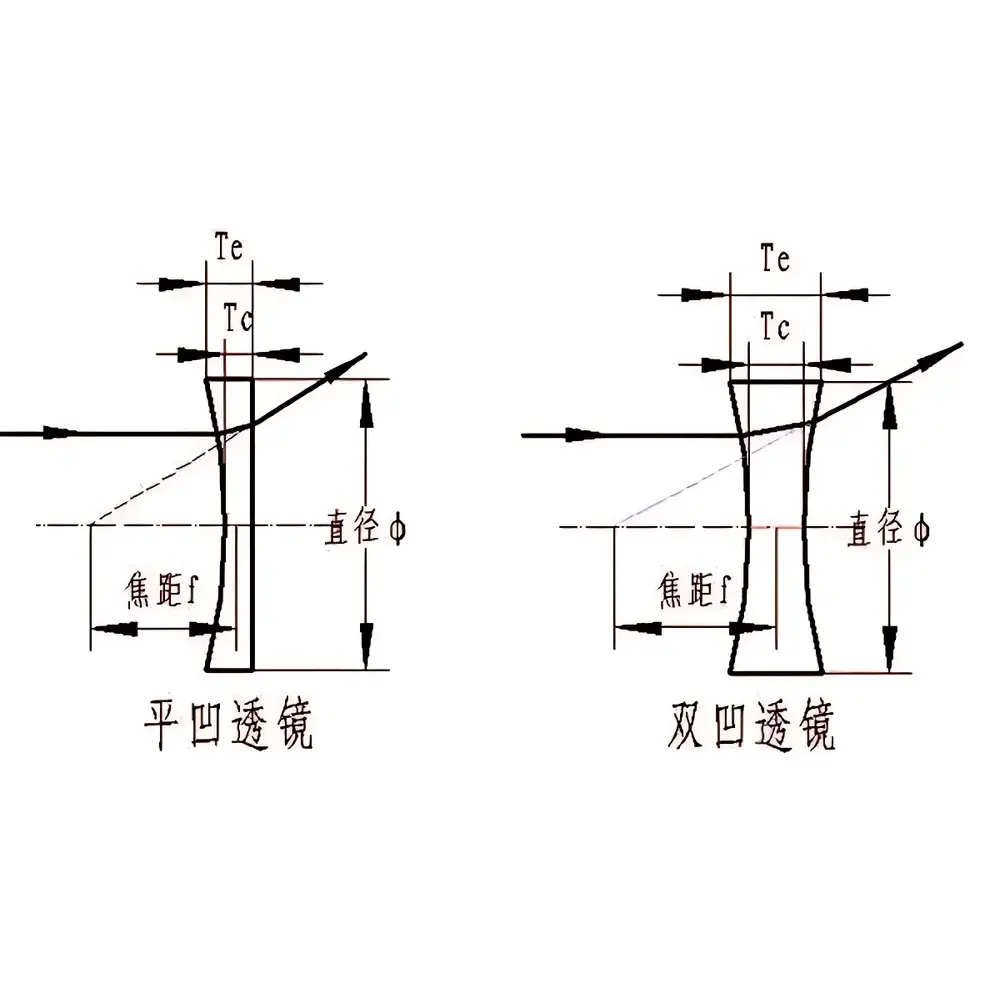
ZOLIX OLD Series Plano-Concave Lens
| Brand | ZOLIX |
|---|---|
| Model Series | OLD (K9 BK7) / OLDQ (UV Fused Silica) |
| Material | Optical Grade K9 Glass (BK7) or UV Fused Silica |
| Diameter Tolerance | +0.0 / −0.1 mm |
| Effective Focal Length (EFL) Tolerance | ±2% |
| Coating | Uncoated |
| Standard Diameters | 25 mm, 25.4 mm |
| Available EFLs | −50 mm, −100 mm, −200 mm |
| Component Category | Optical Element |
| Origin | Beijing, China |
| Manufacturer | ZOLIX (Beijing Zolix Instruments Co., Ltd.) |
Overview
ZOLIX OLD Series plano-concave lenses are precision-ground and polished optical elements engineered for divergent beam manipulation in laboratory-scale optical systems. Based on the fundamental principle of negative refraction, these lenses introduce controlled wavefront divergence by exploiting the geometric asymmetry between a flat surface and a concave spherical surface. Constructed from high-homogeneity K9 borosilicate crown glass (equivalent to SCHOTT BK7) or UV-grade fused silica, each lens adheres to ISO 10110-3 surface form tolerances and meets stringent bulk material specifications for transmission uniformity, bubble/inclusion limits, and stress birefringence. The plano-concave configuration is particularly suited for beam expansion, laser cavity mode control, spatial filtering, and collimation correction where intentional defocusing or virtual image formation is required. All lenses are manufactured under cleanroom conditions and undergo 100% interferometric verification of surface figure (λ/4 @ 632.8 nm) and centration (≤3 arcmin).
Key Features
- Precision-ground spherical concave surface paired with optically polished plano surface — optimized for minimal wavefront distortion and high Strehl ratio performance
- Two material options: K9 (BK7) for visible–near-IR applications (350–2000 nm), and UV fused silica for deep-UV transmission down to 185 nm
- Consistent diameter tolerance of +0.0 / −0.1 mm ensures repeatable mounting in standard SM1- or RMS-threaded lens holders
- EFL accuracy maintained within ±2% across the entire series, verified using calibrated autocollimation and nodal slide methods traceable to NIM (National Institute of Metrology, China)
- Uncoated surfaces provide broad spectral neutrality; optional AR coatings (e.g., MgF₂, V-coat, or broadband BBAR) available upon request for specific wavelength bands
- Compliant with ISO 10110-7 scratch-dig specification (60-40 typical), with edge finishing per MIL-PRF-13830B standards
Sample Compatibility & Compliance
ZOLIX OLD and OLDQ lenses integrate seamlessly into standard optical breadboards, cage systems (e.g., Thorlabs 30 mm and 60 mm), and OEM laser platforms. Their mechanical dimensions conform to common industry interfaces, including SM1 (1.035″-40) external threads and metric M25 × 0.75 mounting compatibility. All K9 variants meet RoHS Directive 2011/65/EU requirements and carry CE marking for optical safety compliance. UV fused silica versions comply with ASTM F795-20 for ultraviolet-transmitting optical materials and satisfy USP particulate matter testing criteria when used in analytical instrumentation. Documentation includes full material certificates (CoC), batch-specific interferograms, and dimensional inspection reports aligned with ISO 9001:2015 quality management protocols.
Software & Data Management
While plano-concave lenses are passive optical components and do not incorporate embedded electronics or firmware, ZOLIX provides comprehensive digital asset support for system integration. Each product shipment includes a downloadable ZIP archive containing: (1) Zemax OpticStudio-compatible .ZMX files with accurate surface sag and refractive index data (Schott N-BK7 or Corning 7980 models); (2) STEP and IGES CAD models for mechanical layout validation; (3) spectral transmittance curves measured on a PerkinElmer Lambda 950 UV/VIS/NIR spectrophotometer; and (4) calibration-ready test reports formatted for GLP/GMP audit trails. Traceability metadata (lot number, grinding date, metrology technician ID) is embedded in PDF report headers and conforms to ISO/IEC 17025:2017 documentation requirements.
Applications
- Laser resonator design — introducing controlled negative power to stabilize TEM00 mode structure in He–Ne, diode-pumped solid-state (DPSS), and fiber lasers
- Beam expanders — combined with plano-convex lenses in Galilean configurations for low-aberration magnification without internal focus
- Optical null testing — serving as reference elements in Twyman–Green and Mach–Zehnder interferometers
- Spectrometer slit illumination — shaping uniform line sources in monochromators and array-based spectrophotometers
- UV photolithography alignment optics — leveraging fused silica’s low thermal expansion coefficient (α = 0.55 × 10⁻⁶ /°C) for stable focal position over temperature gradients
- Educational optics kits — supporting undergraduate labs in geometrical optics, aberration analysis, and Fourier optics experiments per AAPT curriculum guidelines
FAQ
What is the difference between OLD and OLDQ series lenses?
The OLD series uses optical-grade K9 (BK7) glass optimized for visible and near-infrared wavelengths (350–2000 nm), while the OLDQ series employs synthetic UV fused silica for extended transmission into the deep ultraviolet (185–2100 nm) and superior thermal stability.
Can these lenses be used in vacuum environments?
Yes — both K9 and fused silica variants exhibit negligible outgassing per ASTM E595-20, making them suitable for UHV optical paths up to 10⁻⁷ Torr when properly cleaned and baked.
Is custom diameter or focal length available?
ZOLIX offers OEM customization for non-standard diameters (12–100 mm), EFLs (−25 mm to −1000 mm), and surface quality upgrades (λ/10 surface figure, <10 nm RMS roughness) subject to minimum order quantities and lead-time confirmation.
Do uncoated lenses require special handling procedures?
Yes — uncoated surfaces are susceptible to moisture adsorption and fingerprint contamination; we recommend cleanroom gloves, nitrogen purge during storage, and periodic cleaning with spectroscopic-grade acetone followed by IPA rinse per ISO 10110-7 Annex B protocols.





