
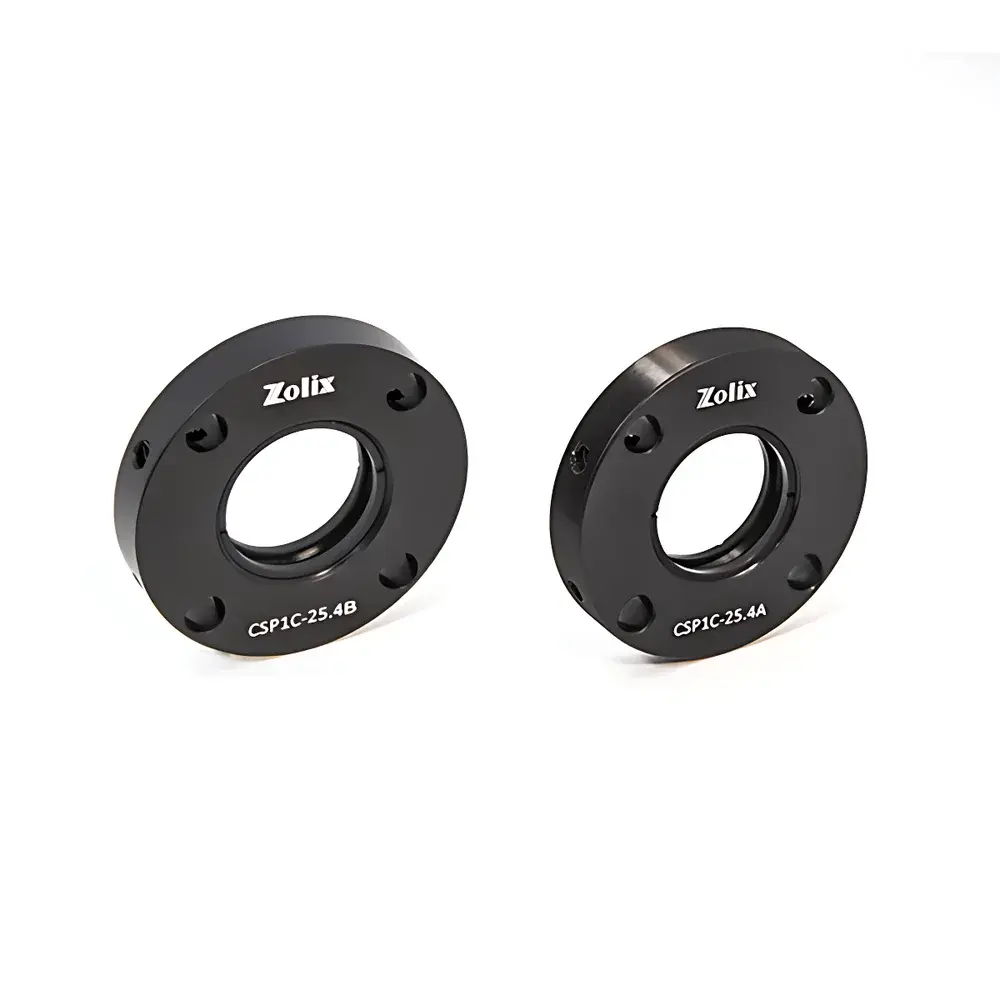
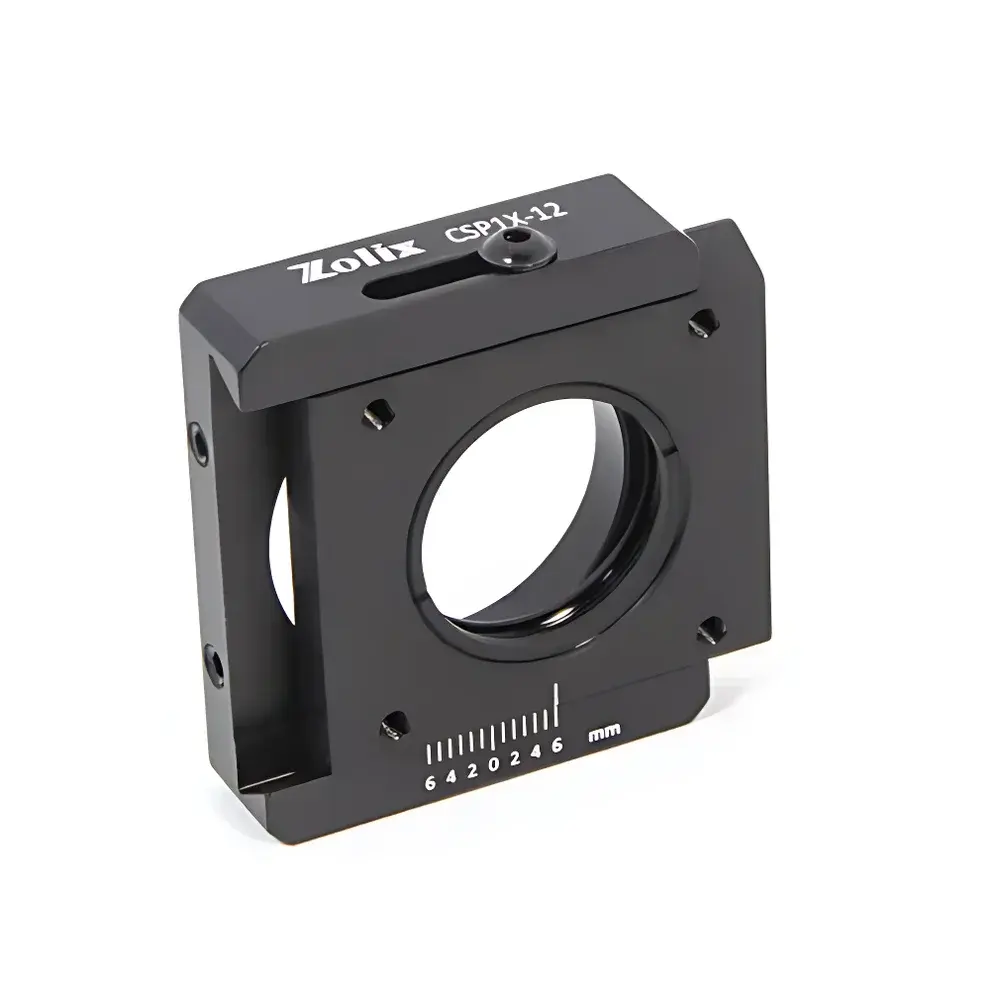
ZOLIX CSP Series 30 mm Cage Plates
| Brand | ZOLIX |
|---|---|
| Model | CSP Series (CSP1S, CSP1C, CSP1T, CSP1X) |
| Type | Standardized Optical Cage System Mounting Plate |
| Material | 6061-T6 Aluminum Alloy |
| Surface Finish | Black Anodized |
| Thickness Options | 4 mm, 9 mm, 12.5 mm |
| Optical Element Mounting Diameter | Ø25.4 mm (1") |
| Central Bore Options | SM05, SM1, RMS (0.800"-36), SM2, or Clear Aperture (Ø23.5–Ø50.8 mm) |
| Cage Rod Compatibility | 30 mm Center-to-Center Spacing |
| Mounting Interface | Four 30 mm Cage Rod Through-Holes with Side-Locating M2.5 Set Screws (1.5 mm Hex) |
| Base Mounting | Integrated M4 Threaded Hole (except CSP1S-25.4) |
| Max Optical Element Thickness | 3.5–5 mm |
| Travel Range (CSP1X-12) | ±6 mm |
| Graduation | 1 mm (±0.1 mm repeatability), 2° angular scale (rotational variant) |
| Compliance | Designed for ISO/IEC 17025-aligned optical alignment workflows, compatible with ANSI/ISO standard optomechanical interfaces |
Overview
The ZOLIX CSP Series 30 mm Cage Plates are precision-engineered mounting platforms designed for modular, repeatable, and stable integration of Ø25.4 mm optical components into standardized 30 mm cage systems. Built on the foundational mechanical architecture of the industry-standard 30 mm cage system—defined by 30 mm center-to-center spacing between parallel cage rods—these plates serve as structural nodes that anchor lenses, filters, mirrors, and other optical elements while maintaining coaxial alignment across multi-stage optical assemblies. Constructed from aerospace-grade 6061-T6 aluminum alloy and finished with hard black anodization (per MIL-A-8625 Type II), each plate delivers dimensional stability under thermal cycling, resistance to wear during repeated assembly/disassembly, and compatibility with vacuum-compatible environments when specified. The series encompasses four functional subfamilies: thin-profile static plates (CSP1S), circular transition plates (CSP1C), threaded-mounting plates with base interface (CSP1T), and translation-adjustable plates (CSP1X), enabling users to select the optimal mechanical interface for beam path construction, spatial filtering, collimation validation, or microscope coupling applications.
Key Features
- Precision-machined 6061-T6 aluminum body with ±5 µm flatness tolerance across mounting surfaces
- Four 30 mm cage rod through-holes with integrated M2.5 side-locating set screws (1.5 mm hex drive) for rigid, backlash-free clamping
- Center-bore options include SM1 internal threading (1.035″-40), RMS (0.800″-36) for microscope objectives, SM05 for miniaturized optics, SM2 for 2-inch components, and clear apertures up to Ø50.8 mm
- Standardized M4 threaded hole on bottom surface (except CSP1S-25.4) for vertical mounting via support posts or kinematic bases
- Black anodized surface (hardness ≥60 HV) provides corrosion resistance and minimizes stray light reflection
- CSP1X-12 translation variant features dual-plate kinematic design with ±6 mm linear travel, engraved 1 mm graduations, and repeatability of ±0.1 mm per adjustment
- Rotational variant includes dual concentric plates with 2° angular scale and flexure-based locking mechanism for coarse/fine rotational positioning
Sample Compatibility & Compliance
The CSP Series accommodates standard Ø25.4 mm (1 inch) optical components—including plano-convex lenses, ND filters, polarizers, beam splitters, and laser windows—with maximum thicknesses ranging from 3.5 mm (CSP1X-12) to 5 mm (CSP1T/CSP1C). All central bores conform to established optomechanical thread standards: SM1 per Thorlabs/Edmund Optics specifications (ANSI B1.10M), RMS per DIN 58410-2 for microscope objective mounting, and SM2 per ISO 10110-7 for large-diameter component interfacing. The plates are fully interoperable with commercial 30 mm cage systems (e.g., Thorlabs, Newport, Standa) without adapter requirements. From a metrology standpoint, dimensional tolerances adhere to ISO 2768-mK general tolerances for machined parts; surface finish complies with ISO 1302 Ra ≤ 0.8 µm on critical bearing faces. These characteristics support compliance with GLP-aligned optical alignment protocols and facilitate traceable setup documentation in regulated R&D environments.
Software & Data Management
While mechanically passive, the CSP Series supports full digital traceability within modern optical lab management frameworks. Each plate is serialized and documented in ZOLIX’s component database with CAD models (STEP/IGES), GD&T annotations, and material certification data. When integrated into automated optical benches equipped with motorized rotation or translation stages (e.g., CSP1X-12 paired with ZOLIX KMS-600 controller), positional feedback is captured via encoder-resolved step counts and logged in CSV/JSON format compliant with ASTM E2500-20 and FDA 21 CFR Part 11 audit trail requirements. Configuration files for common setups—such as collimator alignment sequences or filter wheel indexing routines—are available in Python and LabVIEW APIs for seamless integration into custom test automation suites.
Applications
- Free-space laser beam conditioning: mounting of focusing lenses, spatial filters, and wavefront sensors in interferometric and holographic setups
- Microscope add-on modules: RMS-threaded cage plates enable direct coupling of OEM objectives to custom illumination or detection paths
- Multi-axis optical alignment: CSP1X-12 plates allow iterative optimization of focal plane position in confocal or multiphoton imaging systems
- Modular spectrometer construction: stacking of CSP1C circular plates facilitates transition between 30 mm cage rails and 2-inch monochromator slits or detector mounts
- Education and prototyping labs: standardized geometry reduces mechanical ambiguity in student-built optical trains, supporting reproducible learning outcomes per AAPT curriculum guidelines
- Vacuum-compatible variants (upon request) enable use in UHV spectroscopy chambers where outgassing rates <1×10⁻⁹ Torr·L/s·cm² are required
FAQ
What is the maximum torque specification for the SM1R retaining rings supplied with CSP1T and CSP1C plates?
The included SM1R rings are rated for 12–15 in·lb (1.36–1.70 N·m) tightening torque; exceeding this may deform the aluminum thread or compromise lens centering.
Can CSP1S-25.4 thin plates be used in vacuum environments?
Yes—when ordered with vacuum-compatible anodization (Type III, per MIL-A-8625), CSP1S-25.4 exhibits total mass loss (TML) <1.0% and collected volatile condensable materials (CVCM) <0.1%, meeting NASA SP-R-0022A requirements.
Is RMS threading on CSP1T-25.4A compatible with both Nikon and Olympus microscope objectives?
Yes—the 0.800″-36 RMS thread conforms to JIS B 0207 and is mechanically interchangeable across major OEM objectives requiring RMS mounting.
How is angular accuracy verified on the rotational cage plate variant?
Each unit undergoes calibration against a NIST-traceable autocollimator (resolution 0.5 arcsec); angular deviation across full 360° rotation is certified ≤ ±1.2° at 2° increments.
Are custom center bore configurations (e.g., SM1 + M27×0.75) available?
Yes—ZOLIX offers OEM machining services with lead times of 4–6 weeks; minimum order quantity applies for non-standard configurations.




