
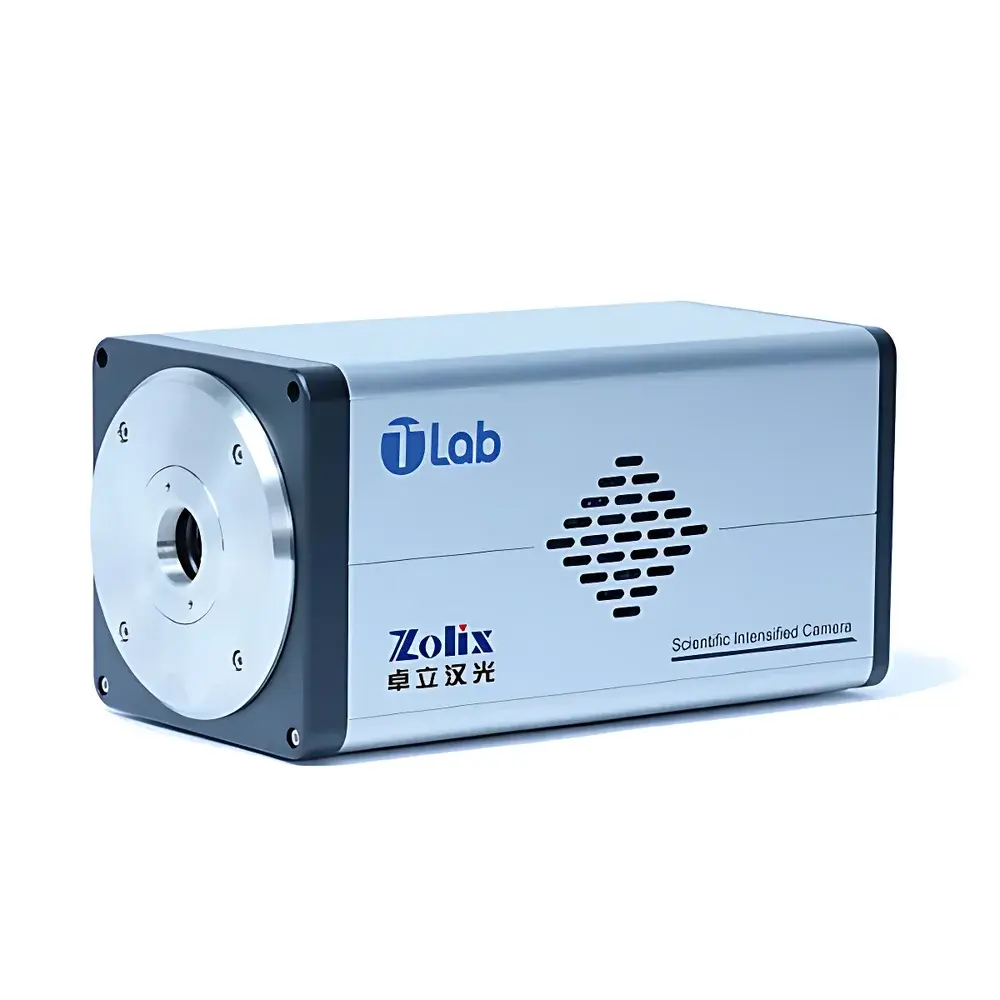
ZOLIX ICCD-18U Scientific Intensified Camera with 6-Megapixel CCD Sensor
| Brand | ZOLIX |
|---|---|
| Origin | Beijing, China |
| Manufacturer Type | Original Equipment Manufacturer (OEM) |
| Imaging Sensor | 6 MP CCD (2750 × 2200), 4.54 µm pixel pitch |
| Spectral Range | 200–900 nm |
| Optical Gate Width | <3 ns (Ultra-Fast Mode) |
| Delay & Gate Timing Resolution | 10 ps |
| Cathode Gating Sync Frequency | Up to 300 kHz |
| Spatial Resolution | >30 lp/mm (fiber-optic coupling), >50 lp/mm (lens coupling) |
| Cooling | Thermoelectrically cooled to 35 °C below ambient |
| Bit Depth | 16-bit |
| Read Noise | 5 e⁻ |
| Dark Current | 0.02 e⁻/pixel/s @ –10 °C |
| Compliance | CE, RoHS, ISO 9001-certified manufacturing |
Overview
The ZOLIX ICCD-18U Scientific Intensified Camera is a high-performance, thermoelectrically cooled imaging system engineered for time-resolved optical detection in demanding scientific environments. It integrates a Generation II microchannel plate (MCP) image intensifier—featuring an 18 mm active diameter S20 or S25 photocathode—with a scientific-grade, deep-depletion CCD sensor (2750 × 2200 pixels, 4.54 µm pitch) via precision lens coupling. This architecture enables spatial resolution exceeding 50 line pairs per millimeter (lp/mm) and temporal resolution governed by sub-3 ns optical gating—critical for capturing ultrafast luminescence decay, plasma dynamics, laser-induced breakdown spectroscopy (LIBS), and single-photon-level transient phenomena. The camera operates across a broad spectral range (200–900 nm), supporting UV-enhanced, visible, and near-infrared detection without external wavelength conversion optics. Its core measurement principle relies on gated intensification: incident photons strike the photocathode, generating photoelectrons accelerated through the MCP, which multiply the signal before phosphor-screen conversion and CCD readout. This cascade preserves photon arrival timing while amplifying weak signals above read noise—enabling quantitative, time-gated imaging under low-light or high-background conditions.
Key Features
- Sub-3 ns optical gate width in Ultra-Fast mode, with <10 ps timing resolution for delay and gate width control
- Integrated digital delay generator (DDG) with 0–10 s delay range and programmable step scanning for time-resolved kinetics acquisition
- Integrate-on-Chip (IOC) mode supporting up to 300 kHz cathode gating frequency for high-repetition-rate signal accumulation
- Thermoelectric cooling to 35 °C below ambient temperature, reducing dark current to ≤0.02 e⁻/pixel/s at –10 °C and enabling long-exposure stability
- Lens-coupled optical interface optimized for spatial fidelity (>50 lp/mm), compatible with standard C-mount and optional Nikon F-mount adapters
- 16-bit digitization with ≤5 e⁻ read noise and full-frame vertical binning (FVB) for spectroscopic applications
- USB 2.0 interface with hardware-triggered acquisition, low-jitter external sync (<100 ps RMS jitter), and direct gate input path (<50 ns intrinsic latency)
Sample Compatibility & Compliance
The ICCD-18U is designed for integration into vacuum-compatible, vibration-isolated, and EMI-controlled laboratory setups. Its sealed intensifier tube meets MIL-STD-810G environmental ruggedness standards for shock and thermal cycling. The system supports compliance with GLP and GMP workflows through audit-trail-capable software logging (T-Lab View), timestamped metadata embedding, and deterministic trigger synchronization traceable to NIST-traceable references. While not FDA 21 CFR Part 11 certified out-of-the-box, its firmware architecture permits integration with validated LIMS environments via API-driven control. The camera conforms to IEC 61000-4 electromagnetic compatibility requirements and carries CE marking for EMC and safety (EN 61326-1). Photocathode quantum efficiency curves (e.g., S25: peak QE ≈17% @ 460 nm; S20B: 35% @ 260 nm) are supplied with NIST-traceable calibration reports upon request.
Software & Data Management
T-Lab View is a native Windows-based acquisition and analysis suite supporting real-time visualization, hardware-synchronized multi-modal acquisition (imaging + spectroscopy), and automated workflow scripting. It provides full control over DDG parameters—including delay stepping, gate width sweeps, IOC activation, and ROI-based multi-track spectral extraction. The software natively interfaces with ZOLIX Omni-λ series spectrometers (320 mm, 500 mm, and 750 mm focal lengths), enabling motorized grating positioning, slit width adjustment, filter wheel control, and wavelength calibration using Hg/Ne lamp references. All acquired datasets embed EXIF-style metadata (exposure, gain, temperature, gate timing, spectrometer configuration) and support HDF5 export for MATLAB, Python (h5py), and Igor Pro interoperability. Background subtraction, spectral stitching, kinetic curve fitting (mono-/bi-exponential decay models), and statistical region-of-interest (ROI) analysis are embedded functions—not plug-ins.
Applications
This intensified camera serves as a core detector in ultrafast spectroscopy laboratories, combustion diagnostics, plasma physics, time-resolved fluorescence lifetime imaging (FLIM), and laser ablation studies. Its combination of picosecond-level temporal resolution and high spatial fidelity makes it suitable for pump-probe experiments using Ti:sapphire or fiber lasers (e.g., 800 nm, 50 fs pulses), where optical gating isolates signal from scattered pump light. In analytical chemistry, it enables time-gated Raman or LIBS detection to suppress fluorescence background in mineral or biological samples. In fundamental physics, it supports single-photon counting in quantum optics setups when operated in photon-counting mode with appropriate thresholding. The IOC capability is particularly valuable for synchrotron beamline experiments requiring high-duty-cycle, time-binned acquisition of periodic emission sources.
FAQ
What is the minimum achievable gate width in Ultra-Fast mode?
The optical gate width is specified at <3 ns (FWHM) under optimal operating conditions, verified using calibrated pulsed LED sources and streak camera cross-validation.
Can the ICCD-18U be synchronized to external laser systems with sub-10 ps jitter?
Yes—the Direct Gate input path provides <50 ns total system latency and <100 ps RMS timing jitter when driven by 50 Ω TTL-compatible triggers (3–5 V amplitude).
Is IOC mode compatible with all photocathode types?
IOC operation is supported across S20, S20B, and S25 photocathodes, though maximum sustainable cathode gating frequency depends on photocathode fatigue characteristics and thermal load management.
Does the system support remote operation via Ethernet or GPIB?
No—control is exclusively via USB 2.0; however, USB-to-fiber extenders (up to 100 m) are available for noise-immune remote deployment in shielded enclosures.
Are calibration certificates provided for spatial resolution and quantum efficiency?
NIST-traceable QE calibration data and MTF measurements are available as optional add-ons, delivered with individual unit test reports.



