
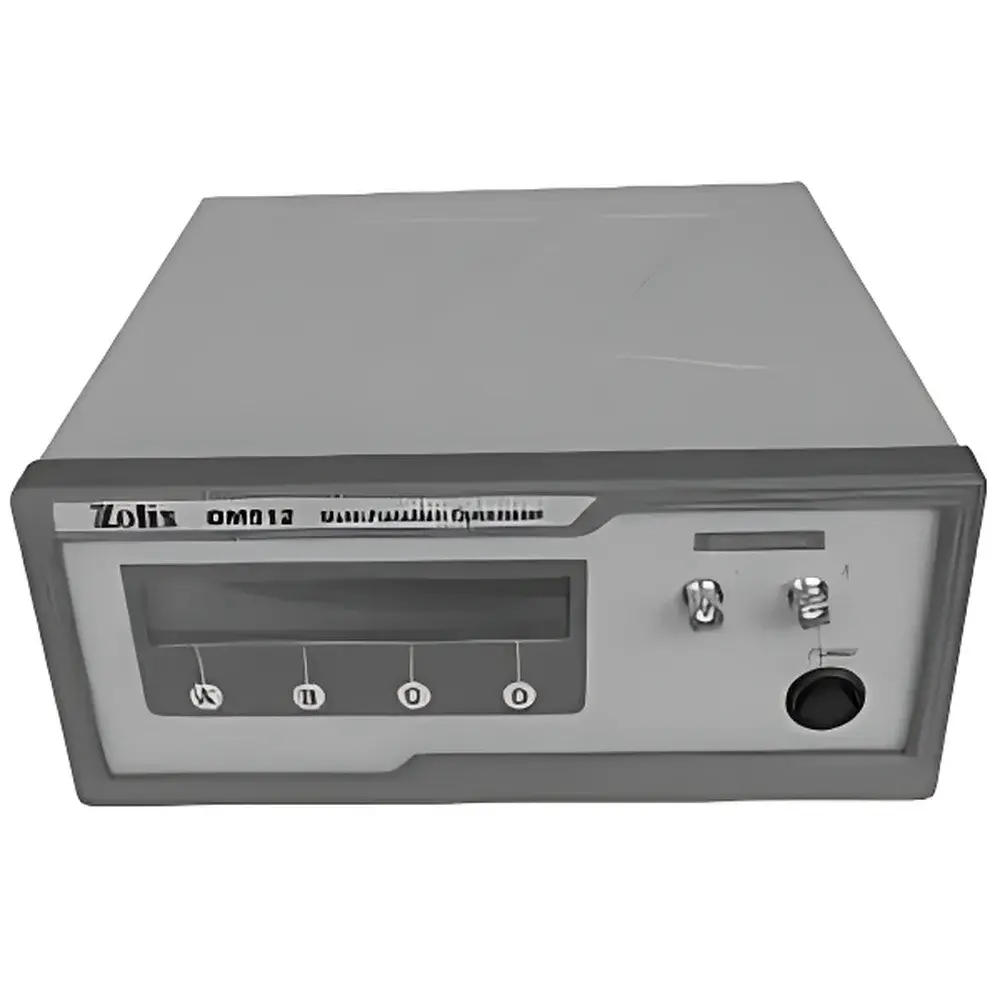
ZOLIX OM512 Intelligent Photometer
| Brand | ZOLIX |
|---|---|
| Origin | Beijing, China |
| Manufacturer Type | Original Equipment Manufacturer (OEM) |
| Product Category | Domestic |
| Model | OM512 |
| Pricing | Upon Request |
Overview
The ZOLIX OM512 Intelligent Photometer is a compact, multi-channel optical measurement instrument engineered for precision photometric, radiometric, and low-current quantification in R&D laboratories and industrial quality control environments. Based on high-stability transimpedance amplifier architecture and calibrated analog front-end design, the OM512 supports simultaneous dual-channel acquisition with independent signal conditioning paths—enabling concurrent measurement of illuminance (lx), luminance (cd/m²), radiant power (W), optical power (dBm), and microphotocurrent (down to 2 pA). Its core measurement principle relies on traceable photodetector responsivity mapping, where each connected sensor is characterized against NIM (National Institute of Metrology, China)–certified reference standards. The device operates as a modular metrology platform rather than a fixed-function meter, allowing flexible reconfiguration via firmware-upgradable calibration tables and programmable acquisition parameters.
Key Features
- Dual independent input channels (Channel I & II) supporting heterogeneous detector types—including photodiode-based illuminance probes, integrating sphere-coupled luminance sensors, thermopile-based laser power detectors, and fiber-coupled dBm modules
- 14½-bit A/D resolution with auto-ranging current measurement from 2 nA to 2 mA; sensitivity threshold of 2 pA in low-noise mode
- Onboard storage for up to 30 detector-specific calibration profiles, each compliant with JJG 245–2005 (Chinese National Verification Regulation for Illuminance Meters)
- Configurable averaging function (N = 1–99) optimized for low-SNR optical signals, such as LED pulse decay analysis or weak fluorescence detection
- Five user-defined parameter sets—including channel assignment, calibration ID, averaging count, linear/log scaling, and alarm thresholds—retained across power cycles
- Real-time ratio mode (Ratio / Log Ratio) for dynamic transmission/absorption monitoring in optical filter characterization or thin-film coating QC
- Hardware-triggered digital output (TTL-compatible) activated when readings exceed programmable upper/lower limits—designed for integration into automated test fixtures and inline production monitors
- RS-232 serial interface compliant with EIA/TIA-232-F standard, enabling remote command execution (SCPI-like syntax), calibration data upload/download, and multi-unit daisy-chain control
Sample Compatibility & Compliance
The OM512 interfaces with a broad range of NIST-traceable and GB/T-standard-compliant optical detectors, including silicon photodiodes (for visible/NIR irradiance), filtered thermopiles (for broadband laser power), and fiber-pigtailed InGaAs modules (for telecom-band dBm). All factory-installed calibrations adhere to Chinese national metrological regulations (JJG 245–2005, JJG 879–2015), and user-loaded calibrations may be documented with full traceability metadata (wavelength, aperture size, angular response, uncertainty budget). The instrument’s thermal drift specification (0.01%/°C) ensures stability across ambient operating conditions (0–45°C), meeting environmental requirements for ISO/IEC 17025-accredited testing labs. While not FDA 21 CFR Part 11–certified out-of-the-box, audit-ready data logging—including timestamped calibration history and parameter change logs—can be implemented via host-side software.
Software & Data Management
The OM512 provides a vendor-neutral communication protocol over RS-232, supporting ASCII-based command/response interaction (e.g., “MEAS?”, “CAL:LOAD? 3”, “ALARM:SET 100,200”). Third-party applications developed in Python, LabVIEW, or MATLAB can fully automate acquisition sequences, batch process calibration updates, and synchronize measurements across multiple units. ZOLIX supplies a Windows-based configuration utility for managing calibration archives, defining alarm logic, and exporting measurement logs in CSV format with ISO 8601 timestamps. Raw data streams include unit-annotated values (e.g., “4.237E-06 A”, “1.892E+02 lx”), eliminating post-processing ambiguity. Firmware updates are delivered via serial bootloader mode, preserving existing calibration integrity during version upgrades.
Applications
- LED and OLED manufacturing: Luminous intensity binning, forward-voltage–luminance correlation mapping, and aging-induced flux degradation tracking
- Backlight unit (BLU) and LCD module QC: Uniformity assessment of edge-lit panels using spatially resolved illuminance scans
- Fiber optic component testing: Insertion loss verification of WDM filters, isolators, and circulators via dual-channel ratio mode
- Laser diode qualification: Threshold current determination, slope efficiency calculation, and catastrophic optical damage (COD) onset detection
- Photobiological safety evaluation: Spectrally weighted irradiance (e.g., UV hazard, blue-light hazard) when paired with appropriate bandpass-filtered detectors
- Academic optics labs: Teaching instrumentation for photometry fundamentals, detector linearity validation, and noise floor characterization
FAQ
Does the OM512 support USB connectivity?
No—only RS-232 serial interface is provided. USB-to-serial adapters may be used, but driver compatibility must be verified per host OS.
Can calibration data be exported for external audit?
Yes—calibration IDs, wavelength points, responsivity values, and uncertainty estimates can be retrieved via “CAL:DATA?” command and saved in plain-text format.
Is temperature compensation applied automatically during measurement?
Yes—the internal temperature sensor feeds real-time correction coefficients to the gain stages, maintaining specified accuracy across the full 0–45°C operating range.
What is the maximum sampling rate in single-channel mode?
The analog bandwidth supports DC to ~1 kHz; effective sampling rate depends on selected averaging count and serial transmission overhead, typically 2–10 Hz for N ≥ 10.
Are OEM integration kits available for embedded system developers?
Yes—ZOLIX provides hardware schematics for TTL-level alarm outputs, pinout documentation for the RS-232 port, and a complete SCPI-style command reference manual under NDA.






