
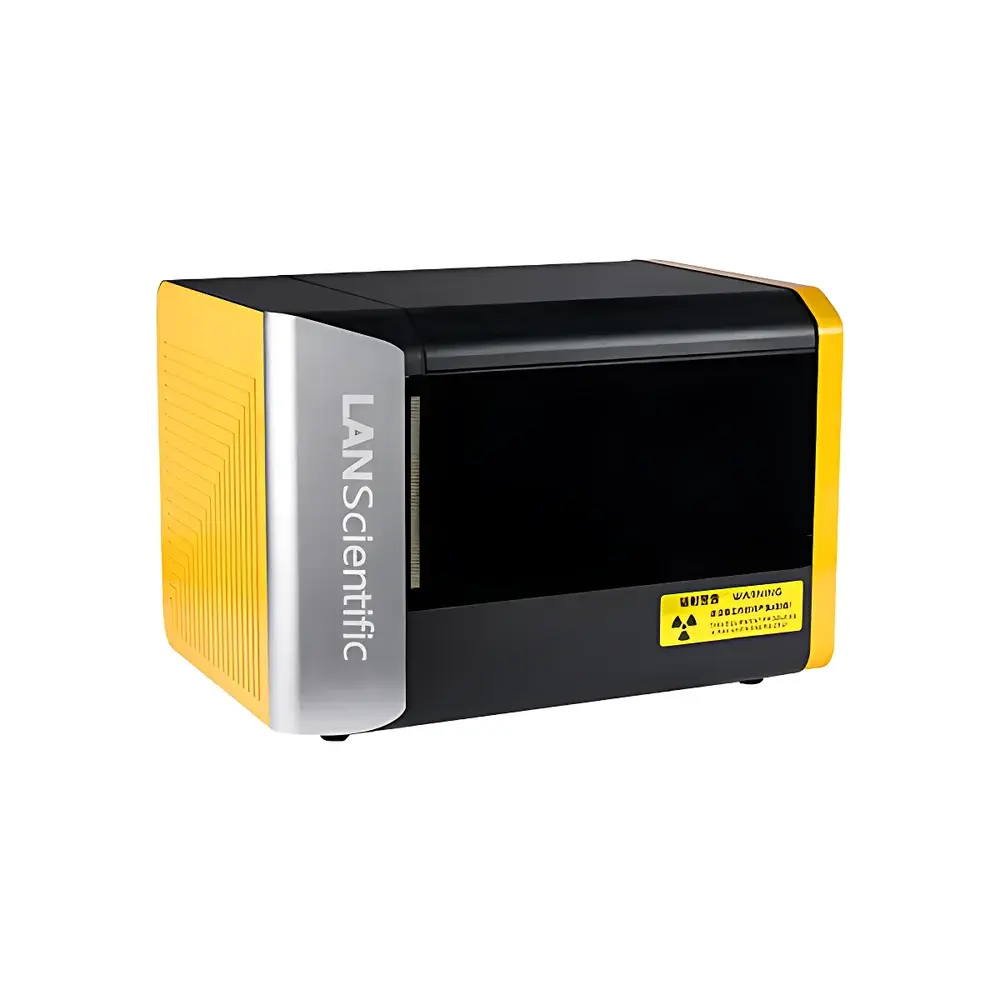
ScopeX Vacuum-Enabled Energy Dispersive X-Ray Fluorescence Spectrometer
| Brand | LANScientific |
|---|---|
| Origin | Jiangsu, China |
| Manufacturer Type | Direct Manufacturer |
| Product Type | Benchtop/Floor-Standing ED-XRF |
| Model | ScopeX 980CS / ScopeX 980CSR |
| Elemental Range | Na (11) to U (92) |
| Detection Limit | 1 ppm (typical, matrix-dependent) |
| Energy Resolution | <125 eV at Mn Kα (5.89 keV) |
| Repeatability | ≤0.1% RSD (for major elements under optimized conditions) |
| Detector | Peltier-cooled Silicon Drift Detector (SDD) |
| Sample Chamber | Dual-mode (air/vacuum) with motorized sample stage |
| Excitation Source | Rhodium-anode microfocus X-ray tube |
| Collimators | 5 mm, 3 mm, 1 mm, 0.5 mm (motorized auto-switching) |
| Filters | Multi-position filter wheel (Al, Cu, Ti, none) |
| Data Interface | USB 3.0, Wi-Fi 5 (802.11ac), Bluetooth 5.0 |
| Report Output | Customizable Excel/PDF templates with spectral overlays, logo embedding, and metadata fields |
| Safety Compliance | Fully shielded metal enclosure with interlocked vacuum door |
Overview
The ScopeX Vacuum-Enabled Energy Dispersive X-Ray Fluorescence Spectrometer is an industrial-grade benchtop/floor-standing ED-XRF system engineered for high-precision, non-destructive elemental analysis across solid, liquid, thin-film, and powdered samples. Based on the fundamental principle of energy-dispersive X-ray fluorescence—where a focused X-ray beam excites inner-shell electrons in atoms, triggering characteristic secondary X-ray emission—the instrument quantifies elemental composition by measuring the energy and intensity of emitted photons. Its integrated vacuum chamber eliminates air absorption of low-energy X-rays, enabling reliable detection and quantification of light elements from sodium (Na) through sulfur (S), including Mg, Al, Si, and P—elements typically attenuated under ambient conditions. The Rh-anode microfocus X-ray tube delivers stable, high-flux excitation, while the Peltier-cooled silicon drift detector (SDD) ensures high count-rate capability and sub-125 eV energy resolution at Mn Kα, supporting accurate peak deconvolution in complex multi-element matrices.
Key Features
- Vacuum-compatible sample chamber with automatic pressure control (≤10 Pa), optimized for light-element sensitivity without cryogenic cooling
- Motorized collimator turret offering four apertures (0.5 mm, 1 mm, 3 mm, 5 mm) and programmable filter wheel (Al, Cu, Ti, open) for analytical flexibility and matrix-adaptive excitation
- Peltier-based thermoelectric cooling of the SDD detector—eliminates liquid nitrogen dependency, reduces operational overhead, and ensures long-term spectral stability
- Non-destructive analysis with zero sample preparation for most homogeneous solids and liquids; no acid digestion or coating required
- Robust mechanical design compliant with ISO 14644-1 Class 8 cleanroom handling standards; fully interlocked safety architecture meeting GB18871-2002 and GBZ115-2002 radiation protection requirements
- Modular software architecture supporting ASTM E1621, ISO 21043, and IEC 62321-5 workflows for RoHS, ELV, and material declaration compliance
Sample Compatibility & Compliance
The ScopeX platform accommodates diverse physical forms—including irregularly shaped metals, pressed pellets, fused beads, thin electroplated layers ( 0.999), limit of detection (LOD) verification, and repeatability assessment per ISO 8258 Shewhart control chart methodology. Full audit trail functionality complies with GLP/GMP documentation requirements and supports 21 CFR Part 11 electronic signature readiness when deployed with optional secure user authentication modules.
Software & Data Management
ScopeX Control Suite v4.x provides intuitive method development, calibration curve management, and real-time spectral visualization. It supports multivariate fundamental parameter (FP) modeling with matrix correction libraries for geological, metallurgical, and polymer matrices. Quantitative results are exportable in CSV, Excel (.xlsx), and PDF formats—with embedded spectral plots, acquisition parameters, and customizable headers (company logo, QA stamp, analyst ID). Data synchronization occurs via encrypted Wi-Fi or USB 3.0 bulk transfer; Bluetooth enables remote status monitoring and alarm notification. All raw spectra and processed results are stored in a timestamped, immutable SQLite database with SHA-256 hash integrity verification. Optional LIMS integration is available via ASTM E1467-compliant HL7 and RESTful API interfaces.
Applications
- Mineral exploration & ore grade control: rapid assay of Fe, Cu, Zn, Pb, Ni, Co, and REEs in drill core and tailings
- Cement & building materials: quantification of CaO, SiO₂, Al₂O₃, Fe₂O₃, SO₃, and alkalis in clinker and blended cements
- Electroplating & surface engineering: thickness and composition analysis of Cr, Ni, Sn, Zn, and Au coatings on steel, Cu, and PCB substrates
- Petrochemical QA/QC: S-content screening in diesel, lubricants, and catalysts per ASTM D2622 and D7039
- Recycling & scrap sorting: identification and grading of alloy families (e.g., 304 vs. 316 stainless, Al 6061 vs. 7075)
- Consumer electronics: restricted substance screening (Pb, Cd, Hg, Cr⁶⁺, Br) in plastics and solder per IEC 62321-5
FAQ
Does the ScopeX require liquid nitrogen for detector cooling?
No. It uses a high-efficiency Peltier thermoelectric cooler, eliminating cryogen handling and enabling continuous 24/7 operation.
Can it analyze light elements such as sodium or magnesium in air mode?
Sodium and magnesium are reliably quantified only under vacuum or helium purge conditions; air mode is suitable for elements Z ≥ 17 (Cl) and above.
Is method transfer possible between different ScopeX units?
Yes—calibration models and spectral libraries are portable across all ScopeX 980CS/980CSR systems running identical firmware and software versions.
What regulatory standards does the instrument support for quality reporting?
It natively supports ASTM E1621 (RoHS), ISO 21043 (spectral evaluation), EN 14382 (cement), and IEC 62321-5 (electrotechnical products), with full traceability logs for internal audits.
How is radiation safety ensured during vacuum operation?
The system employs dual hardware interlocks: vacuum door sensors disable X-ray emission if opened, and real-time dosimetry monitors confirm leakage remains below 1 µSv/h at 5 cm distance per national regulatory limits.



