
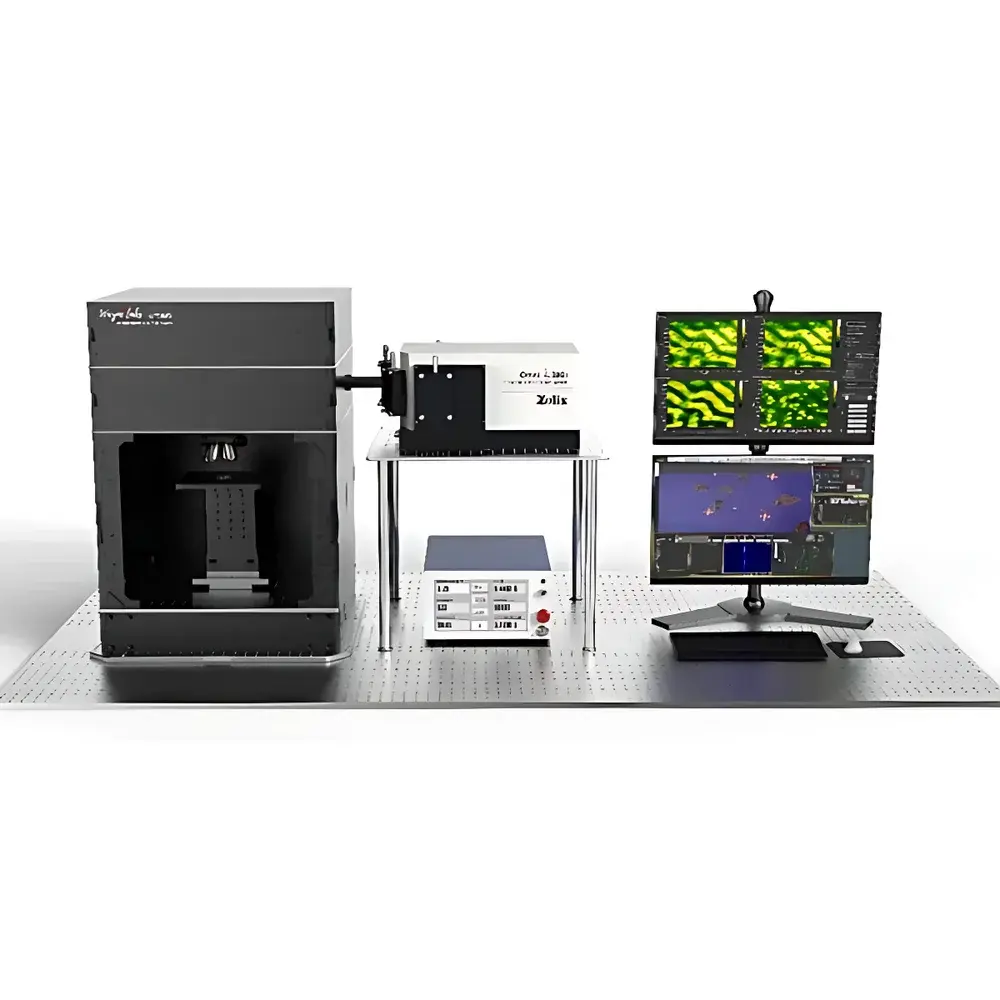
ZOLIX MAMOS Series Magneto-Optical Kerr Effect (MOKE) Microscopy System
| Brand | ZOLIX |
|---|---|
| Model | MAMOS Series |
| Origin | Beijing, China |
| Manufacturer | ZOLIX Optics Co., Ltd. |
| Type | Modular Magneto-Optical Kerr & Reflective Magnetic Circular Dichroism (RMCD) Measurement System |
| Core Capabilities | Micro-area MOKE imaging, RMCD spectroscopy, polarization-resolved mapping, time-resolved magnetization dynamics |
| Laser Source | 532 nm narrow-linewidth laser (Δλ < 0.00001 nm, M² < 1.2, power stability ±2% RMS over 4 h) |
| Spatial Resolution | ≤300 nm (at 532 nm) |
| Kerr Angle Resolution | ~0.5 mdeg (~8.7 µrad) |
| Polarization Control | Motorized polarizer/analyzer with 0.0144° angular resolution |
| Imaging Sensor | Sony 1-inch CMOS, 20 MP, 15 fps @ 5K, 50 fps @ 1.8K |
| Precision Stage | XYZ motorized stage (120 × 120 × 40 mm travel), XY step resolution 40 nm, Z step resolution 10 nm, load capacity >10 kg |
| Optical Architecture | All-reflective, non-magnetic objective or aspheric lens design |
| Software | Modular GUI supporting automated MOKE/RMCD/Raman/PL/SHG scanning, polarization sweeps, script-based sequencing (Python-compatible), GLP-compliant data logging with timestamped metadata and audit trail |
Overview
The ZOLIX MAMOS Series Magneto-Optical Kerr Effect (MOKE) Microscopy System is a research-grade, modular optical platform engineered for quantitative, spatially resolved characterization of surface magnetism in thin-film and two-dimensional magnetic materials. It operates on the physical principle of the magneto-optical Kerr effect—where the polarization state of linearly polarized light undergoes rotation and ellipticity changes upon reflection from a magnetized surface—and integrates reflective magnetic circular dichroism (RMCD) measurements within the same optical path. Unlike contact-based techniques such as SQUID or PPMS, this system enables non-invasive, sub-micron magnetization mapping without sample perturbation, making it indispensable for probing domain wall dynamics, spin reorientation transitions, and ultrafast demagnetization processes in nanoscale spintronic devices. Its architecture supports both static and time-resolved (pump-probe compatible) operation, with inherent compatibility for cryogenic integration (e.g., with closed-cycle refrigerators or variable-temperature stages) and high-field electromagnets.
Key Features
- Modular multi-technique capability: Simultaneous or sequential acquisition of MOKE, RMCD, micro-Raman (532 nm, <80 cm⁻¹ low-wavenumber cutoff), photoluminescence (PL), time-resolved PL (FLIM), and second-harmonic generation (SHG) — all under shared coordinate registration.
- Sub-300 nm spatial resolution achieved via diffraction-limited visible-light imaging and optimized non-magnetic reflective optics, eliminating chromatic aberration and minimizing Faraday rotation in optical components.
- High-sensitivity polarization metrology: Photoelastic modulator (PEM)-based detection synchronized with dual-phase lock-in amplification delivers Kerr angle resolution of ~0.5 mdeg (8.7 µrad) and enables concurrent extraction of both MOKE and RMCD signals within a single field sweep.
- Motorized precision motion control: Integrated XYZ stage with 40 nm XY and 10 nm Z step resolution, >10 kg payload capacity, and programmable mapping routines for automated region-of-interest (ROI) navigation and raster scanning.
- Polarization agility: Computer-controlled polarizer/analyzer pair with 0.0144° angular resolution, enabling full Stokes parameter reconstruction and quantitative analysis of magnetic anisotropy symmetry.
- Robust optical design: All-reflective or aspheric imaging path; polarization-maintaining optical train certified through extinction ratio testing; zero-magnetic-interference mechanical structure using non-ferromagnetic aluminum alloys and ceramic fasteners near magnetic sources.
Sample Compatibility & Compliance
The MAMOS system accommodates a broad range of solid-state magnetic specimens—including epitaxial thin films (Fe, Co, Ni, Heusler alloys), van der Waals magnets (CrI₃, Fe₃GeTe₂, MnBi₂Te₄), exchange-biased heterostructures, skyrmion-hosting multilayers, and spin-orbit torque devices—without requiring electrical contacts or vacuum processing. Sample mounting is compatible with standard SEM stubs, cryostat cold fingers, and commercial magnet systems (up to ±2 T with electromagnets; higher fields achievable with superconducting magnets). The system conforms to ISO/IEC 17025 guidelines for measurement traceability and supports GLP/GMP-aligned workflows through software-enforced electronic signatures, version-controlled protocol storage, and FDA 21 CFR Part 11–compliant audit trails for raw data files, instrument parameters, and user actions.
Software & Data Management
The proprietary ZOLIX MAMOS Control Suite provides a unified, scriptable interface built on a Python-based automation engine. It supports synchronized hardware control across all modules (laser power, PEM frequency, chopper phase, stage position, camera exposure, spectrometer grating position), enabling fully autonomous measurement sequences—from multi-parameter hysteresis loops to hyperspectral MOKE-Raman correlation maps. Data output adheres to HDF5 format with embedded metadata (wavelength, field, temperature, polarization angle, timestamp), ensuring FAIR (Findable, Accessible, Interoperable, Reusable) compliance. Real-time visualization includes live Kerr contrast imaging, vector field reconstruction, and dynamic domain tracking. Export options include TIFF, CSV, and MATLAB .mat formats; batch processing pipelines support FFT-based domain size analysis, Gaussian curvature mapping, and time-domain deconvolution for FLIM decay fitting.
Applications
- Domain imaging and topology analysis in ferromagnetic, antiferromagnetic, and ferrimagnetic thin films and 2D materials.
- Quantitative determination of perpendicular magnetic anisotropy (PMA), exchange bias, and Dzyaloshinskii-Moriya interaction (DMI) strength via angular-dependent MOKE loops.
- Correlative magnetooptical–vibrational spectroscopy: Mapping magnetic phase transitions alongside phonon softening (Raman) or excitonic shifts (PL) in heterostructures.
- Ultrafast spin dynamics: Integration-ready for pump-probe configurations using external femtosecond lasers to resolve sub-picosecond magnetization reversal.
- Device-level characterization: In situ MOKE imaging of current-induced domain wall motion in racetrack memory prototypes and spin-transfer torque oscillators.
- Materials discovery: High-throughput screening of magnetic order in combinatorial libraries or exfoliated flake arrays via automated grid scanning.
FAQ
What magnetic field strengths can the MAMOS system accommodate?
The base configuration supports integration with standard air-core or iron-yoke electromagnets (±2 T typical); custom adaptations for superconducting magnets (up to 9 T) or hybrid vector-field setups are available upon request.
Is cryogenic operation supported?
Yes—the optical layout and stage design are fully compatible with closed-cycle cryostats (e.g., Janis ST-500, BlueFrog) and liquid-helium flow cryostats; thermal drift compensation algorithms are embedded in the stage control firmware.
Can the system perform time-resolved measurements?
The platform provides TTL synchronization I/O ports and delay generator triggers for pump-probe experiments; MOKE signal bandwidth exceeds 100 kHz, enabling direct detection of GHz-range precessional dynamics.
How is data integrity ensured during long-duration mapping?
All acquisitions log hardware state vectors (laser power, PEM voltage, chopper phase, stage coordinates) at millisecond intervals; checksummed HDF5 containers prevent corruption, and optional RAID-backed storage ensures continuous write reliability.
Does the software support third-party instrument integration?
Yes—via TCP/IP, RS-232, and LabVIEW-compatible DLLs; APIs are provided for interfacing with external magnet controllers, temperature monitors, and RF sources.




