
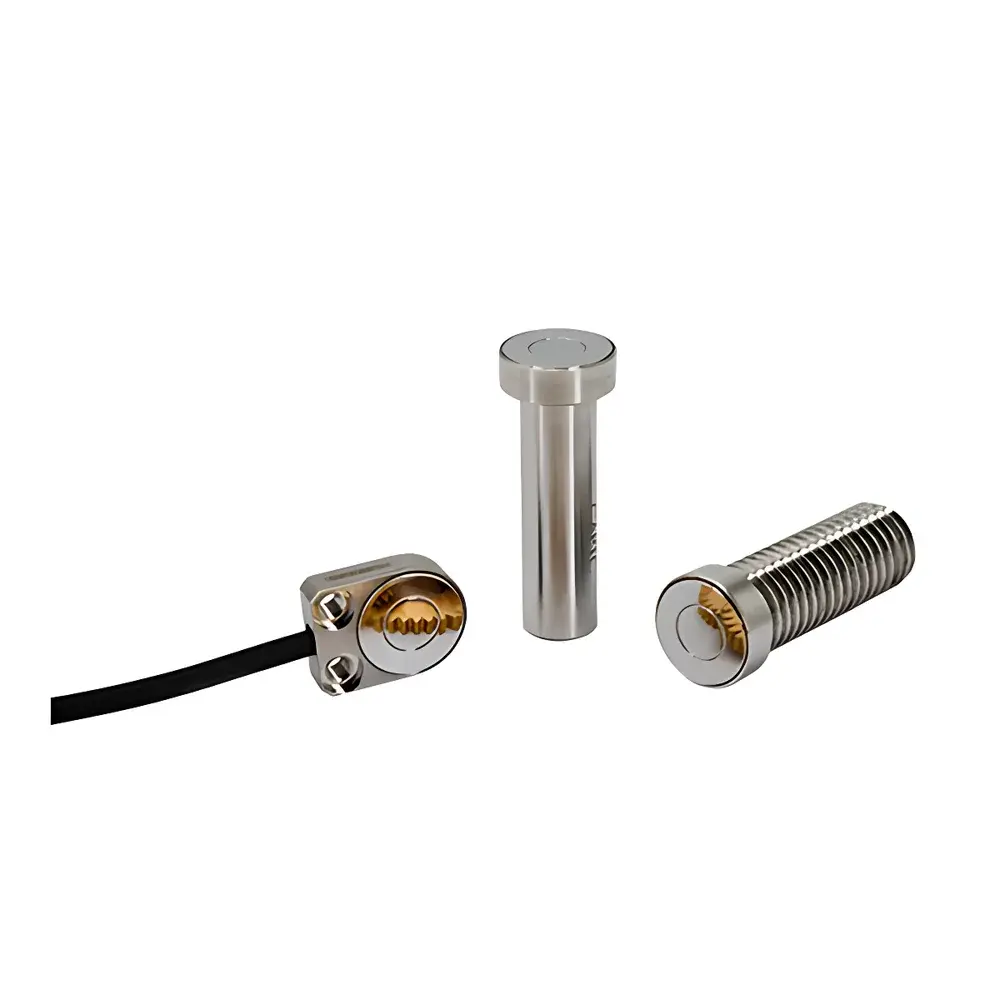
ZOLIX Faraday Series Capacitive Position Sensor System
| Brand | ZOLIX |
|---|---|
| Model | Faraday Series |
| Sensor Probe Types | Flat (FLT), Cylindrical (CYL), Stud (SCR) |
| Measurable Gap Range | 0.2–3 mm |
| Resolution | ≤0.32 nm RMS |
| Linearity Error | <0.01% FSO (laser interferometer calibrated) |
| Analog Bandwidth Options | 20 Hz / 1 kHz / 10 kHz |
| Digital Sampling Rate | 50 kSa/s per channel (up to 8 channels parallel) |
| Output Voltage Options | 0–10 V (default), ±5 V, ±10 V |
| Zero Offset | Adjustable as % of full scale |
| Temperature Drift | 20 ppm/°C |
| Communication Interfaces | Gigabit Ethernet, SPI (20 µs update interval) |
| Vacuum Compatibility | HV, UHV, and Non-Magnetic (NM) variants available |
| Enclosure Options | Faraday.03 (max 3 channels), Faraday.08 (max 8 channels) |
| OEM Customization | Supported for probes, signal conditioning, and board-level integration |
Overview
The ZOLIX Faraday Series Capacitive Position Sensor System is a high-precision, non-contact displacement measurement platform engineered for nanoscale metrology in demanding research and industrial environments. Based on the fundamental principle of capacitive sensing—where changes in capacitance between a conductive target and a precisely machined electrode are linearly correlated to gap distance—the system delivers sub-nanometer resolution and exceptional long-term stability. Unlike optical or inductive alternatives, capacitive sensing offers immunity to electromagnetic interference, insensitivity to surface reflectivity or color, and intrinsic compatibility with ultra-high vacuum (UHV) and non-magnetic (NM) applications—making it ideal for synchrotron beamline instrumentation, cryogenic positioning stages, scanning probe microscopy (SPM) feedback loops, and precision semiconductor alignment systems. The Faraday architecture separates sensing, signal conditioning, and data acquisition into modular units: interchangeable probe heads (FLT/CYL/SCR), scalable monitor chassis (Box03/Box08), and a deterministic software framework—enabling rigorous traceability, system-level calibration, and seamless integration into closed-loop motion control architectures compliant with ISO 230-2 and ASTM E2544 standards.
Key Features
- Sub-nanometer spatial resolution: Verified RMS noise ≤0.32 nm (C0.2-FLT + Faraday.03, 1 nm step motion)
- High linearity: <0.01% full-scale output (FSO) error across entire range, validated via laser interferometer traceable to NIST standards
- Configurable analog bandwidth: Selectable 20 Hz, 1 kHz, or 10 kHz low-pass filtering to match dynamic response requirements without compromising SNR
- Real-time digital acquisition: Sustained 50 kSa/s per channel across up to 8 parallel channels; synchronized sampling enabled via internal clock distribution
- Dual communication architecture: Gigabit Ethernet for bulk data streaming and configuration; SPI interface (20 µs update latency) for deterministic closed-loop control
- Vacuum- and magnetically compatible variants: HV, UHV, and NM probe assemblies constructed from OFHC copper, stainless steel 316L, and ceramic insulators
- Thermal stability: Monitor electronics exhibit ≤20 ppm/°C gain drift, ensuring positional fidelity over ambient temperature fluctuations common in lab and cleanroom settings
- OEM-ready modularity: Probe geometry, voltage output scaling (x0.3 to x3), zero offset (n% of range), and board-level form factors support custom integration into OEM motion platforms
Sample Compatibility & Compliance
The Faraday Series is designed exclusively for conductive targets—including aluminum, silicon wafers, gold-coated mirrors, and stainless-steel optics—requiring no surface treatment or coating. It complies with IEC 61000-6-2 (immunity) and IEC 61000-6-4 (emission) for laboratory electromagnetic environments. All UHV-rated variants meet ISO 10109:2013 for outgassing performance (<1×10⁻⁹ mbar·L/s·cm²). Calibration certificates include uncertainty budgets traceable to national metrology institutes. The system supports GLP/GMP workflows through audit-trail-enabled software logging (per FDA 21 CFR Part 11 requirements when deployed with validated host software), and its deterministic timing behavior satisfies real-time constraints defined in IEC 61131-3 for motion control PLC integration.
Software & Data Management
The native Faraday Control Suite provides a deterministic, low-latency environment for configuration, visualization, and analysis. It features time-synchronized multi-channel oscilloscope views, real-time FFT-based spectral analysis (up to 25 kHz digital bandwidth), and export-ready HDF5 and CSV formats. Raw sensor data is timestamped using IEEE 1588 PTP synchronization when connected via Gigabit Ethernet. For embedded integration, the SPI register map enables direct register access for PID loop execution on external microcontrollers (e.g., Xilinx Zynq, TI C2000). Firmware updates are signed and version-controlled; configuration files store calibration coefficients, probe geometry parameters, and thermal compensation tables—ensuring reproducibility across instrument deployments. Batch calibration reports include linearity residuals, hysteresis maps, and temperature coefficient matrices.
Applications
- Nanoscale motion control: Real-time position feedback for piezoelectric nanopositioners, achieving <1 µm step settling in 5.3 ms with zero overshoot (200 mm/s velocity profile)
- Vibration modal analysis: High-bandwidth capture of structural resonances in optical mounts, mirror stages, and MEMS devices; spectral leakage minimized via configurable windowing and overlap processing
- Non-contact thickness metrology: Dual-sensor differential configuration for conductor thickness measurement—eliminating mechanical contact wear and enabling in-line wafer inspection
- Beamline diagnostics: UHV-compatible positioning of monochromator crystals, slits, and photon detectors in synchrotron and XFEL facilities
- Cryogenic stage monitoring: NM variant operation at 4 K with minimal thermal EMF generation, supporting dilution refrigerator-based quantum device characterization
- Interferometer auxiliary sensing: Supplemental gap monitoring where laser interferometers face coherence length limitations or environmental vibration sensitivity
FAQ
What target materials are compatible with Faraday sensors?
Conductive materials only—e.g., metals, doped semiconductors, and conductive coatings. Insulators or composites require metallization for reliable measurement.
Can multiple Faraday monitors be synchronized across a distributed system?
Yes—via shared 10 MHz reference clock input and Ethernet PTPv2, enabling sub-microsecond inter-chassis timing alignment for multi-axis metrology networks.
Is factory recalibration required annually?
No scheduled recalibration is mandated; however, users performing ISO/IEC 17025-compliant measurements should verify linearity and resolution annually using traceable step gauges or interferometric references.
How is thermal drift compensated in long-duration experiments?
Monitor electronics incorporate dual-sensor thermal monitoring and gain-correction algorithms; probe-specific temperature coefficients are stored in firmware and applied during real-time signal reconstruction.
Does the system support third-party DAQ integration beyond SPI and Ethernet?
Yes—through optional PCIe carrier boards and LabVIEW FPGA IP cores, enabling direct integration with National Instruments PXIe platforms and real-time OS environments (e.g., VxWorks, QNX).




