
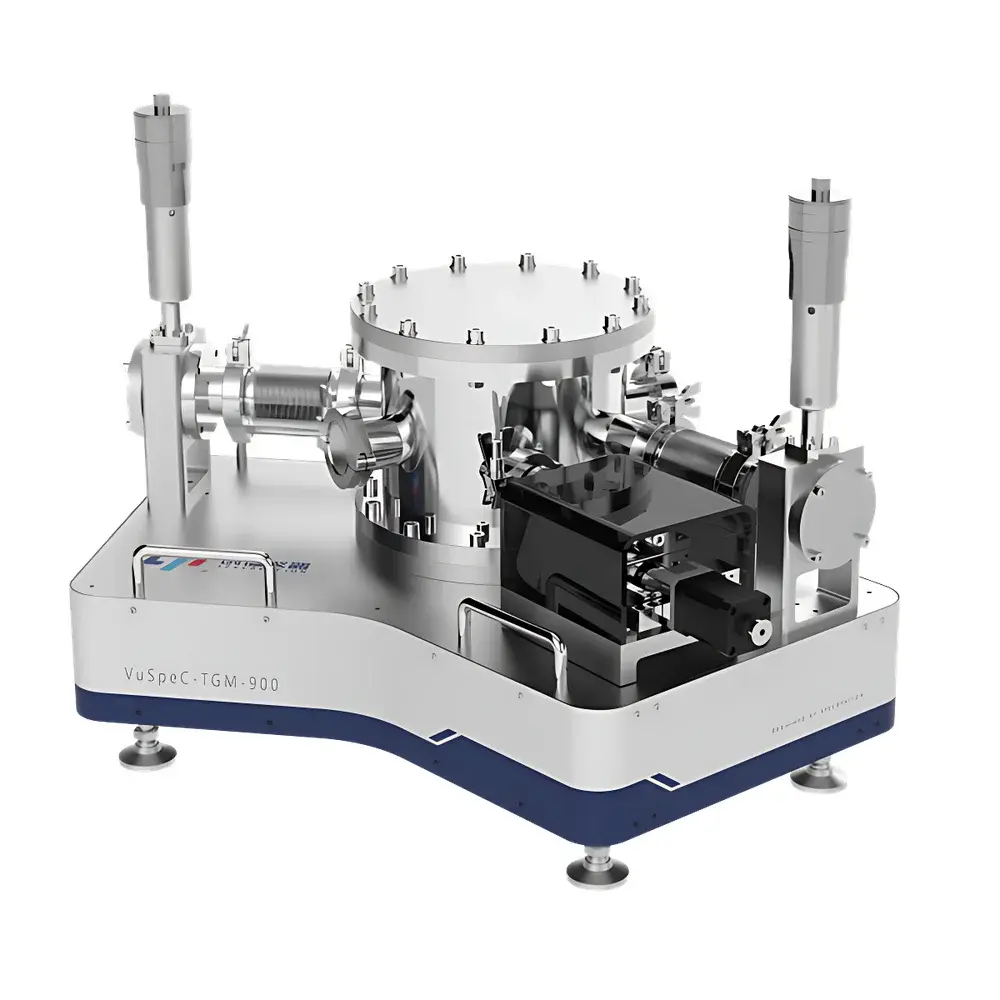
Ultra-Hyperbolic Grating Monochromator CP-SR by SPECREATION
| Brand | SPECREATION |
|---|---|
| Origin | Anhui, China |
| Manufacturer Type | Authorized Distributor |
| Model | CP-SR |
| Spectral Resolution | 0.1 nm @ 37.93 nm (tunable via grating selection) |
| Wavelength Range | 10–300 nm |
Overview
The Ultra-Hyperbolic Grating Monochromator CP-SR is a vacuum- or inert-gas-compatible scanning monochromator engineered for high-fidelity spectral isolation in the extreme ultraviolet (EUV) and far-ultraviolet (FUV) regions. Unlike conventional toroidal or spherical grating monochromators, the CP-SR employs an aberration-corrected ultra-hyperbolic diffraction grating as its core dispersive element. This optical design minimizes coma, astigmatism, and spherical aberration across the entire 10–300 nm range—enabling simultaneous optimization of spectral resolution, throughput, and imaging fidelity without mechanical reconfiguration. The instrument operates on the principle of wavelength-selective diffraction governed by the grating equation mλ = d(sin α + sin β), where groove density, incidence angle (α), and exit angle (β) are precisely controlled via motorized rotation stages calibrated to sub-arcsecond repeatability. Designed for integration into synchrotron beamlines, laser-produced plasma sources, and laboratory-scale EUV metrology setups, the CP-SR delivers stable, reproducible bandpass selection under high-vacuum conditions (<1×10⁻⁵ mbar typical).
Key Features
- Aberration-corrected ultra-hyperbolic grating geometry enabling diffraction-limited performance from 10 nm to 300 nm
- Motorized grating turret supporting up to three interchangeable gratings (e.g., 1200 g/mm for high resolution, 600 g/mm for enhanced throughput)
- Spectral resolution of ≤0.1 nm at 37.93 nm—verified using He I (38.89 nm) and Ne I (39.45 nm) emission lines under standard alignment
- Entrance and exit slits with micrometer-adjustable width (10–500 µm), each equipped with precision stepper-motor actuation and encoder feedback
- Integrated vacuum flange interface (CF-63 or CF-100 configurable) compliant with UHV standards (ISO-KF and ISO-F interchangeable)
- Thermally stabilized optical bench with low-expansion Invar frame to suppress drift-induced wavelength shift (<0.005 nm/h at 25°C ambient)
Sample Compatibility & Compliance
The CP-SR is not a sample-contacting instrument; it functions exclusively as a wavelength-selection and spectral purification module within larger optical systems. It is compatible with collimated or focused beam inputs from synchrotron undulators, high-harmonic generation (HHG) sources, discharge lamps (e.g., deuterium, hollow-cathode), and laser-driven plasma emitters. All internal optics are coated with boron carbide (B₄C) or iridium for optimal reflectivity below 50 nm, and optional MgF₂ or LiF coatings extend usability to the near-VUV (115–200 nm). The monochromator complies with ISO 14644-1 Class 5 cleanroom handling protocols during assembly and conforms to CE electromagnetic compatibility directives (2014/30/EU). Vacuum integrity meets ASTM E595 outgassing requirements for space-qualified optical instrumentation.
Software & Data Management
Control is executed via the vendor-agnostic CP-MonControl SDK, supporting LabVIEW, Python (PyVISA), and MATLAB interfaces. The software provides closed-loop wavelength calibration using reference emission lines (e.g., He, Ne, Ar), automatic slit-width compensation for constant bandpass, and real-time intensity normalization against photodiode monitor signals. Audit trails—including grating position, slit settings, calibration timestamps, and user credentials—are logged in SQLite format with SHA-256 hashing for data integrity. While not inherently 21 CFR Part 11 compliant, the system supports third-party validation packages for GLP/GMP environments when deployed with timestamped, role-based access control servers.
Applications
- EUV lithography mask inspection and reflectometry
- Atomic and molecular absorption spectroscopy in planetary atmospheric simulation chambers
- Calibration of space-borne solar spectrometers (e.g., SDO/EVE, Solar Orbiter/SPICE)
- Time-resolved photoelectron spectroscopy (TR-PES) pump-probe experiments
- Plasma diagnostics in fusion research (e.g., ITER diagnostic port plug integration)
- Material bandgap mapping of wide-bandgap semiconductors (AlN, Ga₂O₃, BN)
FAQ
Is the CP-SR suitable for operation under ambient atmosphere?
No. The optical path must be maintained under vacuum or purged with high-purity argon/nitrogen to prevent oxygen absorption below 190 nm and hydrocarbon contamination.
Can the monochromator be retrofitted with a different grating after purchase?
Yes. The motorized grating turret accepts custom gratings with standard 50×50 mm substrates and kinematic mounting interfaces per ISO 10110-7 specifications.
What is the typical wavelength reproducibility over 8 hours of continuous scanning?
±0.008 nm RMS under temperature-stabilized lab conditions (22 ± 0.5°C), verified using repeated scans of the Ne I 39.45 nm line.
Does the system include a detector or require external signal acquisition?
The CP-SR is a passive monochromator only. Detectors (e.g., channeltrons, MCPs, silicon photodiodes) and associated HV supplies must be selected and integrated separately.
Is technical support available for beamline integration at synchrotron facilities?
Yes. SPECREATION provides remote alignment assistance and on-site commissioning services for major international light sources upon request and contractual agreement.





