
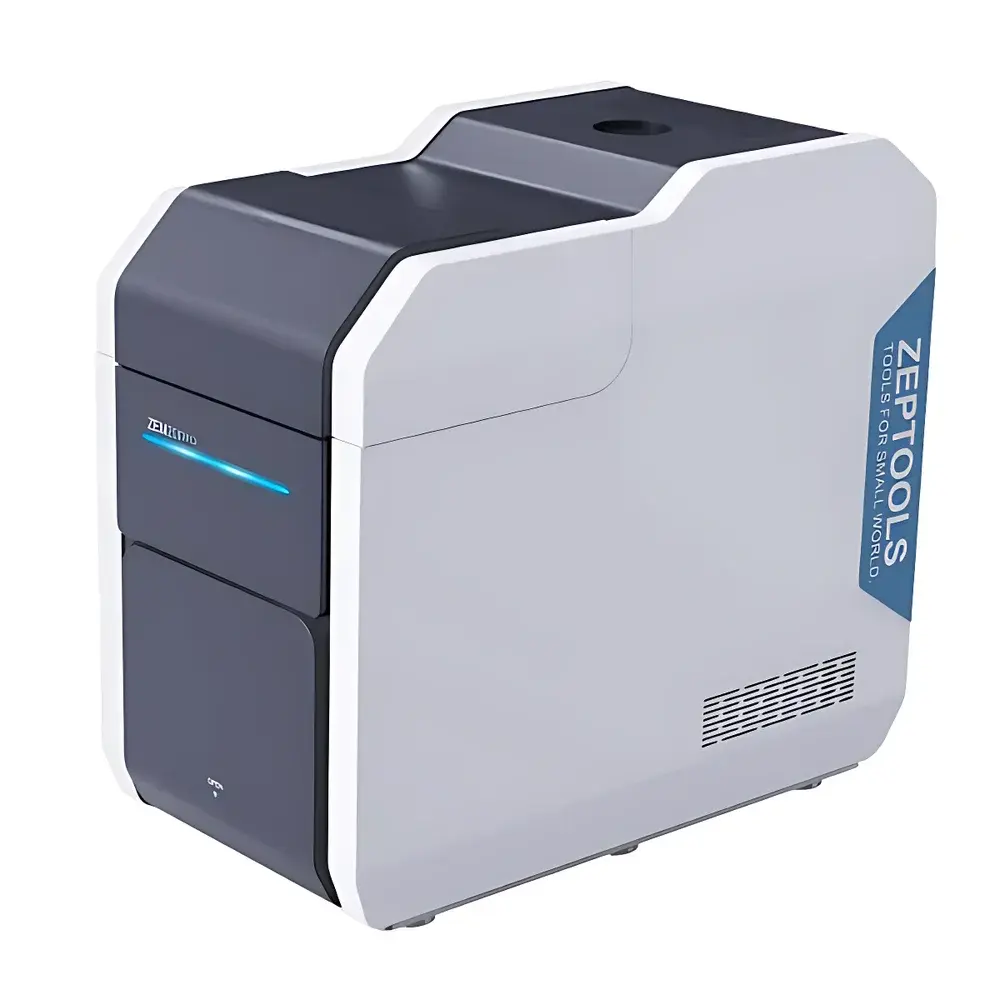
ZEPTOOLS ZEM Pro Single-Crystal Filament Desktop Scanning Electron Microscope
| Brand | ZEPTOOLS |
|---|---|
| Origin | Anhui, China |
| Manufacturer Type | Direct Manufacturer |
| Instrument Type | Desktop SEM |
| Electron Gun | Single-Crystal LaB₆ Filament |
| SEM Class | Entry-Level Tungsten- or LaB₆-Based SEM (Non-FEG) |
| Secondary Electron Resolution | 3 nm @ 20 kV |
| Maximum Magnification | 360,000× |
| Accelerating Voltage Range | 3–20 kV |
| Backscattered Electron Resolution | 3 nm @ 20 kV |
| Sample Chamber Dimensions (max) | 165 × 122 × 51.5 mm (W × D × H) |
| Stage Movement (standard) | X = 60 mm, Y = 55 mm (2-axis) |
| Optional Deceleration Mode | 0–10 kV landing energy via sample bias |
| Imaging Modes | Video mode (512 × 512), Fast Scan (512 × 512), Slow Scan (2048 × 2048) |
| Image Formats | BMP, TIFF, JPEG, PNG |
| Navigation | Integrated optical camera + chamber-viewing CCD |
| Automation | Auto Contrast/Brightness, Auto Focus, Large-Area Image Stitching |
| Dimensions (main unit) | 650 × 370 × 642 mm (W × D × H) |
| In-situ Compatibility | TEC cooling stage, heating stage, tensile stage (ZEPTOOLS proprietary) |
Overview
The ZEPTOOLS ZEM Pro is a compact, high-performance desktop scanning electron microscope engineered for laboratories requiring nanoscale surface characterization without the infrastructure demands of floor-standing systems. Unlike field-emission SEMs, the ZEM Pro employs a thermionic single-crystal lanthanum hexaboride (LaB₆) electron source—delivering superior brightness and stability compared to conventional tungsten filaments, while maintaining lower operational complexity and cost of ownership. Operating at accelerating voltages from 3 kV to 20 kV, it achieves a verified secondary electron (SE) resolution of 3 nm at 20 kV—a performance benchmark validated under ISO 16700:2016 test conditions using certified gold-on-carbon resolution standards. The instrument utilizes a robust electromagnetic lens column with optimized stigmator and beam alignment algorithms, enabling stable imaging across magnifications up to 360,000×. Its modular vacuum architecture features a turbomolecular pump backed by a dry scroll pump, achieving base pressures below 2 × 10⁻⁴ Pa—sufficient for routine SE and backscattered electron (BSE) imaging, as well as optional EDS microanalysis.
Key Features
- Single-crystal LaB₆ electron gun offering 5–10× higher brightness than standard tungsten filaments, with extended operational lifetime (>1,500 hours under typical use)
- Dual-detector configuration: Everhart-Thornley-type secondary electron detector (SED) and segmented solid-state backscattered electron detector (BSED) for simultaneous topographic and compositional contrast acquisition
- Integrated optical navigation system with 10×–40× zoom optical camera and real-time chamber-viewing CCD, enabling precise region-of-interest targeting prior to electron imaging
- Full automation suite: Auto-focus, auto-contrast/brightness, and multi-frame image stitching (up to 100 tiles) with sub-pixel registration accuracy
- Modular sample chamber (165 × 122 × 51.5 mm) designed for mechanical compatibility with ZEPTOOLS in-situ stages—including Peltier-cooled cryo-stages (–180 °C to +400 °C), resistive heating stages (up to 1,200 °C), and electro-mechanical tensile platforms (±5 mm displacement, 50 N load capacity)
- Three scan modes optimized for workflow efficiency: video-rate preview (512 × 512, <1 s/frame), fast acquisition (512 × 512, signal-averaged), and high-fidelity slow-scan (2048 × 2048, full dynamic range digitization)
Sample Compatibility & Compliance
The ZEM Pro accommodates samples up to 165 mm wide, 122 mm deep, and 51.5 mm tall—supporting standard 3” and 4” wafers, bulk metallurgical mounts, geological thin sections, and biological specimens on stubs. Conductive coating (Au/Pd sputtering) is recommended for non-conductive samples; low-voltage imaging (3–5 kV) minimizes charging artifacts in uncoated polymers and ceramics. All hardware and software comply with IEC 61000-6-3 (EMC emissions) and IEC 61000-6-2 (immunity). Data acquisition workflows meet GLP documentation requirements, with timestamped metadata embedding (operator ID, HV, WD, dwell time, detector gain) in every exported TIFF file. Optional EDS integration supports qualitative and semi-quantitative elemental analysis per ASTM E1508 and ISO 22309 standards.
Software & Data Management
Control and analysis are performed via ZEM-Studio v3.x—a Windows-based application developed in accordance with FDA 21 CFR Part 11 principles. It includes audit-trail logging (user actions, parameter changes, image exports), electronic signature support, and role-based access control (admin, operator, viewer). Raw image data is stored in lossless 16-bit TIFF format with embedded calibration metadata (pixel size, working distance, kV). Batch processing tools enable automated measurement of particle size distribution (PSD), line profiles, and grain boundary mapping using ISO 13322-1 compliant algorithms. Export options include CSV reports compatible with LIMS integration and standardized MIB (Microscopy Image Benchmark) metadata tags for FAIR data compliance.
Applications
The ZEM Pro serves academic, industrial, and quality control laboratories conducting routine morphological and microstructural analysis. Typical use cases include failure analysis of solder joints and PCB traces, particle morphology assessment in pharmaceutical excipients (per USP ), fracture surface evaluation in aerospace alloys, porosity quantification in battery electrode coatings, and cross-sectional imaging of multilayer thin films. Its low-kV capability enables charge-free imaging of insulating materials such as polymers, glasses, and geological specimens—making it suitable for geoscience core logging, forensic fiber analysis, and additive manufacturing powder characterization. In-situ thermal and mechanical testing extends its utility to dynamic studies of phase transformation, creep deformation, and thermal expansion coefficient validation.
FAQ
What vacuum level does the ZEM Pro achieve, and how is it maintained?
The system reaches a base pressure of ≤2 × 10⁻⁴ Pa using a 160 L/s turbomolecular pump and dry scroll backing pump. Vacuum integrity is continuously monitored via a cold cathode gauge, with automatic pump-down sequencing and interlocks preventing electron beam activation unless pressure criteria are met.
Is EDS detection available as a factory-installed option?
Yes—ZEPTOOLS offers an integrated silicon drift detector (SDD) with ≥10 eV Mn-Kα resolution and 10 mm² active area, mounted at 35° take-off angle. Software includes spectrum deconvolution, elemental mapping, and standardless quantification per ISO 16553.
Can the ZEM Pro be operated in a standard laboratory environment without external vibration isolation?
The instrument incorporates passive multi-stage damping feet and a rigid granite baseplate. It meets ISO 20486:2018 vibration sensitivity thresholds for desktop SEMs and operates reliably on standard optical tables without active isolation.
What training and service support is provided with purchase?
ZEPTOOLS delivers on-site installation, 2-day operator training, and remote diagnostics support. A 24-month comprehensive warranty covers parts, labor, and filament replacement. Extended service contracts include annual calibration verification against NIST-traceable standards.





