
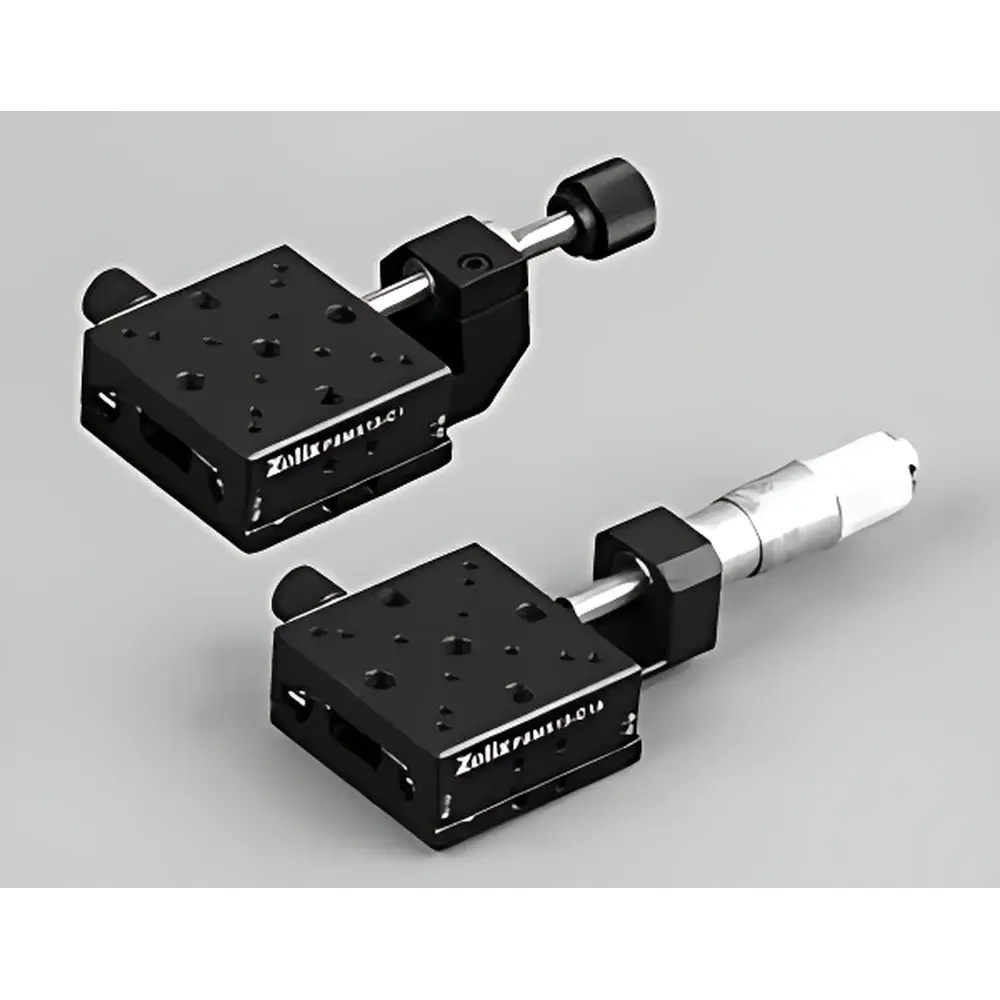
ZOLIX PSMX13 Series Precision Manual Translation Stage
| Brand | ZOLIX |
|---|---|
| Model | PSMX13 Series |
| Origin | Beijing, China |
| Manufacturer | ZOLIX (Original Equipment Manufacturer) |
| Drive Mechanism | M7×0.25 Threaded Spindle or Micrometer Head |
| Travel Range | ±6.5 mm |
| Minimum Graduation | 0.01 mm (micrometer models only) |
| Sensitivity | 0.001 mm |
| Platform Dimensions | 34 mm × 34 mm |
| Load Capacity | 5.0 kg (L1/1/C1/C2 variants), 1.5 kg (L1A/1A/C1A/C2A variants) |
| Guide System | Precision Ground Steel Rods with Linear Ball Bearings |
| Return Mechanism | Dual Preloaded Tension Springs |
| Mounting Configuration Options | Left-Hand (L1/L1A), Right-Hand (1/1A), Center-Driven (C1/C1A), Vertical-Mount (C2/C2A) |
Overview
The ZOLIX PSMX13 Series Precision Manual Translation Stage is a high-stability, low-backlash optical positioning platform engineered for demanding alignment and fine-adjustment tasks in laser optics, interferometry, microscopy, and photonics research laboratories. Built upon a robust mechanical architecture, the stage employs precision-ground stainless steel guide rods paired with low-friction linear ball bearings to ensure smooth, repeatable motion across its full ±6.5 mm travel range. Motion transmission is achieved either via a calibrated M7×0.25 threaded spindle (for coarse/fine dual-stage control) or a high-resolution micrometer head (with 0.01 mm graduation and 0.001 mm sensitivity), depending on configuration. Dual preloaded tension springs eliminate backlash by maintaining constant axial preload on the drive train—critical for applications requiring deterministic repositioning without hysteresis. The stage’s lightweight yet rigid aluminum alloy body (CNC-machined to ±5 µm flatness on mounting surfaces) supports high payload-to-mass ratio performance, enabling stable integration into multi-axis kinematic stacks without compromising dynamic rigidity.
Key Features
- Precision ground steel rod guide system with recirculating linear ball bearings for sub-micron straightness and minimal wobble (< 5 µrad angular deviation over full stroke)
- Backlash-free operation enabled by dual tension springs applying consistent axial preload on the drive nut assembly
- Interchangeable drive options: M7×0.25 fine-pitch threaded spindle (L1/1/C1/C2) or calibrated micrometer head (L1A/1A/C1A/C2A) with vernier scale reading to 0.01 mm
- Four standardized mounting configurations—left-hand (L1/L1A), right-hand (1/1A), center-driven (C1/C1A), and vertical-mount (C2/C2A)—facilitating flexible integration into custom optical benches and multi-axis assemblies
- Optimized platform geometry: 34 mm × 34 mm top surface with 4 × M3 tapped holes (pitch = 12.7 mm) and countersunk mounting holes for direct compatibility with standard optomechanical components
- Load capacity up to 5.0 kg for base configurations; 1.5 kg for micrometer-equipped variants due to torque limitations of fine-thread actuation
Sample Compatibility & Compliance
The PSMX13 series is designed for use with standard optical components including mirrors, beam splitters, fiber couplers, and detector mounts. Its non-magnetic, anodized aluminum construction ensures compatibility with ultra-high vacuum (UHV)-adjacent environments and minimizes thermal drift (coefficient of linear expansion: 23.1 × 10⁻⁶ /°C). While not certified for ISO 14644 Class 5 cleanroom operation, the stage meets mechanical requirements for GLP-compliant optical alignment workflows when used within controlled laboratory conditions. All machined surfaces conform to ISO 2768-mK general tolerances; critical datum faces are inspected per ASME Y14.5-2018 geometric dimensioning standards. No electrical or pneumatic interfaces are present, eliminating EMI concerns in sensitive measurement setups.
Software & Data Management
As a purely manual, non-motorized translation stage, the PSMX13 series requires no firmware, drivers, or software integration. Position data is recorded manually using the integrated scale or external digital calipers. For traceable metrology workflows, users may document positional settings alongside timestamps in laboratory notebooks compliant with 21 CFR Part 11 requirements when paired with electronic signature-capable documentation systems. The absence of embedded electronics simplifies audit readiness and eliminates validation overhead associated with automated motion controllers.
Applications
- Laser cavity alignment and mode-matching optimization in Ti:sapphire and diode-pumped solid-state laser systems
- Fiber-to-fiber or fiber-to-waveguide coupling alignment in photonic integrated circuit (PIC) testing
- Interferometric path-length balancing in Michelson, Mach–Zehnder, and Sagnac configurations
- Sample positioning in confocal Raman and fluorescence microscopy stages where motor-induced vibration must be avoided
- Calibration reference stage for verifying resolution and linearity of motorized translation systems
- Education and training platforms in undergraduate optics laboratories emphasizing tactile feedback and mechanical intuition
FAQ
What is the difference between L1 and L1A configurations?
The “L1” variant uses an M7×0.25 threaded spindle with knurled knob; “L1A” replaces this with a calibrated micrometer head offering 0.01 mm graduation and enhanced sensitivity for fine-tuning.
Can multiple PSMX13 stages be stacked for XYZ motion?
Yes—the standardized 34 mm × 34 mm footprint and symmetric hole pattern enable direct stacking using optional mounting brackets or custom adapter plates. Angular coupling error remains below 8 µrad per stage when stacked orthogonally.
Is the stage compatible with vacuum environments?
The base aluminum body and stainless steel hardware are UHV-compatible; however, the elastomeric spring material (phosphor bronze) is rated for ≤10⁻⁶ mbar. For higher vacuum, users should specify optional vacuum-rated spring replacements.
How is repeatability quantified for this stage?
Under controlled temperature (23 ± 0.5 °C) and load (≤2 kg), 100-cycle bidirectional repeatability is ≤±0.002 mm (2σ) for micrometer variants and ≤±0.003 mm for threaded variants, measured via capacitive displacement sensor traceable to NIST standards.
Does ZOLIX provide calibration certificates?
Factory calibration reports (including travel linearity, sensitivity verification, and load-dependent hysteresis data) are available upon request at time of order; third-party ISO/IEC 17025 accredited calibration is supported through authorized metrology partners.





