
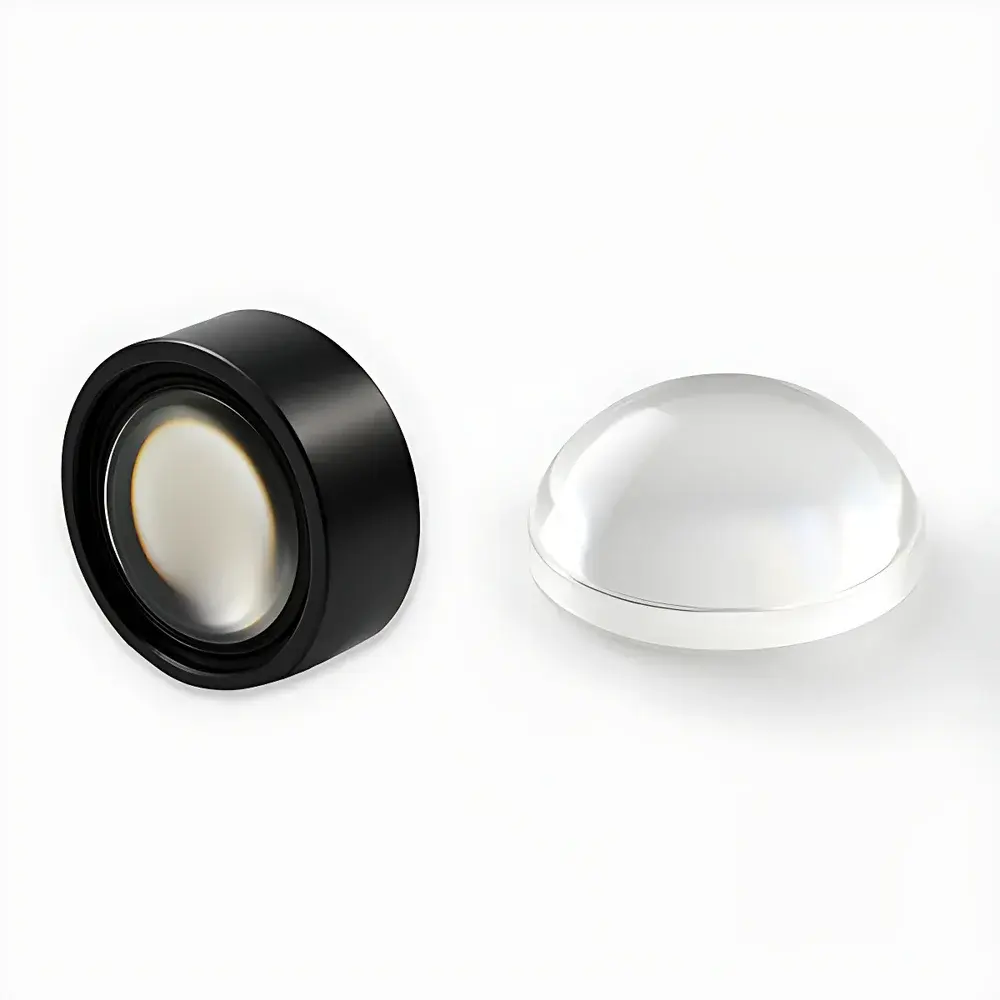
ZOLIX Molded Aspheric Lenses
| Brand | ZOLIX |
|---|---|
| Origin | Beijing, China |
| Manufacturer Type | Manufacturer |
| Product Category | Optical Component |
| Model | Molded Aspheric Lens |
| Price Range | USD 47–128 (per unit, FOB) |
| Material Options | D-ZK3, D-ZLAF52LA, D-LAK6 |
| Coating Options | Uncoated, AR (350–700 nm), AR (600–1050 nm), AR (1000–1700 nm) |
| Mounting Options | Bare optic (unmounted), Standard kinematic mount (AMD/BMD series), Custom flange-compatible housing |
| Surface Quality | 40/20 scratch-dig |
| Wavefront Error | ≤ diffraction-limited (RMS) |
| Diameter Range | 2.0–12.2 mm |
| Focal Length Range | 1.5–18.4 mm |
| NA Range | 0.2–0.7 |
| Operating Wavelength Range | 350–2400 nm |
Overview
ZOLIX Molded Aspheric Lenses are high-precision optical components engineered for demanding laser beam shaping applications—including collimation of point-source emitters and tight focusing of divergent beams. Unlike conventional spherical lenses, these aspheres eliminate spherical aberration through a non-spherical surface profile defined by a polynomial equation (e.g., z = cr² / [1 + √(1 − (1 + k)c²r²)] + ΣAir2i), enabling diffraction-limited performance in compact, single-element configurations. Manufactured via precision glass molding using high-refractive-index optical glasses—D-ZK3 (nd ≈ 1.62), D-ZLAF52LA (nd ≈ 1.80), and D-LAK6 (nd ≈ 1.63)—each lens achieves enhanced numerical aperture (NA), reduced f-number (f/#), and improved power throughput without requiring multi-element correction. The molded process ensures exceptional batch-to-batch consistency, low wavefront error (≤ diffraction-limited RMS), and scalability for integration into OEM instrumentation, fiber-coupled modules, and automated optical assemblies.
Key Features
- Precision Glass Molding Process: Enables sub-micron surface form accuracy (< ±0.1 µm PV) and high repeatability across production lots—critical for volume deployment in laser diode collimators and sensing systems.
- Material-Specific Design Optimization: Each lens variant is optimized for its base glass’s dispersion and thermal expansion properties; e.g., D-ZLAF52LA variants deliver superior broadband transmission from 380 nm to 2400 nm with minimal chromatic shift in focal position.
- Multiple Coating Options: Available uncoated or with broadband anti-reflection (AR) coatings: Ravg < 0.5% over 350–700 nm (AR1), 600–1050 nm (AR2), or 1000–1700 nm (AR3), meeting ISO 9211-3 specifications for residual reflectance and environmental durability (MIL-C-48497A compliant).
- Modular Mounting Flexibility: Supplied either as bare optics (for custom integration) or pre-mounted in standardized aluminum kinematic mounts (AMD/BMD series) with centering tolerance ≤ ±5 µm and axial runout ≤ 10 µm—enabling rapid prototyping and alignment-free system integration.
- Tight Metrological Control: All lenses undergo interferometric verification (Zygo GPI series) and spectral transmittance validation per ISO 10110-2; dimensional tolerances maintained at ±0.015 mm (diameter), ±0.050 mm (center thickness), and ±1.0% (focal length).
Sample Compatibility & Compliance
ZOLIX Molded Aspheric Lenses are compatible with common semiconductor laser sources (e.g., 405 nm GaN, 635–685 nm AlGaInP, 780–980 nm InGaAs, 1064/1550/1310 nm InGaAsP), fiber pigtails (SMF-28, PM1550, HI1060), and spatial filtering setups. They meet mechanical and optical requirements for use in Class 1 and Class 3B laser safety-compliant systems per IEC 60825-1:2014. Surface quality adheres to MIL-PRF-13830B (40/20 scratch-dig), and coating adhesion is validated per ISO 21254-1 (laser-induced damage threshold ≥ 5 J/cm² @ 1064 nm, 10 ns pulse). The lenses are suitable for GLP/GMP-aligned manufacturing environments where traceable calibration and material certification (including RoHS-compliant glass batch documentation) are required.
Software & Data Management
While the lenses themselves are passive optical elements, ZOLIX provides full optical prescription data (including conic constant k, aspheric coefficients A4–A12, radius of curvature, and thickness) in Zemax .zmx and Code V .seq formats upon request—facilitating accurate modeling in illumination, laser cavity, and coupling simulations. Each product lot includes a Certificate of Conformance (CoC) listing measured focal length, surface irregularity (PV and RMS), and coating spectral curves (200–2500 nm, 1 nm resolution). For customers implementing automated QA workflows, ZOLIX supports CSV-based metrology export from interferometer and spectrophotometer systems, compatible with LabVIEW, Python (via PyZDDE), and MATLAB optical design pipelines.
Applications
- Laser Diode Collimation: Single-element replacement for traditional achromatic doublets—reducing alignment complexity and back-reflection in pump modules for DPSS lasers and fiber amplifiers.
- Fiber Coupling Efficiency Enhancement: High-NA variants (up to NA 0.7) maximize coupling efficiency (>90%) between multimode or single-mode fibers and VCSELs or edge-emitting lasers.
- Spatial Filtering & Beam Homogenization: Used in 4f systems and Köhler illumination paths to suppress higher-order modes and improve beam uniformity in machine vision and lithography alignment subsystems.
- Medical Endoscopy & OCT Probe Optics: Compact form factor and broadband AR options support miniaturized probe designs operating across visible-NIR windows (e.g., 780 nm and 1310 nm OCT bands).
- Industrial Sensing & LIDAR Receivers: Robust thermal stability (dn/dT ≈ −1.5 × 10⁻⁶/°C for D-ZK3) ensures consistent focus position under ambient temperature fluctuations in factory-floor enclosures.
FAQ
What is the typical lead time for custom aspheric prescriptions?
Standard catalog lenses ship within 5–7 business days ex-Beijing warehouse. Custom prescriptions (non-standard radii, coefficients, or mounting interfaces) require 4–6 weeks for mold tooling qualification and first-article inspection.
Do you provide lens drawings with GD&T annotations per ASME Y14.5?
Yes—dimensional drawings include geometric tolerancing for mounting features (position, concentricity, perpendicularity), surface form (profile of a surface), and datum references aligned with optical axis definition per ISO 10110-5.
Can these lenses be used in vacuum or elevated temperature environments?
D-ZK3 and D-LAK6 variants are rated for continuous operation from −40°C to +80°C; outgassing tests per ASTM E595 confirm TML < 0.5% and CVCM < 0.1%—making them suitable for moderate-vacuum (<10−4 Torr) optical benches.
Is there a minimum order quantity (MOQ) for AR-coated variants?
No MOQ applies to standard AR1/AR2/AR3 coated lenses; however, non-standard coating targets (e.g., narrowband or dual-band) require a minimum batch size of 50 units for cost-effective chamber utilization.
How is wavefront error verified—and is interferometric data available per unit?
Each production lot undergoes full-aperture interferometry (633 nm HeNe source); RMS wavefront error is reported statistically (mean ± 3σ) on the CoC. Unit-level interferograms are available upon request for critical applications, subject to additional QA surcharge.



