
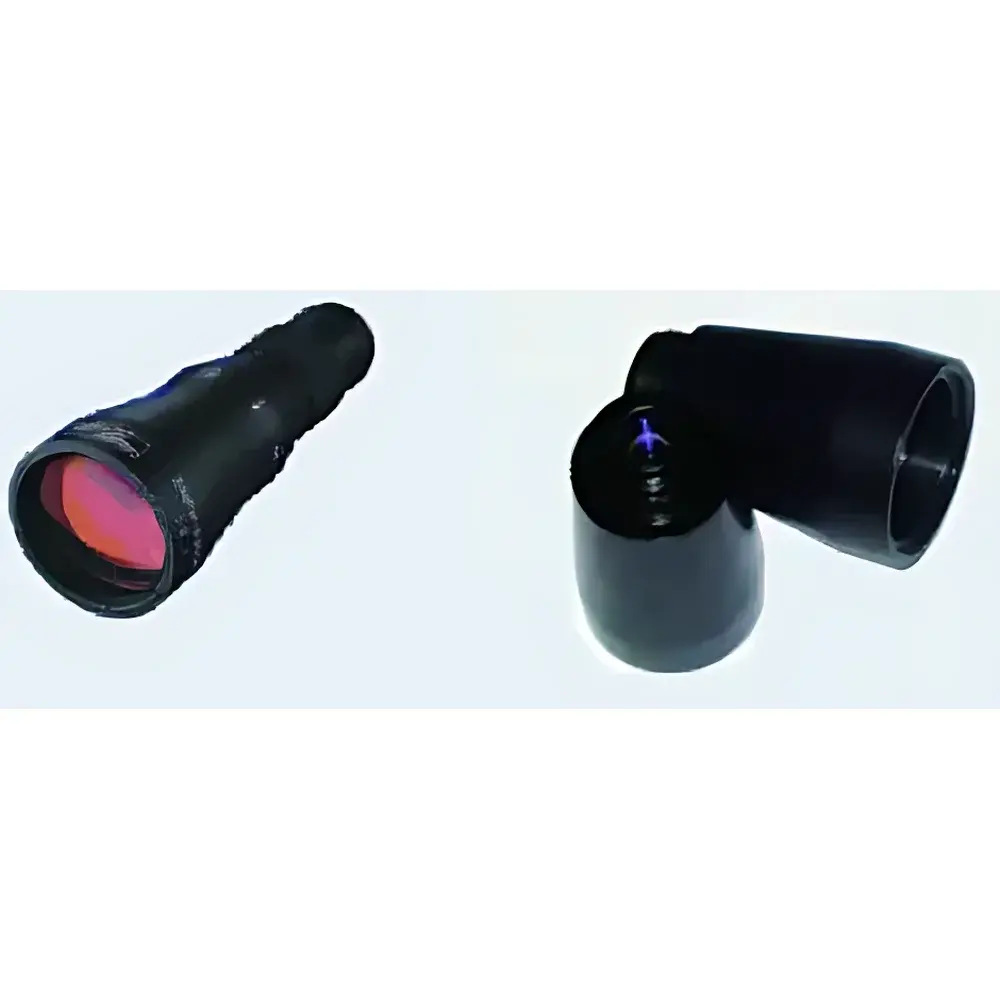
ZOLIX LEB Series Laser Beam Expanders
| Brand | ZOLIX |
|---|---|
| Model | LEB Series |
| Type | Reflective/Refractive Beam Expander (Galilean or Keplerian configuration) |
| Wavelength Range | 532 nm, 632.8 nm, 1064 nm |
| Expansion Ratios | 4×, 5×, 10× |
| Max Output Beam Diameter | 30–48 mm |
| Transmission | ≥92%–95% (AR-coated optics) |
| Housing Length (L) | 80–127 mm |
| Housing Diameter (D) | 37–57 mm |
| Mounting Thread | M22×0.75 |
| Construction | Precision-machined aluminum alloy housing with kinematic lens alignment |
| Compliance | ISO 10110 optical surface specifications, RoHS-compliant coatings |
Overview
The ZOLIX LEB Series Laser Beam Expanders are precision-engineered optical components designed to scale the diameter of collimated laser beams while preserving beam quality and wavefront fidelity. Based on either Galilean (negative-then-positive lens) or Keplerian (positive-then-positive lens) optical configurations—depending on model and application requirements—these expanders operate on fundamental principles of paraxial ray optics and Gaussian beam propagation. By increasing beam diameter prior to focusing, the LEB series enables diffraction-limited spot size reduction in downstream optics (e.g., scanning galvanometers, objective lenses, or material processing heads), directly improving spatial resolution in applications such as laser micromachining, interferometry, and confocal microscopy. Simultaneously, beam expansion improves angular collimation tolerance, reducing sensitivity to minor misalignments in multi-element optical trains and enhancing long-path stability in metrology setups.
Key Features
- Precision AR-coated fused silica or BK7 optical elements optimized for specific laser wavelengths (532 nm, 632.8 nm, and 1064 nm), ensuring ≥92% transmission across the designated band
- Fixed magnification options (4×, 5×, and 10×) with calibrated mechanical design to minimize wavefront distortion (typical λ/10 RMS surface accuracy per element)
- Robust aluminum alloy housings with integrated M22×0.75 external threading—compatible with standard optomechanical posts, lens tubes, and vacuum-compatible mounts
- Kinematic lens cell design enabling factory-set alignment; no user adjustment required under normal handling conditions
- Compact form factor (L = 80–127 mm; D = 37–57 mm) suitable for integration into space-constrained optical breadboards and OEM laser systems
- Compliance with ISO 10110-3 surface quality standards (scratch-dig ≤ 20-10) and RoHS Directive 2011/65/EU for environmentally controlled coating materials
Sample Compatibility & Compliance
The LEB series is compatible with continuous-wave (CW) and nanosecond-pulsed lasers operating within its specified wavelength bands. It supports input beam diameters up to 8 mm (for 4× and 5× models) and up to 12 mm (for 10× models), assuming TEM00 spatial profile and M² < 1.3. All models are rated for power densities up to 500 W/cm² (CW) and 1 J/cm² (10 ns pulse, 10 Hz rep rate) without measurable thermal lensing or coating damage. The optical design avoids internal focus points—eliminating risk of air breakdown or plasma formation in high-peak-power applications. As a passive optical component, the LEB series does not require electrical certification; however, its mechanical construction conforms to ISO 9001-manufactured tolerances and undergoes 100% inspection for centration error (< 3 arcmin) and axial runout (< 5 µm).
Software & Data Management
As a purely passive optical element, the LEB series requires no firmware, drivers, or software interface. However, it is fully compatible with industry-standard optical design and simulation platforms—including Zemax OpticStudio, CODE V, and FRED—for modeling beam propagation, divergence control, and M²-dependent focal spot prediction. ZOLIX provides downloadable .zmx and .seq files for each LEB model upon request, including full surface prescriptions, coating spectral data (.csv), and mechanical drawings (STEP and PDF). Traceability documentation—including individual unit test reports with measured transmission spectra and wavefront error maps—is archived for 10 years and available under GLP-aligned quality records.
Applications
- Laser material processing: Enabling tighter focus spots for high-resolution ablation, drilling, and thin-film scribing
- Interferometric metrology: Improving fringe contrast and coherence length in Michelson and Twyman-Green configurations
- Optical trapping and tweezers: Scaling trap beam size to match objective NA and reduce thermal lensing in aqueous media
- Spectroscopic illumination: Homogenizing excitation profiles in Raman and LIBS systems via overfilled entrance slits
- Defense and aerospace: Supporting beam conditioning in free-space optical communication terminals and LIDAR transmitter modules
- Academic research: Serving as a foundational component in undergraduate and graduate optics laboratories for teaching Gaussian beam transformation theory
FAQ
Can the LEB series be used with femtosecond lasers?
Yes—with caution. While the coated optics support broad bandwidths, group delay dispersion (GDD) is not compensated. For pulses < 100 fs, consult ZOLIX for custom chirped mirror integration or dispersion-balanced variants.
Is vacuum compatibility available?
Standard units use vacuum-stable adhesives and outgassing-tested anodization. Custom vacuum-rated versions (ISO-KF flange mounting, <1×10⁻⁹ mbar·L/s outgassing) are available upon request.
What is the maximum input beam divergence acceptable for optimal performance?
Input divergence should remain below ±1.5 mrad for all models to maintain specified wavefront fidelity and avoid vignetting at intermediate conjugates.
Do you offer motorized or variable-ratio beam expanders?
ZOLIX offers the LEB-M series (motorized zoom) and LEB-VAR (continuously adjustable 3–12×) as separate product lines—contact technical sales for integration guidance.
Are calibration certificates traceable to NIST or other national metrology institutes?
Transmission and surface quality data are verified using NIST-traceable spectrophotometers and interferometers; full calibration reports include uncertainty budgets per ISO/IEC 17025 requirements.



