
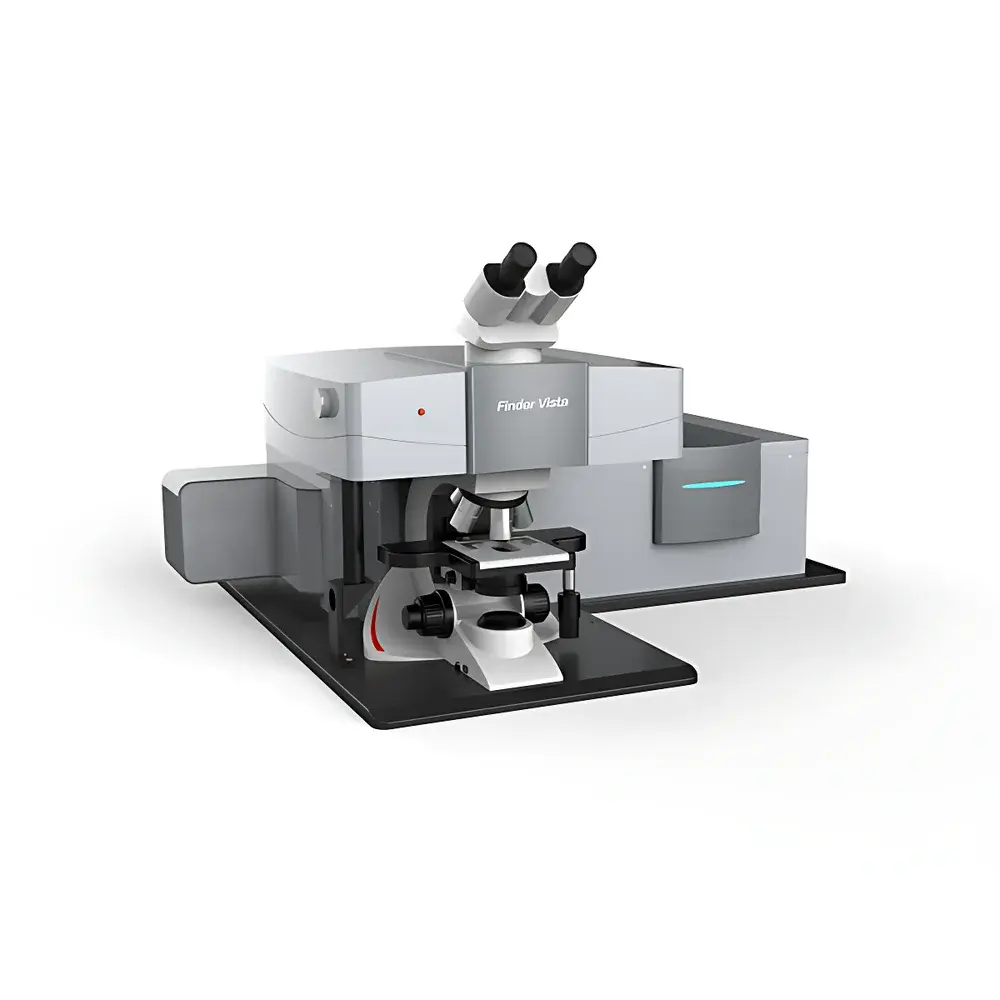
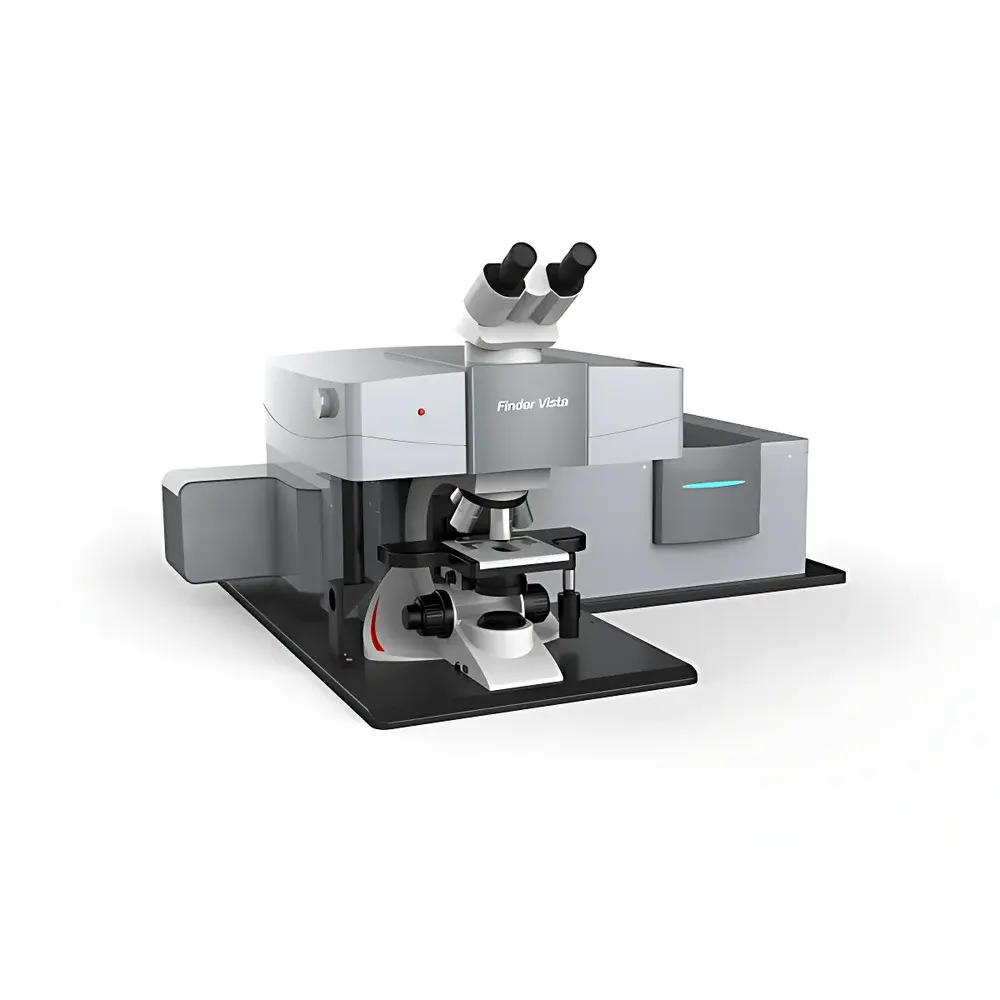
ZOLIX Finder Vista Research-Grade Confocal Laser Raman Spectrometer
| Brand | ZOLIX |
|---|---|
| Origin | Beijing, China |
| Manufacturer Type | Original Equipment Manufacturer (OEM) |
| Product Category | Domestic |
| Model | Finder Vista |
| Instrument Type | Confocal Micro-Raman Spectrometer |
| Spectral Range | 50–5,000 cm⁻¹ |
| Spectral Resolution | <1 cm⁻¹ |
| Spatial Resolution | ≤1 µm (lateral), ≤2 µm (axial) |
| Minimum Wavenumber | 50 cm⁻¹ |
| Spectral Repeatability | ≤±0.15 cm⁻¹ |
| Standard Laser | 532 nm (≥100 mW, TEM₀₀) |
| Optional Lasers | 266 nm, 325 nm, 633 nm, 785 nm |
| Microscope Configuration | Upright |
| Detector | TE-cooled back-illuminated CCD (LDC-DD technology), 2000 × 256 pixels, 15 × 15 µm pixel size, QE ≥95% @ 780 nm |
Overview
The ZOLIX Finder Vista is a research-grade confocal micro-Raman spectrometer engineered for high-fidelity vibrational spectroscopy at the microscale. It operates on the principle of inelastic scattering of monochromatic laser light—where incident photons interact with molecular vibrations to produce Stokes and anti-Stokes shifts—enabling non-destructive, label-free chemical identification and structural characterization. Built around a next-generation confocal optical architecture, the system integrates an aberration-corrected imaging spectrometer, precision motorized optics, and a thermoelectrically cooled deep-depletion back-illuminated CCD detector. This design ensures optimal photon throughput, minimal stray light, and exceptional signal-to-noise ratio across the full spectral range of 50–5,000 cm⁻¹. The instrument is optimized for laboratory environments requiring long-term stability, quantitative reproducibility, and compatibility with diverse sample types—from single-crystal semiconductors to biological tissues—without compromising spatial or spectral fidelity.
Key Features
- Confocal optical design with adjustable pinhole aperture for depth-resolved spectral acquisition and rejection of out-of-focus fluorescence.
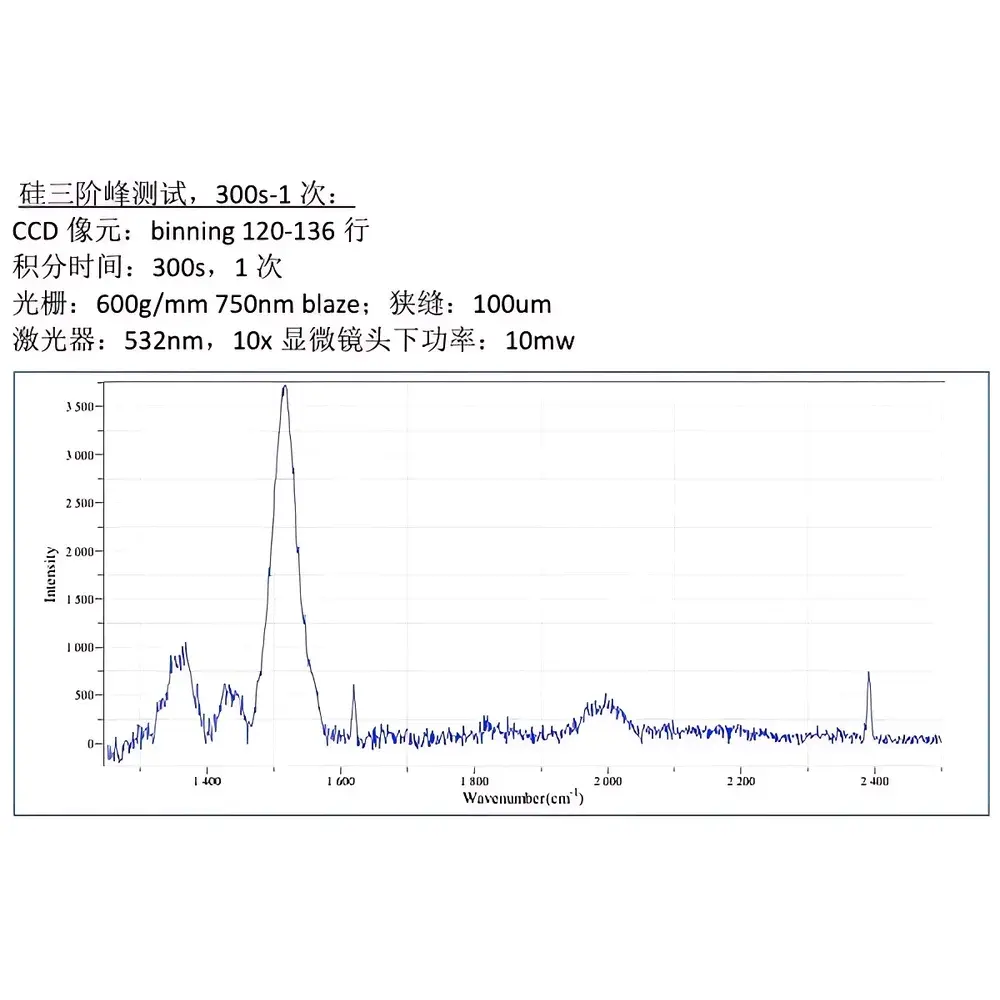
- High-throughput imaging spectrometer with corrected optics, delivering <1 cm⁻¹ spectral resolution (measured at 585.25 nm) and ≤±0.15 cm⁻¹ wavenumber repeatability over extended measurement sessions.
- Lateral spatial resolution ≤1 µm and axial resolution ≤2 µm under standard 532 nm excitation—achievable via diffraction-limited focusing through an upright microscope platform with high-NA objectives.
- Modular laser engine supporting multiple excitation wavelengths (266 nm, 325 nm, 532 nm, 633 nm, 785 nm), enabling resonance Raman enhancement, fluorescence suppression, and depth-profiling optimization.
- Fully automated optical path switching between micro-Raman and macro-Raman configurations; no post-switch recalibration required due to rigid mechanical alignment and software-synchronized actuation.
- TE-cooled back-illuminated CCD detector with LDC-DD (Low Dark Current – Deep Depletion) architecture, 2000 × 256 pixel format, and quantum efficiency >95% at 780 nm—critical for low-light, long-integration measurements.
Sample Compatibility & Compliance
The Finder Vista accommodates solid, liquid, and thin-film samples—including conductive substrates, insulating ceramics, polymer composites, live cells, and geological specimens—without mandatory metallization or vacuum requirements. Its open optical architecture permits integration with environmental stages (temperature-controlled, humidity-regulated, or gas-purged), electrochemical cells, and strain-applying fixtures. The system complies with ISO/IEC 17025 general requirements for competence of testing and calibration laboratories. Spectral data integrity adheres to ASTM E1840-22 (Standard Guide for Raman Shift Standards) and supports traceable calibration using NIST-traceable silicon (520.7 cm⁻¹) and sulfur (153.5 cm⁻¹, 218 cm⁻¹, 472 cm⁻¹) reference standards. All instrument control logs and spectral metadata are timestamped and exportable in HDF5 and ASCII formats to facilitate GLP/GMP-aligned documentation workflows.
Software & Data Management
The proprietary ZOLIX RamanSuite v4.x software provides a unified interface for instrument control, real-time spectral preview, multi-point mapping, and hyperspectral image reconstruction. It supports automated batch acquisition with user-defined ROI selection, background subtraction (polynomial and morphological), peak fitting (Voigt/Lorentzian/Gaussian models), and multivariate analysis (PCA, cluster analysis). Audit trails record all parameter changes, calibration events, and user actions—meeting FDA 21 CFR Part 11 requirements for electronic records and signatures when deployed with optional secure login and role-based access modules. Raw spectra are stored in vendor-neutral formats compatible with third-party platforms including Igor Pro, MATLAB, Python (via h5py and ramanapi libraries), and commercial chemometrics suites.
Applications
The Finder Vista serves as a core analytical platform across physical chemistry, materials science, life sciences, and forensic disciplines. Typical use cases include: identification and quantification of functional groups in organic and inorganic compounds; stress/strain mapping in 2D materials (e.g., graphene, MoS₂); crystallinity assessment and phase distribution in polymer blends; defect analysis in semiconductor wafers; in situ monitoring of catalytic reactions; spatially resolved biochemical profiling of fixed and live cells; mineralogical differentiation in geological thin sections; and non-invasive pigment analysis in cultural heritage artifacts. With optional add-ons, the system extends into time-resolved photoluminescence (TRPL), Raman imaging (up to 1024 × 1024 pixel maps), and fluorescence lifetime imaging (FLIM)—all co-registered to the same optical coordinate system.
FAQ
What laser wavelengths are supported natively, and how does wavelength selection affect spectral range and sensitivity?
The system ships with a 532 nm laser (≥100 mW, TEM₀₀). Optional lasers include 266 nm, 325 nm, 633 nm, and 785 nm. Shorter wavelengths increase Raman scattering cross-section but may induce fluorescence or photodegradation; longer wavelengths reduce fluorescence interference but lower scattering efficiency. Spectral coverage remains 50–5,000 cm⁻¹ across all excitations, though detector quantum efficiency and grating blaze angle influence signal intensity.
Is the system compatible with cryogenic or heating stages?
Yes—the upright microscope stage accepts standard commercial temperature stages (−190 °C to +600 °C) with optical access ports. Mechanical coupling and vibration isolation are maintained via kinematic mounting interfaces.
Can spectral data be exported for regulatory submission or peer-reviewed publication?
All spectra are saved with embedded metadata (excitation wavelength, grating position, integration time, objective magnification, calibration coefficients) in HDF5 and CSV formats. Exported files comply with journal requirements (e.g., ACS, RSC, IOP) and support audit-ready archiving in LIMS environments.
Does the system support automated focus tracking during large-area Raman mapping?
Yes—integrated Z-stage feedback loop coupled with real-time intensity-based autofocus enables continuous focal plane maintenance across mm-scale scans, preserving spectral quality and spatial registration accuracy.
What service and calibration options are available internationally?
ZOLIX provides factory-certified annual calibration services traceable to NIST standards, remote diagnostics, and on-site engineering support through authorized regional partners in North America, Europe, and APAC regions. Extended warranty and preventive maintenance contracts include spectral verification, optical alignment validation, and software update entitlements.
Related Products






