
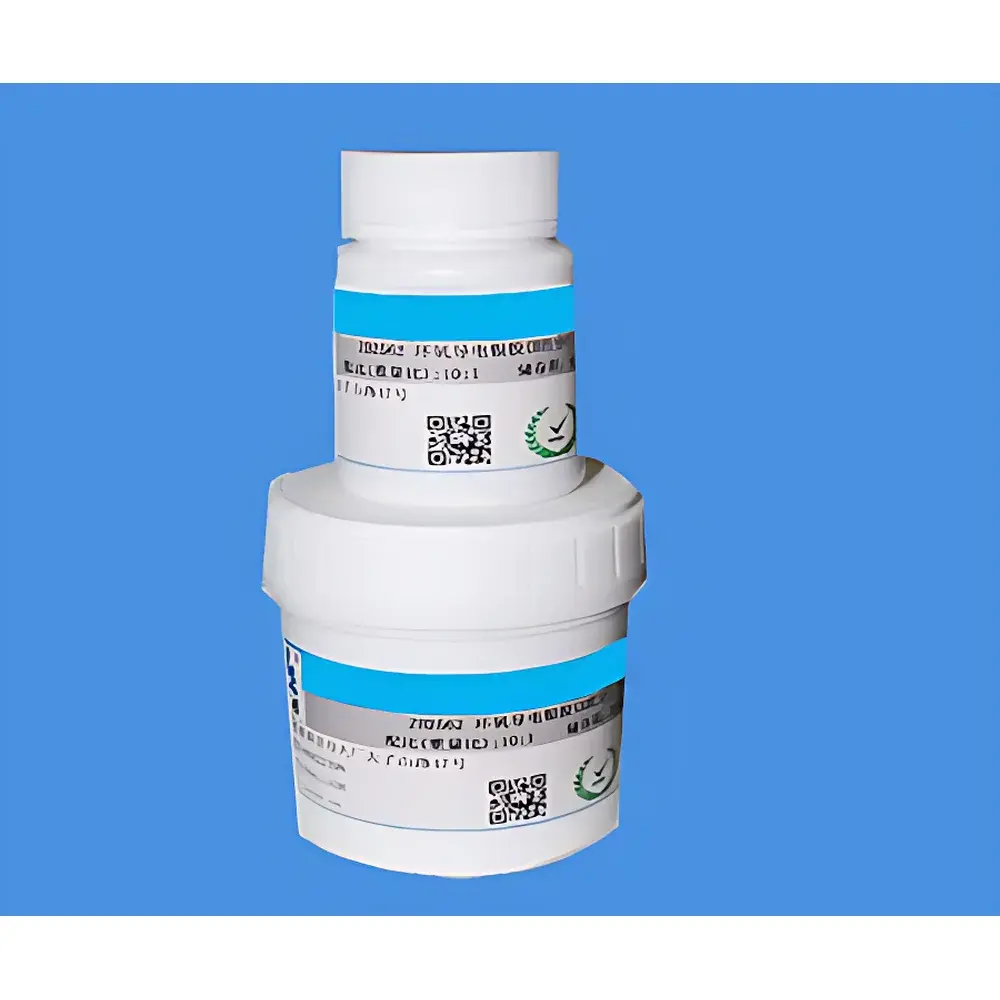
Epoxy-Based Conductive Silver Adhesive
No specifications available.
Overview
This epoxy-based conductive silver adhesive is a two-component formulation engineered for high-reliability electrical interconnection and structural bonding in microelectronic, sensor, and thin-film device fabrication. Composed of modified epoxy resin, modified amine hardener, and high-purity spherical silver particles, the adhesive delivers stable bulk conductivity and robust mechanical adhesion across heterogeneous substrates—including metals (e.g., Al, Cu, Au), alumina and zirconia ceramics, fused silica and borosilicate glass, and sputtered or evaporated electrode films (e.g., ITO, Cr/Au, NiCr). Its operating principle relies on percolation network formation: upon curing, silver particles coalesce into continuous conductive pathways while the crosslinked epoxy matrix provides dimensional stability and thermal resilience. Designed specifically for integration with quartz crystal microbalance (QCM) systems, this adhesive enables secure mounting of electrodes, transducers, and functional coatings without introducing parasitic mass loading or damping effects that compromise QCM frequency stability or dissipation monitoring.
Key Features
- Two-part system with precise 10:1 weight ratio (A:B), ensuring reproducible stoichiometry and minimal batch-to-batch variability
- Cure flexibility: fully polymerized at ambient conditions (25 °C, 12 h), accelerated at 60 °C (2 h) or 90 °C (30 min), compatible with standard QCM oven stages and vacuum bake protocols
- Bulk volume resistivity as low as 3.0 × 10⁻⁴ Ω·cm under optimized thermal cure—validated via four-point probe measurement per ASTM F1529
- Shear strength >80 kg/cm² on Al–Al joints after 90 °C/30 min cure, exceeding MIL-STD-883H Method 2019.7 requirements for die-attach reliability
- Thermal operating range from −55 °C to +200 °C, with coefficient of thermal expansion (CTE) closely matched to common QCM substrates (e.g., AT-cut quartz, CTE ≈ 13 ppm/°C)
- Non-hazardous classification per UN GHS and CLP regulations; compliant with RoHS 2015/863/EU for restricted substances
Sample Compatibility & Compliance
The adhesive exhibits excellent wettability and interfacial adhesion on substrates routinely used in electrochemical and QCM-based sensing platforms: gold-coated quartz crystals, platinum interdigitated electrodes, silicon nitride membranes, and sol-gel derived metal oxide films. It contains no volatile organic compounds (VOCs) or halogenated solvents, eliminating outgassing risks in ultra-high vacuum (UHV) QCM chambers (≤10−8 mbar). Batch certification includes traceability to raw material lot numbers, shelf-life validation per ISO 8502-12 (storage stability at 25 °C/60% RH), and documented compatibility testing with common cleaning agents (e.g., acetone, isopropanol, oxygen plasma). The formulation conforms to ISO 9001:2015 manufacturing controls and supports GLP-compliant documentation for regulated R&D environments.
Software & Data Management
While the adhesive itself is a consumable material—not a software-driven instrument—it is fully compatible with industry-standard QCM data acquisition and analysis workflows. Users may integrate its use into automated process logs within QCM control software (e.g., Q-Sense Analyzer, Stanford Research Systems QCM200 interface) by assigning custom material IDs and cure protocol tags. For audit readiness, manufacturers provide Certificate of Analysis (CoA) with each batch, including measured resistivity, shear strength, and TGA-derived residual mass at 500 °C—data exportable in CSV format for LIMS or ELN integration. Full traceability supports FDA 21 CFR Part 11 compliance when used in medical device development under design control procedures.
Applications
- Permanent electrode attachment in QCM-based gas, humidity, and biomolecular affinity sensors
- Die bonding of piezoelectric transducers in acoustic wave devices requiring low acoustic loss
- Interconnection of thin-film resistors and heater elements on MEMS platforms
- Hermetic sealing of edge contacts in high-frequency resonator packages
- Repair and rework of cracked or delaminated conductive traces on ceramic hybrid circuits
- Functionalization of QCM-D (dissipation) crystals with nanoparticle monolayers via controlled capillary assembly
FAQ
What is the recommended surface preparation prior to application?
Clean substrates using oxygen plasma (100 W, 30 s) or sequential ultrasonication in acetone and isopropanol (5 min each), followed by nitrogen drying. Avoid silane primers unless validated for silver migration resistance.
Can this adhesive be used in high-vacuum QCM systems?
Yes—TGA shows <0.5 wt% mass loss below 200 °C and no detectable condensable volatiles after 24 h at 10−6 mbar, meeting NASA RP-1251 outgassing specifications.
Is post-cure required for optimal conductivity?
No—full conductivity is achieved after the specified thermal cure; however, a 1-h post-bake at 120 °C improves long-term resistance stability under thermal cycling.
How does humidity affect uncured adhesive shelf life?
Store sealed at ≤30% RH and 25 °C; moisture absorption in Part A accelerates amine hardener degradation—hence the 6-month shelf life under controlled conditions.
Are there alternatives for low-temperature processing (≤40 °C)?
This formulation requires minimum 25 °C for full crosslinking; for sub-ambient cures, consult technical support for catalyzed variants with latent imidazole initiators.






