
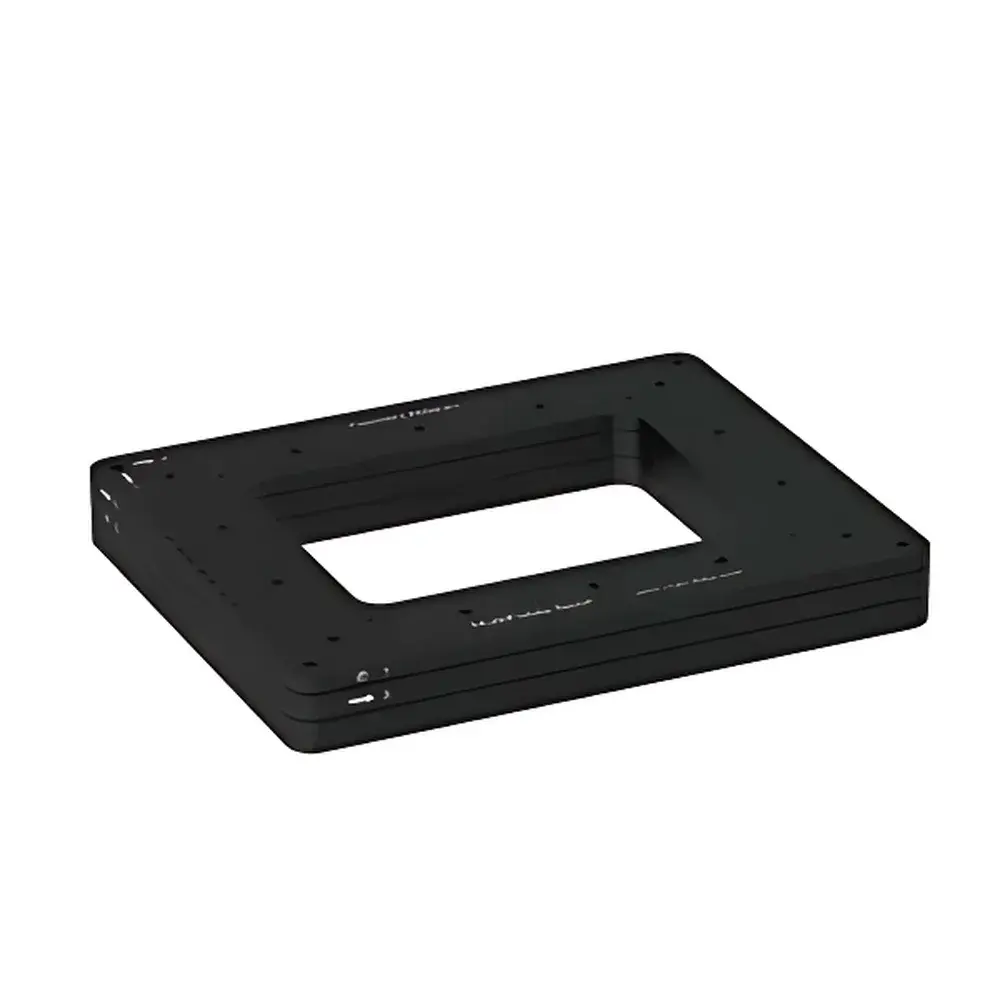
ZOLIX Carrier.L7550.XY High-Resolution Piezo-Driven XY Translation Stage
| Brand | ZOLIX |
|---|---|
| Origin | Beijing, China |
| Manufacturer Type | Original Equipment Manufacturer (OEM) |
| Product Category | Motorized Translation Stage |
| Model | Carrier.L7550.XY |
| Motion Axes | X, Y |
| Travel Range | 75 mm × 50 mm |
| Minimum Step Size | ~30 nm (with optional 1 nm resolution grating encoder) |
| Maximum Speed | 20 mm/s |
| Drive Frequency | up to 20 kHz |
| Load Capacity | 2 kg |
| Body Material | Anodized Black Aluminum Alloy |
| Operating Temperature | 10–40 °C |
| Mounting Footprint | 325 mm × 250 mm |
| Clear Aperture | 85 mm × 65 mm |
| Position Sensing Options | Resistive Sensor (.R, 100–200 nm resolution) or Optical Grating Encoder (.O, 10 nm standard / 1 nm optional) |
| Environmental Versions | Standard, Non-Magnetic (.NM), High Vacuum (.HV), Ultra-High Vacuum (.UHV) |
| Cable Interface | Shielded D-Sub9 connector with Kapton-insulated PEEK-pin leads |
Overview
The ZOLIX Carrier.L7550.XY is a high-precision, piezo-driven XY translation stage engineered for demanding optical alignment, semiconductor metrology, and nanoscale positioning applications in research and industrial laboratories. Unlike conventional stepper- or servo-motor-based stages, the Carrier.L7550.XY employs direct piezoelectric actuation combined with closed-loop position feedback to deliver sub-30 nm step resolution, smooth continuous motion, and exceptional repeatability across its full 75 mm × 50 mm travel range. Its monolithic aluminum alloy body—hard-anodized and blackened for low outgassing and thermal stability—is structurally optimized to minimize mechanical hysteresis and drift while maintaining a large central aperture (85 mm × 65 mm) compatible with multi-axis optical setups, vacuum chambers, and probe station integration. Designed for operation in ambient conditions (10–40 °C), the stage supports optional environmental configurations—including non-magnetic (.NM), high-vacuum (.HV), and ultra-high-vacuum (.UHV) variants—ensuring compatibility with electron microscopy, cryogenic optics, and UHV surface science systems.
Key Features
- Large-area XY scanning capability: 75 mm × 50 mm bidirectional travel with <30 nm minimum step size and up to 20 mm/s maximum velocity
- Closed-loop positioning architecture with two sensor options: resistive position sensing (100–200 nm resolution) or high-fidelity optical grating encoder (10 nm standard, 1 nm optional)
- Ultra-low acoustic signature: piezo drive operates at frequencies up to 20 kHz, enabling silent, vibration-free motion critical for interferometric and single-photon detection setups
- Robust mechanical design: rigid aluminum alloy frame with hard-anodized black finish ensures dimensional stability, low thermal expansion, and compatibility with cleanroom protocols
- Modular environmental adaptability: standardized mechanical interface allows seamless integration of .NM (non-magnetic), .HV (10⁻⁶ mbar), or .UHV (10⁻¹¹ mbar) versions without redesigning mounting fixtures
- Integrated electrical interface: shielded D-Sub9 connector with Kapton-insulated PEEK-pin leads minimizes EMI coupling and enables reliable signal transmission in electrically noisy environments
Sample Compatibility & Compliance
The Carrier.L7550.XY is designed to meet the mechanical and environmental requirements of ISO 14644-1 Class 5 cleanrooms and ASTM E2500-13 guidelines for laboratory instrumentation qualification. Its non-magnetic variant (.NM) complies with IEC 61326-2-1 for electromagnetic compatibility in magnetic resonance environments. The .UHV version adheres to ISO 14523 and ESA ECSS-E-ST-32-01C standards for outgassing performance (<1×10⁻¹² Pa·m³/s·cm² total mass loss), making it suitable for synchrotron beamline endstations and atomic layer deposition tool integration. All variants support GLP-compliant installation verification through traceable calibration reports (NIST-traceable encoder verification available upon request).
Software & Data Management
The stage is fully compatible with ZOLIX’s ZControl SDK (Windows/Linux/macOS), offering native support for LabVIEW™, MATLAB®, Python (PyVISA), and C/C++ APIs. Position data logging includes timestamped encoder readings with configurable sampling rates up to 10 kHz, supporting audit-trail generation per FDA 21 CFR Part 11 requirements when deployed in regulated QC/QA workflows. Optional firmware upgrades enable synchronized multi-axis triggering via TTL/RS-422 interfaces, facilitating precise coordination with laser pulse generators, CCD shutters, or AFM controllers.
Applications
- Optical microscope stage automation for confocal, STED, and super-resolution imaging
- Wafer-level alignment in photomask inspection and maskless lithography systems
- Probe positioning in cryogenic transport measurements (e.g., Hall effect, quantum Hall regimes)
- Beam steering and focus correction in adaptive optics test benches
- Multi-point spectroscopic mapping across semiconductor wafers or 2D material heterostructures
- Integration into custom-built UHV scanning tunneling microscopy (STM) or angle-resolved photoemission spectroscopy (ARPES) systems
FAQ
What is the difference between the .R and .O sensor options?
The .R variant uses integrated resistive position sensors with 100–200 nm resolution and lower cost; the .O variant employs high-stability optical grating encoders delivering 10 nm standard resolution (1 nm optional), ideal for applications requiring traceable, long-term positional fidelity.
Can the stage be operated in vertical orientation?
Yes, but maximum payload must be reduced to 1.2 kg for vertical mounting to maintain specified dynamic performance and encoder linearity; consult the mechanical installation manual for torque and center-of-gravity constraints.
Is third-party controller compatibility supported?
Yes—the D-Sub9 interface follows standard analog ±10 V position command and encoder quadrature output conventions, enabling interoperability with Newport, Thorlabs, and PI motion controllers using appropriate adapter firmware.
How is thermal drift compensated during extended scans?
While the aluminum structure exhibits low thermal expansion (23.1 µm/m·K), users performing >1-hour continuous scanning are advised to implement periodic reference point re-homing or integrate external interferometric feedback via the auxiliary TTL sync port.
What documentation is provided for regulatory validation?
ZOLIX supplies factory calibration certificates, RoHS/REACH declarations, CE marking documentation, and optional IQ/OQ protocol templates aligned with ISO/IEC 17025 for laboratory accreditation purposes.



