
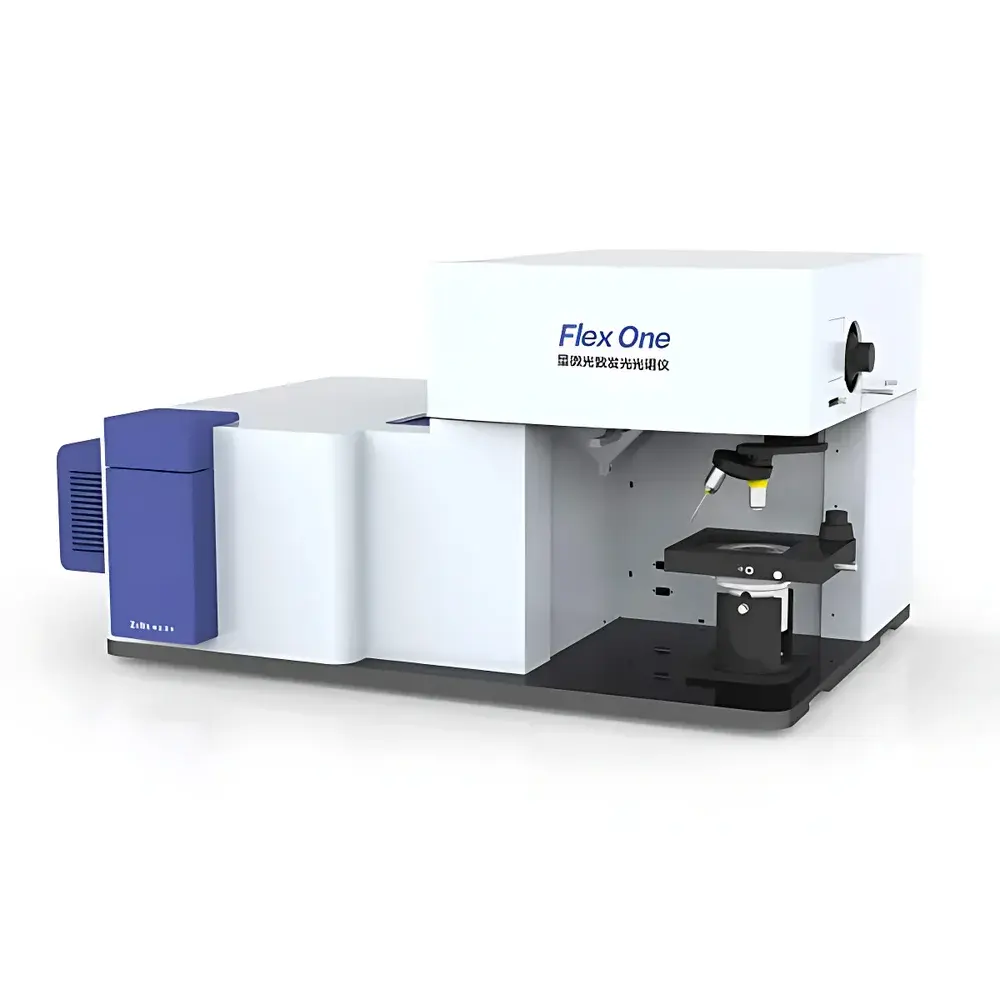
ZOLIX Flex One Molecular Fluorescence Spectrometer
| Brand | ZOLIX |
|---|---|
| Origin | Beijing, China |
| Manufacturer Type | Direct Manufacturer |
| Regional Classification | Domestic (China) |
| Model | Flex One |
| Price | USD 70,000 (approx.) |
| Dispersive Element | Holographic Grating & Interference Filters |
| Slit Width (Spectral Bandpass) | 0.05 nm |
| Optical Resolution | 0.1 nm |
| Wavelength Accuracy | ±0.2 nm |
| Spectral Range | 300–2200 nm (standard configuration) |
| Spatial Resolution | <50 µm |
| Excitation Wavelength Options | 266, 325, 405, 442, 473, 532, 633, 785 nm |
| Detector Options | Cooled Si CCD (2000×256), PMT, Single-Point InGaAs, Cooled InGaAs Array (512×1), or Custom Detector Modules |
Overview
The ZOLIX Flex One Molecular Fluorescence Spectrometer is a high-performance, modular micro-photoluminescence (PL) measurement system engineered for quantitative optical characterization of semiconductor materials, nanomaterials, quantum dots, 2D materials (e.g., MoS₂, WS₂), and organic emissive compounds. It operates on the principle of photoluminescence spectroscopy—where samples are excited by monochromatic laser radiation across UV–NIR wavelengths, and the resulting emission spectra are dispersed via a calibrated holographic grating and resolved with sub-nanometer spectral fidelity. Unlike conventional microscope-coupled PL systems, the Flex One integrates a purpose-built, optomechanically stable optical path optimized for maximum collection efficiency, minimal stray light, and precise spatial registration between excitation focus and spectral detection. Its rigid monolithic chassis eliminates thermal drift and mechanical misalignment, ensuring long-term repeatability required for comparative studies, process monitoring, and R&D validation under GLP-compliant workflows.
Key Features
- Integrated optical alignment architecture: factory-aligned, vibration-damped optical bench with kinematic mounts for all critical components—no user recalibration required.
- Dual-axis sample illumination geometry: switchable horizontal/vertical excitation pathways accommodate standard cuvettes, wafer holders, cryostat windows, and custom substrates without realignment.
- Extended spectral coverage: 300–2200 nm standard range; expandable to 200–2500 nm using hybrid grating/filter configurations and detector-swappable modules.
- Real-time video-guided positioning: integrated CMOS imaging channel co-aligned with excitation path enables micron-scale targeting (<50 µm spatial resolution) and ROI selection on opaque, reflective, or heterogeneous samples.
- Multi-laser excitation compatibility: pre-aligned laser ports support simultaneous or sequential use of up to eight discrete excitation wavelengths (266–785 nm), including deep-UV (266 nm) and telecom-band (785 nm) sources.
- Modular detector interchangeability: supports scientific-grade cooled Si CCD, photon-counting PMT, single-point InGaAs, or linear InGaAs arrays (512×1) with thermoelectric cooling to –40 °C for low-noise NIR detection.
Sample Compatibility & Compliance
The Flex One accommodates solid-state wafers (Si, GaN, GaAs, perovskites), thin films, powders, colloidal suspensions, and biological fluorophores mounted on standard XYZ translation stages (manual or motorized). Optional cryogenic integration includes vacuum-compatible cold-finger stages (4–300 K) with optical access windows and temperature feedback control—fully compatible with closed-cycle refrigerators and liquid-helium dewars. All optical paths comply with ISO 17025 traceability requirements for wavelength calibration (NIST-traceable Hg/Ne/Ar lamp standards), and spectral data acquisition adheres to ASTM E131–22 (Standard Terminology Relating to Molecular Spectroscopy) and IEC 61000-4-3 (EMC immunity for laboratory instrumentation). System firmware supports audit trail logging and user-access controls aligned with FDA 21 CFR Part 11 readiness for regulated environments.
Software & Data Management
Control and analysis are executed via ZOLIX SpectraStudio v4.x—a native Windows application built on Qt/C++ with Python API extension capability. The software provides full instrument orchestration: automated wavelength scanning, multi-channel detector synchronization, time-resolved decay fitting (via TCSPC add-on), spectral deconvolution (Gaussian/Lorentzian peak separation), and batch processing for mapping datasets. Raw spectra are stored in HDF5 format with embedded metadata (excitation λ, slit width, integration time, detector gain, temperature stamp). Export options include CSV, ASCII, JCAMP-DX, and MATLAB .mat files. Data integrity safeguards include checksum validation, version-controlled calibration files, and optional encrypted project archives compliant with institutional data governance policies.
Applications
- Bandgap determination and defect-state analysis in III–V and II–VI semiconductors (e.g., InP, CdSe, ZnO).
- Quantum yield mapping and exciton dynamics in perovskite solar cell absorbers.
- Strain and doping uniformity assessment across 200 mm and 300 mm semiconductor wafers.
- Temperature-dependent PL thermometry in micro-LED arrays and VCSEL structures.
- Fluorescence lifetime imaging (FLIM) when coupled with time-correlated single-photon counting hardware.
- Correlative analysis with Raman spectroscopy (via optional shared microscope platform) for structural–electronic property linkage.
FAQ
What excitation wavelengths are supported natively without optical realignment?
All listed lasers (266, 325, 405, 442, 473, 532, 633, 785 nm) are pre-aligned into dedicated fiber-coupled or free-space ports; switching requires only software selection and shutter activation—no manual mirror adjustment.
Can the system be upgraded for time-resolved fluorescence measurements?
Yes—TCSPC modules (e.g., Becker & Hickl SPC-150) integrate via TTL synchronization and photon-event timestamping; full decay analysis is supported in SpectraStudio’s Lifetime module.
Is the Flex One compatible with ultra-high-vacuum (UHV) chambers?
Standard configurations use atmospheric or purged enclosures; UHV-compatible versions feature CF-flanged optical viewports, bakeable mounts, and non-outgassing optical adhesives—available upon engineering review.
How is wavelength calibration maintained over extended operation?
Automated internal calibration uses a sealed mercury–argon reference lamp; users may schedule daily or weekly verification routines with NIST-traceable uncertainty reporting.
Does the system support GMP/GLP documentation packages?
Yes—validation documentation (IQ/OQ/PQ protocols), calibration certificates, and electronic signature-enabled audit logs are available as optional deliverables per ISO/IEC 17025 and FDA guidance.
Related Products





