
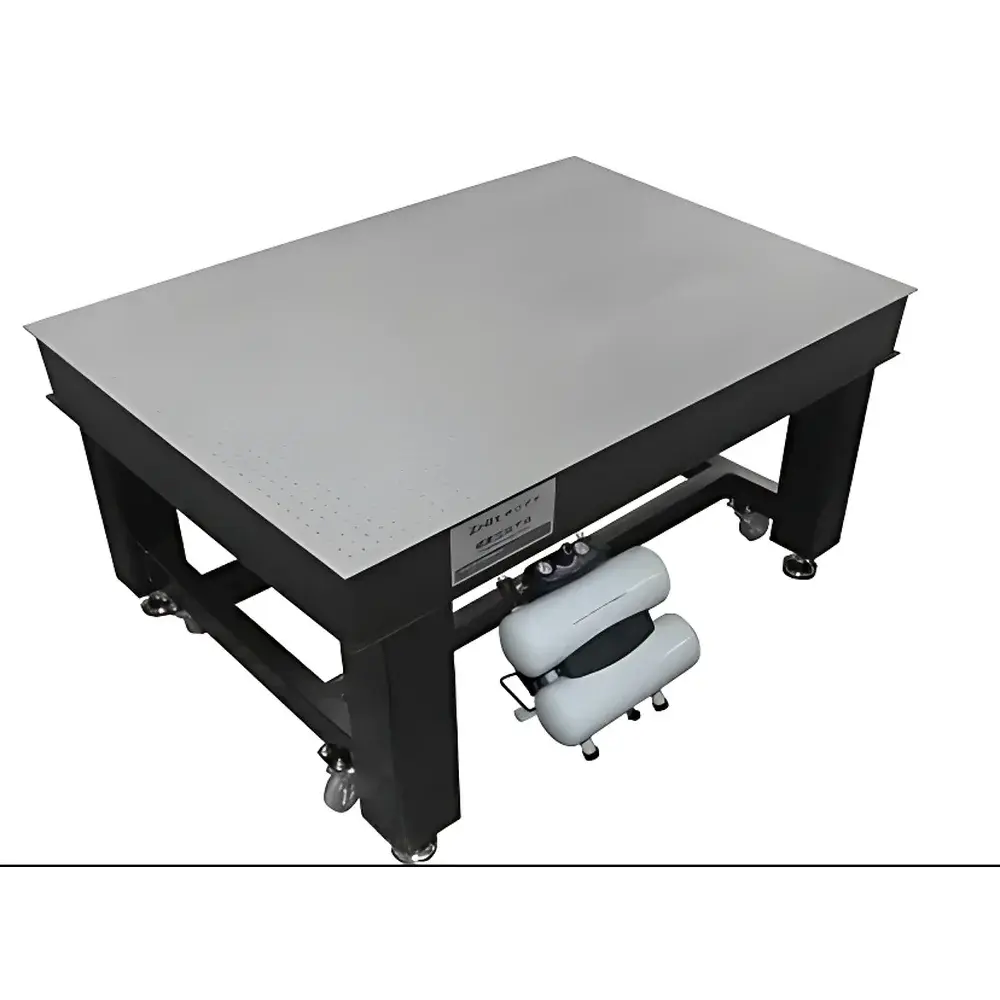
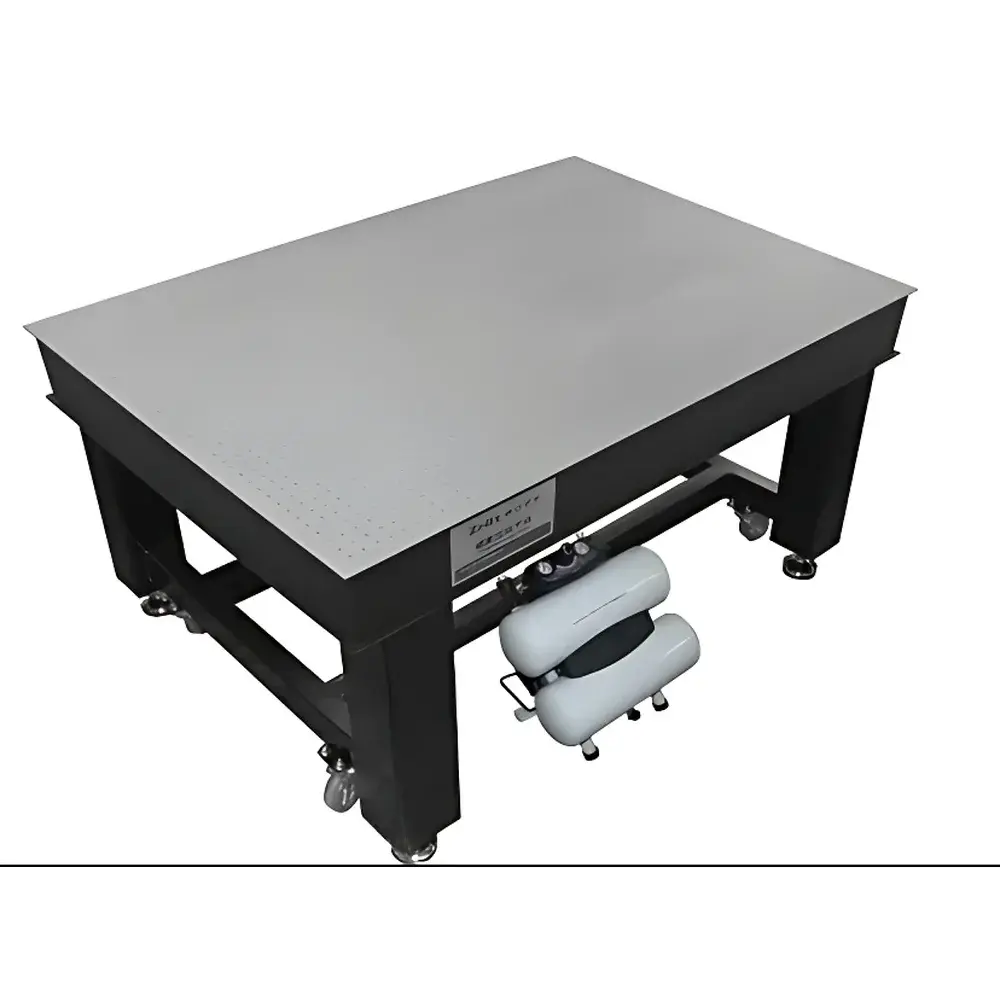
ZOLIX ZLT Series Pneumatic Air-Floating Optical Isolation Table
| Brand | ZOLIX |
|---|---|
| Origin | Beijing, China |
| Manufacturer Type | Direct Manufacturer |
| Model | ZLT Series |
| Platform Thickness Options | 100 mm / 200 mm / 300 mm |
| Natural Frequency | < 3–4.5 Hz |
| Surface Flatness | 0.02–0.05 mm per 600 mm × 600 mm |
| Mounting Pattern | M6 threaded holes on 25 mm × 25 mm grid |
| Total Height | 800 mm (adjustable range: −20 mm to +30 mm) |
| Structural Design | Three-layer sandwich core (top: 4–6 mm ferromagnetic stainless steel |
| center | steel honeycomb lattice |
| base | 4–6 mm carbon steel with black powder coating) |
| Support System | Dual-chamber pneumatic air chambers with four or six imported high-reliability air bladders |
| Included Accessories | Silent oil-free air compressor (operating pressure: 3–7 kg/cm²), moisture separator, stainless-steel corner guards, precision spirit level, portable hand pump |
Overview
The ZOLIX ZLT Series Pneumatic Air-Floating Optical Isolation Table is engineered for high-stability optical experimentation and precision metrology applications requiring sub-Hertz mechanical isolation. Utilizing passive pneumatic isolation based on low-resonance air-spring suspension, the ZLT platform achieves a natural frequency of less than 3–4.5 Hz—well below typical floor-borne vibration spectra (e.g., building HVAC, footfall, and machinery-induced disturbances in the 5–50 Hz range). Its structural architecture integrates fundamental principles of modal decoupling and inertial mass optimization: the massive three-layer sandwich tabletop provides high rigidity-to-mass ratio, while the dual-chamber pneumatic support system ensures consistent vertical and horizontal damping across operational load ranges (400–800 kg, depending on configuration). Designed and manufactured in Beijing by ZOLIX—a vertically integrated OEM specializing in optical instrumentation—the ZLT series meets the mechanical stability requirements of interferometry, laser alignment, quantum optics setups, and nanoscale imaging systems where micron-level positional drift must be minimized over extended acquisition periods.
Key Features
- Three-layer monolithic tabletop: Top layer of 4–6 mm ferromagnetic stainless steel (M6-threaded, 25 mm pitch grid); central high-strength steel honeycomb lattice for optimal stiffness distribution; bottom layer of 4–6 mm carbon steel with durable black powder coating.
- Precision surface finish: Ground and lapped top surface with flatness of 0.02–0.05 mm over any 600 mm × 600 mm area—exceeding ISO 10360-2 tolerances for Grade 0 granite reference surfaces.
- Dual-chamber pneumatic isolation system: Four or six imported elastomeric air bladders housed in hermetically sealed, pressure-regulated dual-cavity chambers; enables stable levitation with minimal hysteresis and thermal drift.
- Active leveling & height adjustment: Three high-sensitivity imported proportional leveling valves provide rapid, repeatable horizontalization (< 2 s response time); proprietary height-adjustment mechanism allows ±30 mm fine-tuning without compromising structural integrity.
- Integrated environmental mitigation: Standard inclusion of oil-free silent air compressor (3–7 kg/cm² operating range), inline moisture separator, and optional base-mounted viscoelastic damping pads for enhanced low-frequency attenuation.
- Modular scalability: Available in 16 standard configurations (900×600 mm to 3500×1500 mm), with thickness options of 100 mm, 200 mm, and 300 mm—each calibrated for specific payload density (120–167 kg/m²) and dynamic compliance targets.
Sample Compatibility & Compliance
The ZLT platform accommodates a broad spectrum of optical components—including motorized translation stages, kinematic mirror mounts, fiber launch systems, and vacuum-compatible optomechanics—without inducing parasitic resonances or static deformation. Its ferromagnetic stainless steel surface supports direct magnetic base attachment, while the M6 grid enables secure fastening of industry-standard Thorlabs, Newport, and Standa accessories. From a regulatory standpoint, the ZLT design aligns with mechanical stability prerequisites defined in ISO 10360-2 (coordinate measuring machine foundations), ASTM E177 (standard practice for use of control charts in calibration laboratories), and IEC 60068-2-64 (vibration testing for electronic equipment). Though not certified to ISO/IEC 17025, its repeatable leveling performance and documented flatness metrics support GLP-compliant experimental documentation when paired with traceable metrology tools.
Software & Data Management
The ZLT series operates as a purely mechanical isolation system with no embedded electronics or firmware; therefore, it requires no software drivers, firmware updates, or cybersecurity protocols. However, its compatibility with third-party motion control and data acquisition ecosystems is fully maintained: the rigid, vibration-damped surface serves as an ideal mounting substrate for USB/Ethernet-connected cameras, piezo controllers, and lock-in amplifiers used in closed-loop optical experiments. For labs implementing 21 CFR Part 11-compliant workflows, the platform’s passive nature eliminates audit concerns related to electronic record integrity—its operational parameters (e.g., leveling status, pressure setpoints) are manually verified and logged using calibrated analog gauges and digital inclinometers, ensuring full traceability in GxP environments.
Applications
- Laser interferometry and gravitational wave prototype test benches requiring <10 nm RMS displacement stability over 1-hour intervals.
- Confocal and super-resolution microscopy platforms where stage vibration directly limits lateral resolution and Z-stack repeatability.
- Quantum optics experiments involving trapped ions or cold atoms, where ground-state cooling fidelity depends on sub-µm mechanical stability.
- Optical coherence tomography (OCT) and femtosecond laser micromachining systems sensitive to path-length fluctuations in Mach–Zehnder or Michelson configurations.
- Calibration laboratories performing ISO 10360-compliant verification of coordinate measuring machines (CMMs) and vision-based metrology systems.
- Educational advanced physics labs demonstrating wave-particle duality, holography, or polarization interference under real-world ambient conditions.
FAQ
What is the recommended compressed air supply specification for continuous operation?
A clean, dry, oil-free air source delivering 3–7 kg/cm² (43–100 psi) is required. The included silent oil-free compressor satisfies this requirement; external shop air must pass through a coalescing filter and refrigerated dryer to prevent moisture-induced bladder degradation.
Can the ZLT platform be integrated into a cleanroom environment (ISO Class 5 or better)?
Yes—the black powder-coated carbon steel base, stainless-steel corner guards, and non-outgassing elastomeric bladders meet ISO 14644-1 particulate emission thresholds. Optional electropolished stainless-steel side panels are available upon request.
How does temperature variation affect leveling stability?
The three-point leveling valve system compensates for thermal expansion differentials between steel and air bladder materials. Long-term drift remains below ±0.005° over 24 h at constant 22±1°C ambient, validated per ISO 230-1 Annex C.
Is retrofitting with active vibration cancellation possible?
The ZLT’s structural mass and inherent damping allow integration with commercially available active cancellation systems (e.g., STACIS or Halcyonics), though such configurations require custom interface brackets and independent power/data routing—ZOLIX provides mechanical interface drawings upon NDA.
What maintenance schedule is recommended for the pneumatic system?
Quarterly inspection of air bladder integrity and valve seal condition; annual replacement of moisture separator cartridge; biannual recalibration of leveling valve sensitivity using certified digital inclinometer (traceable to NIST standards).





