
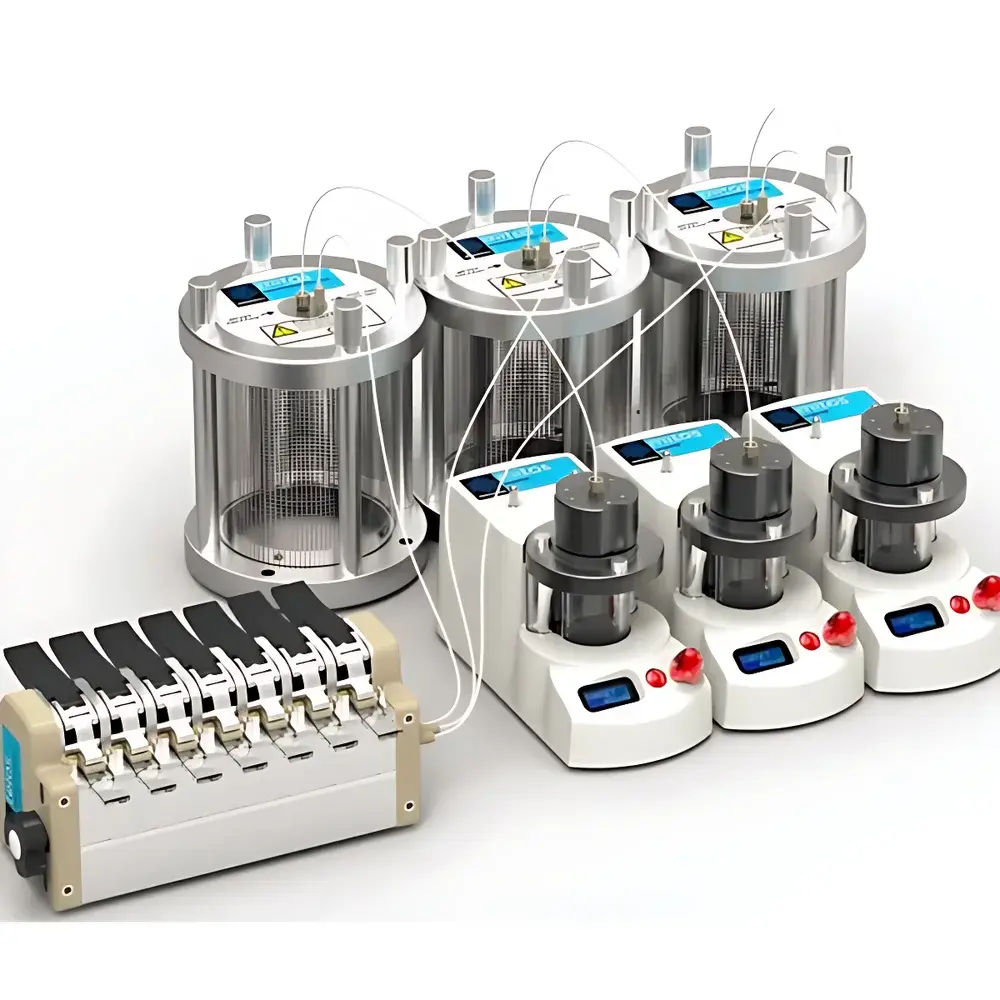
Dolomite Microfluidics Telos High-Throughput Droplet Generation System
| Brand | Dolomite |
|---|---|
| Origin | United Kingdom |
| Manufacturer Type | Authorized Distributor |
| Product Origin | Imported |
| Model | Telos® |
| Operating Pressure Range | 0–10 bar (150 psi) |
| Temperature Control Range | 4–80 °C |
| Maximum Parallel Modules | 10 |
| Channels per Module | 7 |
| Total Parallel Channels (with Support Frame 3200375) | 70 |
| Illumination | Dual-side (top & bottom) optical access |
| Integrated Flow Control | On-chip pneumatic valves |
| Output Configuration | Bulk reservoir or parallel tubing collection |
Overview
The Dolomite Microfluidics Telos® High-Throughput Droplet Generation System is an engineered platform for scalable, reproducible microfluidic processing based on continuous-flow droplet microfluidics. It operates on the principle of controlled interfacial destabilization—typically using flow-focusing, T-junction, or co-flow geometries embedded in glass or thermoplastic microfluidic chips—to generate monodisperse emulsions, polymeric microparticles, liposomes, or encapsulated reagents with precise control over size, composition, and frequency. Unlike serial microfluidic setups limited to µL/min throughput, the Telos® architecture enables true parallelization: up to 10 independently addressable modules can be mounted simultaneously on a rigid support frame (Part No. 3200375), delivering aggregate volumetric output on the order of liters per day while maintaining sub-5% coefficient of variation (CV) in droplet diameter. This bridges the critical gap between lab-scale discovery and process-relevant manufacturing in biologics formulation, diagnostic assay development, and materials synthesis.
Key Features
- Modular scalability: Supports up to 10 identical Telos® modules mounted vertically via the standardized Support Frame (3200375), enabling 70 parallel microfluidic channels without cross-talk.
- Independent per-module control: Each module features dedicated pressure regulation, temperature setpoint adjustment (4–80 °C), and real-time flow monitoring—critical for multi-parameter optimization studies.
- Dual optical access: Top- and bottom-illuminated chip mounting enables simultaneous brightfield, fluorescence, or phase-contrast imaging across all active channels using standard inverted or upright microscopes.
- Integrated microvalve actuation: On-chip pneumatically actuated valves allow dynamic flow routing, droplet merging, splitting, or stop-flow operations without external fluidic switching hardware.
- Robust process interface: Compatible with both bulk collection (e.g., into 50 mL conical tubes or stirred reactors) and parallel outlet tubing (e.g., for downstream sorting, lyophilization, or inline analytics).
- Compliant pressure operation: Rated for continuous use at 0–10 bar (150 psi), supporting high-viscosity oil phases (e.g., fluorinated carriers) and aqueous polymer solutions without channel deformation.
Sample Compatibility & Compliance
The Telos® system accommodates a broad range of immiscible phase pairs—including water-in-oil (W/O), oil-in-water (O/W), and double emulsions (W/O/W)—across viscosities from 1 cP to >50 cP. Chip substrates are fabricated from borosilicate glass or cyclic olefin copolymer (COC), ensuring chemical resistance to organic solvents (e.g., chloroform, DCM), surfactants (e.g., Span 80, Tween 80), and biological buffers (PBS, HEPES). All wetted components comply with USP Class VI biocompatibility standards. The system architecture supports GLP/GMP-aligned workflows: pressure and temperature logs are timestamped and exportable in CSV format; optional integration with third-party SCADA systems enables 21 CFR Part 11-compliant audit trails when paired with validated electronic signatures.
Software & Data Management
Telos® operation is managed via Dolomite’s proprietary Telos Control Software (v3.2+), a Windows-based application providing synchronized control of up to 10 modules. The software implements PID-regulated thermal management, closed-loop pressure feedback, and programmable sequence scripting (e.g., ramped flow rates, timed valve actuation, temperature gradients). Real-time pressure traces, temperature stability metrics (<±0.3 °C), and module status indicators are visualized in a unified dashboard. All operational parameters and sensor outputs are logged at user-defined intervals (100 ms–10 s resolution) and stored in structured HDF5 files—enabling traceability, batch comparison, and integration with Python- or MATLAB-based analysis pipelines.
Applications
- High-throughput formulation screening of lipid nanoparticles (LNPs) for mRNA delivery, with automated variation of lipid ratios, flow rates, and temperature to map encapsulation efficiency vs. particle size.
- Scalable synthesis of PLGA, chitosan, or alginate microparticles for controlled-release drug delivery, achieving batch-to-batch CV <3% in diameter distribution (measured by laser diffraction or SEM).
- Rapid prototyping of digital ELISA or single-cell RNA-seq partitioning assays, where 70-channel parallelism reduces assay development time from weeks to days.
- Continuous-flow photochemical or enzymatic reactions within droplets, leveraging precise residence time control (100 ms–10 min) and integrated UV/visible illumination ports.
- Quality-by-Design (QbD) studies compliant with ICH Q5A and Q5C guidelines for biopharmaceutical excipient evaluation under accelerated stress conditions.
FAQ
What chip formats are compatible with the Telos® system?
Standard Telos® modules accept Dolomite’s proprietary 7-node glass or COC chips (e.g., Telos Emulsion Chip, Telos Mixing Chip); custom chip designs can be integrated via the universal manifold interface.
Can the system operate under sterile conditions for cell encapsulation?
Yes—modules and fluidic lines are autoclavable (121 °C, 20 min); chips may be sterilized via ethanol rinse, UV exposure, or plasma treatment per ISO 11137 protocols.
Is remote monitoring supported?
The Telos Control Software includes TCP/IP server mode, allowing secure remote access via institutional VPNs for real-time supervision and parameter adjustment.
How is calibration performed for pressure and temperature sensors?
Factory calibration certificates are provided; field recalibration follows ASTM E2877-19 procedures using NIST-traceable reference transducers and PT100 standards.
What maintenance is required for long-term reliability?
Quarterly inspection of pneumatic seals and annual validation of thermal uniformity across all module zones using calibrated IR thermography per ISO/IEC 17025 requirements.
Related Products



