
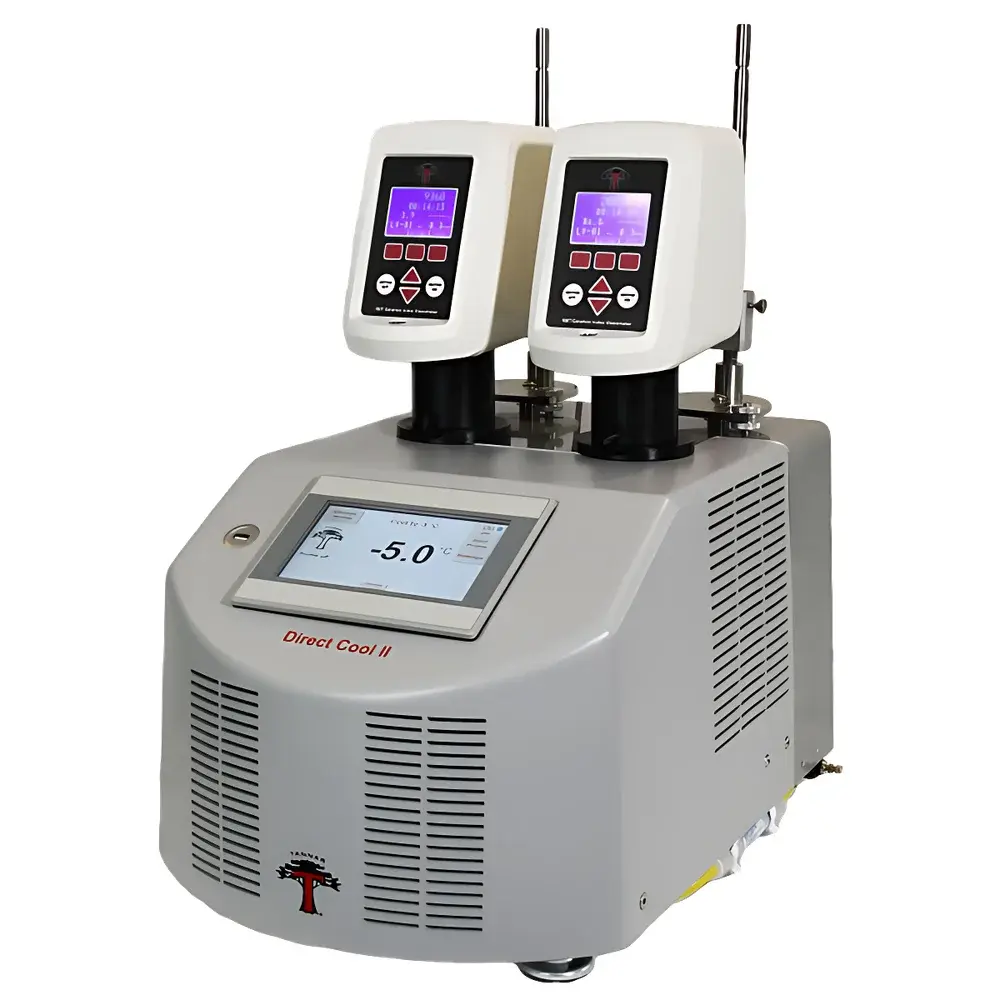
Tannas SBT DC-II Gel Index Analyzer
| Brand | Tannas&King |
|---|---|
| Origin | USA |
| Manufacturer Type | Authorized Distributor |
| Origin Category | Imported |
| Model | SBT DC-II |
| Pricing | Upon Request |
| Dimensions (W×D×H) | 32 × 51 × 74 cm |
| Weight | ~36.3 kg |
| Power Supply | 220–240 VAC, 50/60 Hz |
| Cooling Range | +90 °C to –45 °C (±0.1 °C stability) |
| Max. Cooling Rate | 60 °C/h |
| Heating Capability | Up to 90 °C |
| Sample Capacity | 2 simultaneous tests |
| Control | Single PC can manage up to 4 units |
| Safety Certifications | CE compliant |
| Transport Dimensions | ~81 × 76 × 104 cm |
| Transport Weight | ~125 kg |
| Compliant Standards | ASTM D5133, ASTM D7110, ILSAC GF-2 through GF-6 (A&B), API SL/SM/SN, GB 11121, SH/T 0732, JPI-5S-56-99 |
Overview
The Tannas SBT DC-II Gel Index Analyzer is a purpose-built, dual-sample thermal rheological testing system engineered for precise evaluation of low-temperature flow behavior in engine oils and liquid petroleum products. It operates on the principle of controlled thermal ramping and real-time torque-based gelation detection—measuring the onset, progression, and structural strength of wax crystallization networks under standardized cooling profiles. Unlike generic viscometers or pour point testers, the SBT DC-II implements a direct-contact refrigeration architecture that eliminates reliance on cryogenic liquids or external chillers, enabling stable, repeatable temperature control from +90 °C down to –45 °C with ±0.1 °C thermal stability. This capability is essential for quantifying the Gel Index—a dimensionless parameter derived from torque vs. temperature curves—as defined in ASTM D5133 and D7110. The instrument serves as a critical tool for formulating low-SAPS (Sulfated Ash, Phosphorus, Sulfur) engine oils compliant with ILSAC GF-6 and API SP specifications, where cold-flow performance directly correlates with startability, oil pumpability, and valve train lubrication integrity at sub-zero ambient conditions.
Key Features
- Direct-contact solid-state refrigeration system—no liquid nitrogen, dry ice, or secondary coolant loops required.
- Dual independent sample chambers with synchronized or staggered thermal programs for comparative analysis.
- Integrated high-precision temperature control with active feedback loops ensuring ±0.1 °C stability across the full operational range (+90 °C to –45 °C).
- Programmable cooling rate up to 60 °C/h, supporting both standard test methods and custom thermal protocols.
- Robust mechanical architecture with CE-certified safety interlocks—including high-voltage circuit breakers and hardware-limited over-temperature cutoffs.
- Scalable network operation: one Windows-based host PC can concurrently monitor and control up to four SBT DC-II units via Ethernet interface.
- Pre-heating capability to 90 °C ensures complete wax dissolution prior to controlled cooling, satisfying method prerequisites in ASTM D5133 and D7110.
Sample Compatibility & Compliance
The SBT DC-II accepts standard 100-mL cylindrical sample tubes conforming to ASTM D5133 geometry requirements. It supports all commercially available engine oils—including conventional, synthetic, and bio-based formulations—as well as base stocks, transmission fluids, and hydraulic oils exhibiting wax-dependent low-temperature rheology. Its measurement protocol is validated against multiple international regulatory and industry standards: ASTM D5133 (Standard Test Method for Low-Temperature, Low-Shear Rate, Gelation Point of Diesel Fuels), ASTM D7110 (Standard Test Method for Low-Temperature Flow Properties of Engine Oils), ILSAC GF-2 through GF-6 (A&B), API Service Categories SL, SM, SN, and SP, and Chinese national standards GB 11121 and SH/T 0732. All firmware and calibration routines are traceable to NIST-traceable references, and the system supports audit-ready data logging aligned with GLP and GMP documentation practices.
Software & Data Management
The instrument is operated via Tannas’ proprietary Windows-native software suite, which provides full method setup, real-time graphical monitoring (torque vs. temperature, dT/dt vs. time), automated Gel Index calculation per ASTM D5133 Annex A1, and export of raw and processed datasets in CSV and PDF formats. Software features include user-level access controls, electronic signature support, and configurable audit trails meeting FDA 21 CFR Part 11 requirements for regulated laboratories. Calibration history, maintenance logs, and test metadata (operator ID, sample ID, environmental conditions) are embedded within each result file. Data backups are supported via scheduled network synchronization or local USB archiving—ensuring long-term integrity and compliance with ISO/IEC 17025 Clause 7.5 requirements for record retention.
Applications
- Development and validation of low-temperature pumpability specifications for passenger car motor oils (PCMOs) and heavy-duty engine oils (HDEOs).
- Screening wax inhibitors and pour point depressants during additive package optimization.
- Quality assurance testing of finished lubricants prior to release, particularly for winter-grade formulations (e.g., 0W-20, 5W-30).
- Root-cause analysis of field-reported cold-start failures linked to gel-induced filter blocking or oil starvation.
- Supporting OEM-specific lubricant approval protocols requiring Gel Index verification per JPI-5S-56-99 or equivalent internal specifications.
- Academic and industrial research into wax crystallization kinetics and thixotropic recovery behavior in complex hydrocarbon mixtures.
FAQ
What does the Gel Index represent, and how is it calculated?
The Gel Index is a quantitative measure of the torque inflection point during controlled cooling, normalized to baseline viscosity and expressed as a unitless value. It is derived from the first derivative of torque versus temperature data, identifying the onset of structured network formation. Calculation follows ASTM D5133 Annex A1 using proprietary curve-fitting algorithms embedded in the SBT software.
Can the SBT DC-II be used for non-engine-oil samples such as gear oils or greases?
While optimized for engine oils and distillate fuels, the SBT DC-II may be applied to other wax-containing petroleum products if they fall within the specified thermal and rheological operating envelope. Validation per ASTM D5133 is required for non-standard matrices.
Is remote diagnostics or firmware update capability supported?
Yes—the system supports secure remote access via TLS-encrypted VNC sessions for technical support, and firmware updates are delivered as signed packages through the Tannas Customer Portal.
Does the instrument require annual recalibration by an authorized service provider?
Annual calibration verification is recommended per ISO/IEC 17025 and internal QA policies. Tannas-certified field service engineers perform traceable thermocouple and torque sensor validation using NIST-traceable reference standards.
How is data integrity ensured during power interruption or system crash?
The SBT DC-II implements non-volatile memory buffering: all active test data is written to flash storage at 1-second intervals. In the event of unexpected shutdown, the software resumes from the last saved state upon reboot without data loss.






