
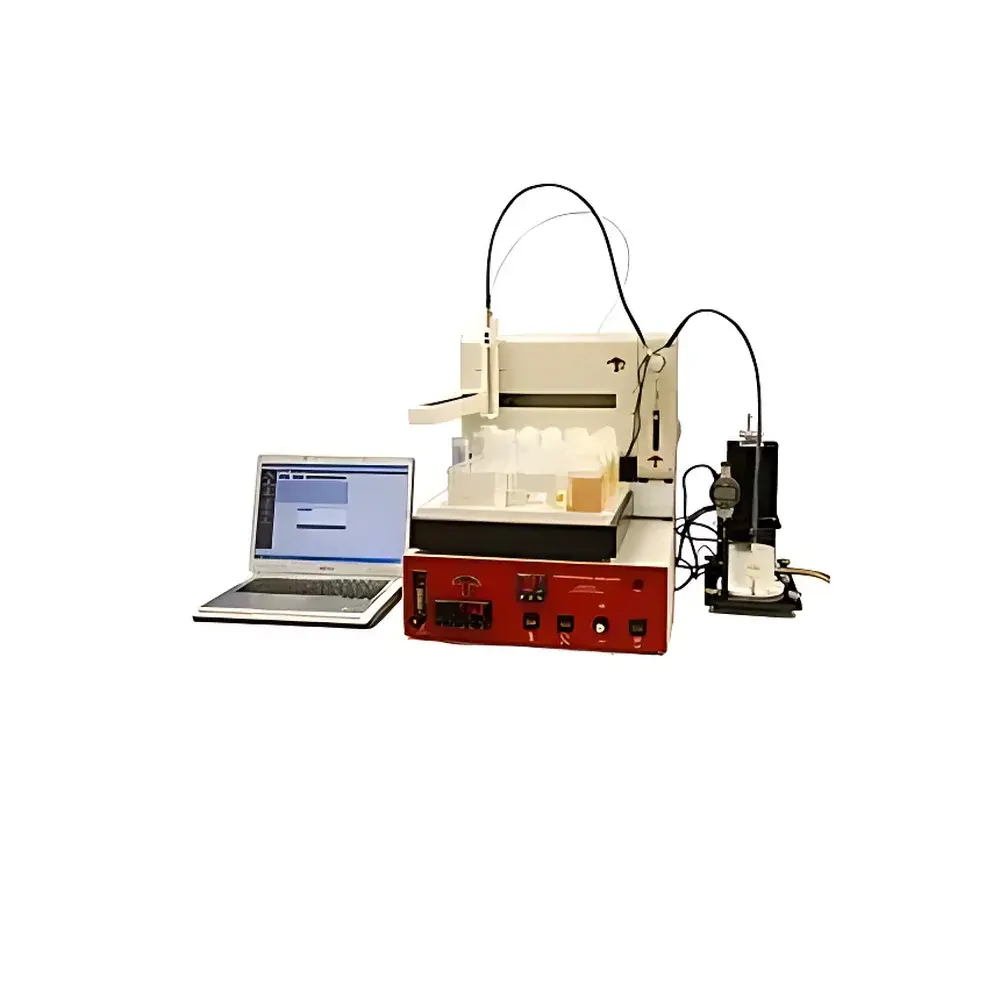
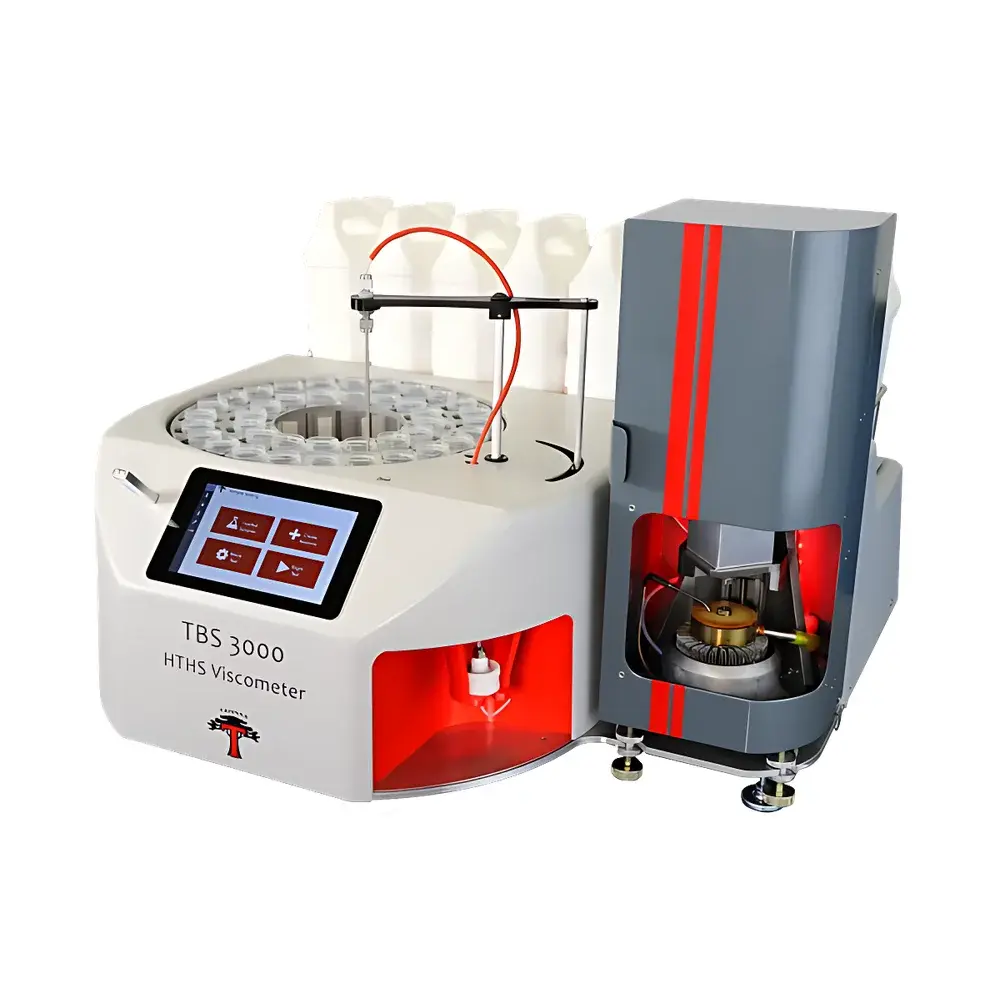
Tannas TBS2100E-F / TBS3000 High-Temperature High-Shear (HTHS) Viscometer
| Brand | Tannas & King |
|---|---|
| Origin | USA |
| Manufacturer Status | Authorized Distributor |
| Origin Category | Imported |
| Model | TBS2100E-F / TBS3000 |
| Price | Upon Request |
| Dimensions (Viscometer) | 18 × 30.5 × 35.5 cm |
| Dimensions (Control Unit) | 46 × 46 × 15 cm |
| Dimensions (Auto-sampler, optional) | 46 × 51 × 61 cm |
| Weight (Viscometer) | 15.5 kg |
| Weight (Control Unit) | 9 kg |
| Weight (Auto-sampler) | 25.4 kg |
| Voltage | 220–240 V AC |
| Frequency | 50/60 Hz |
| Sample Volume | 50 mL (recommended) |
| Test Duration per Sample | ~5–7 min |
| Temperature Range | 40 °C to 200 °C (±0.1 °C stability) |
| Shear Rate Range | 5×10⁴ s⁻¹ to 7×10⁶ s⁻¹ |
| Speed Steps | 12 discrete settings (800–8000 rpm) |
| Overtemperature Protection | Programmable safety limit |
| Compliance | CE-marked |
| Shipping Weight (Manual System) | 68 kg |
| Shipping Weight (Auto System) | 72.5 kg |
| Shipping Dimensions (Manual) | 61 × 81 × 89 cm |
| Shipping Dimensions (Auto) | 61 × 81 × 127 cm |
Overview
The Tannas TBS2100E-F and TBS3000 High-Temperature High-Shear (HTHS) Viscometers are precision-engineered instruments designed for the rheological characterization of engine oils, gear oils, and other lubricants under conditions that simulate critical in-service shear environments—particularly within bearing contacts and journal bearings operating at elevated temperatures. Developed in 1979 and protected by multiple U.S. patents, the TBS platform established the first standardized methodology for HTHS viscosity measurement and remains the globally recognized reference instrument for ASTM D4683, ASTM D6616, and ISO 20844 compliance. Its core measurement principle relies on a controlled-capillary Couette flow geometry: a rotating inner spindle shears the sample within a precisely defined annular gap, while temperature is actively stabilized via integrated PID-controlled heating and cooling circuits. This architecture ensures high reproducibility (< ±0.5% RSD across replicate runs) and traceable calibration against NIST-traceable reference oils.
Key Features
- Industry-standard HTHS viscosity measurement platform, serving as the arbitration method for OEM specifications (e.g., GM dexos1™, Ford WSS-M2C945-A, API SP/CK-4) and regulatory testing protocols.
- Dual operational modes: manual benchtop configuration (TBS2100E-F) and fully automated system with integrated auto-sampler (TBS3000), enabling unattended sequential analysis of up to 12 samples.
- Precise thermal control over 40–200 °C with ±0.1 °C stability—achieved through dual-zone heating, forced-air cooling, and real-time thermocouple feedback in both spindle and capillary zones.
- 12-step motor speed control (800–8000 rpm), generating shear rates from 5×10⁴ s⁻¹ to 7×10⁶ s⁻¹—covering the full range required for modern low-viscosity, high-performance engine oils (e.g., SAE 0W-16, 0W-20).
- Automated calibration routine executed entirely under software command—including zero-point verification, torque sensor linearity check, and capillary geometry validation using certified reference fluids.
- Fast sample exchange mechanism with programmable solvent flush cycles (using approved hydrocarbon solvents such as n-heptane or xylene), minimizing carryover and reducing turnaround time between tests.
- Robust mechanical design with stainless-steel fluid path components, ceramic-coated spindles, and sealed high-torque brushless DC motor—optimized for long-term reliability in QC laboratories and third-party testing facilities.
Sample Compatibility & Compliance
The TBS series accommodates a broad spectrum of petroleum-based and synthetic lubricants, including conventional mineral oils, polyalphaolefins (PAOs), ester-based formulations, and low-SAPS (Sulfated Ash, Phosphorus, Sulfur) engine oils. It supports viscosity measurements for finished products, base stocks, and additive packages prior to formulation. The instrument meets essential regulatory and industry requirements: ASTM D4683 (Standard Test Method for Measuring Viscosity of Engine Oils at High Temperature and High Shear Rate), ASTM D6616 (for gear oils), ISO 20844 (lubricant HTHS viscosity determination), and SAE J300 Appendix C. All hardware and firmware configurations support GLP-compliant operation, including audit-trail-enabled user access logs, electronic signature capability, and data integrity safeguards aligned with FDA 21 CFR Part 11 expectations when deployed with validated software versions.
Software & Data Management
Instrument operation, method definition, data acquisition, and reporting are managed via Tannas’ proprietary Windows-based ControlSuite™ software. The interface supports customizable test sequences, multi-point temperature ramping profiles, and real-time torque/viscosity trend visualization. Raw data—including raw voltage signals, temperature logs, rotational speed, and calculated HTHS viscosity (in mPa·s)—are stored in structured binary files with embedded metadata (operator ID, timestamp, calibration status, environmental conditions). Export options include CSV, PDF reports (with configurable templates), and direct integration into LIMS via ODBC or HL7-compatible drivers. Software updates are delivered with full version history, release notes, and IQ/OQ documentation packages for regulated environments.
Applications
- Quality control of engine oil formulations during R&D and manufacturing release testing.
- Verification of HTHS viscosity compliance for API licensing and OEM approval programs.
- Stability assessment of viscosity modifiers (e.g., olefin copolymers, methacrylate polymers) under thermal and mechanical stress.
- Correlation studies between HTHS viscosity and fuel economy performance metrics (e.g., Sequence VIE, ASTM D7589).
- Failure analysis of field-return lubricants exhibiting abnormal wear or oxidation-related thickening.
- Supporting development of next-generation low-viscosity lubricants targeting improved cold-start efficiency without compromising high-temperature film strength.
FAQ
What standards does the TBS2100E-F/TBS3000 comply with?
It is fully compliant with ASTM D4683, ASTM D6616, ISO 20844, and SAE J300 Appendix C for high-temperature, high-shear viscosity measurement.
Is the instrument suitable for testing bio-based or renewable lubricants?
Yes—provided the sample exhibits Newtonian or near-Newtonian behavior within the defined shear rate and temperature window, and does not chemically degrade the stainless-steel or ceramic wetted surfaces.
Can the system be integrated into an existing laboratory network?
Yes—ControlSuite™ supports standard Ethernet connectivity, remote desktop access (with IT-approved security protocols), and bidirectional data exchange with major LIMS platforms.
What maintenance is required for long-term accuracy?
Annual recalibration of torque transducers and temperature sensors is recommended; capillary cleaning after every 50–100 tests; spindle alignment verification every six months using included alignment jig and calibration oil set.
Does the auto-sampler support non-standard sample containers?
The TBS3000 auto-sampler accepts standard 50-mL glass vials with crimp-top seals; custom adapters can be fabricated upon request for alternative vial geometries.





