
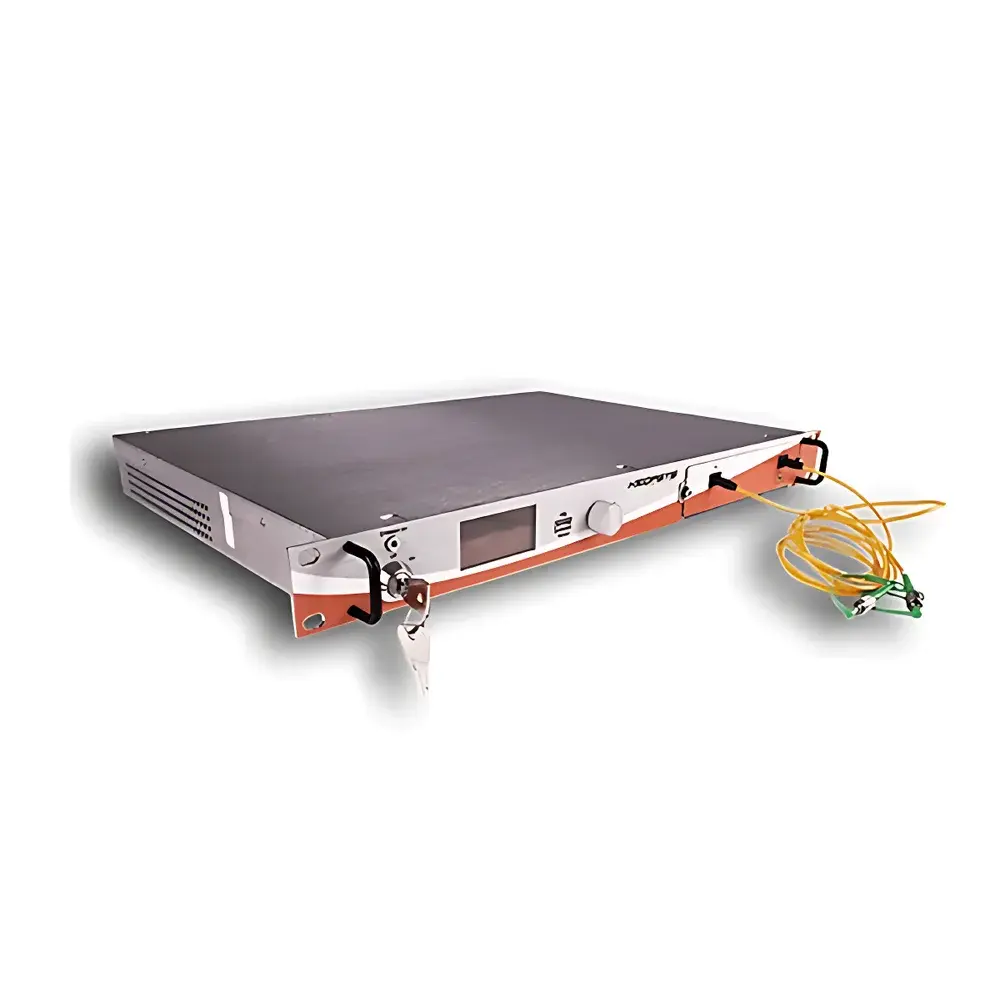
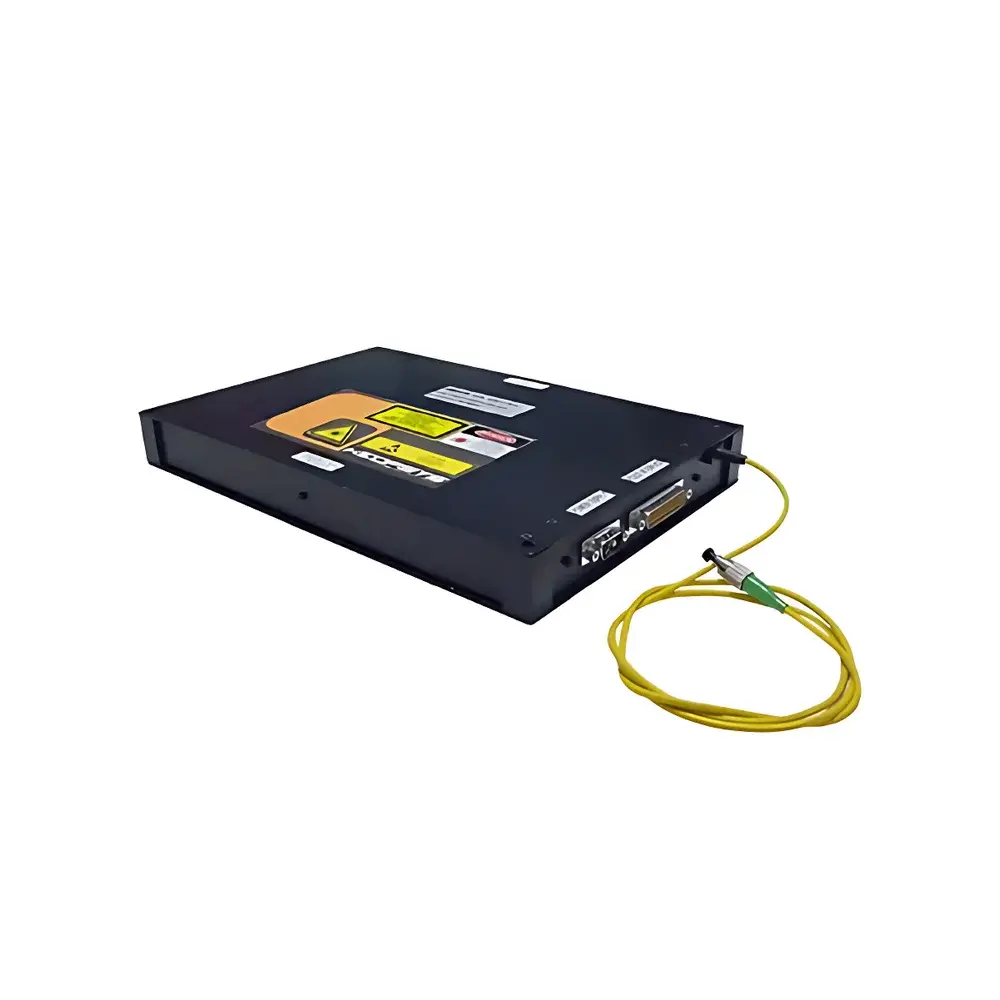
Keopsys CRFL Continuous-Wave Raman Fiber Laser
| Brand | Keopsys |
|---|---|
| Origin | France |
| Manufacturer | Keopsys SA |
| Type | CW Raman Fiber Laser |
| Model | CRFL |
| Output Power | 2–20 W |
| Operating Wavelengths | 1455 nm & 1480 nm (standard), customizable |
| Spectral Linewidth | < 2 nm or < 3 nm |
| In-Band Power | > 90% (±5 nm around peak) |
| SMSR (1000–1400 nm) | >14 dB or >15 dB |
| Polarization State | Unpolarized |
| Beam Quality (M²) | < 1.1 |
| Output Fiber | SMF-28 |
| Connector Options | FC/APC, E2PS, or collimated output |
| Power Stability | High (typical < ±0.5% RMS over 8 hrs) |
| Control Options | Internal photodiode + APC (optional) |
| Power Tuning Range | 10–100% or 25–100% (model-dependent) |
| Platform Form Factor | Benchtop or OEM module |
Overview
The Keopsys CRFL is a high-performance continuous-wave (CW) Raman fiber laser engineered for demanding optical amplification and test applications in telecommunications, distributed sensing, and advanced photonics research. Unlike conventional rare-earth-doped fiber lasers, the CRFL leverages stimulated Raman scattering (SRS) in passive silica fiber to generate coherent light at wavelengths inaccessible to erbium- or ytterbium-based sources—specifically in the L-band (1455–1480 nm) region. This physics-based wavelength conversion enables precise spectral alignment with low-loss transmission windows in standard single-mode fiber (SMF-28), making the CRFL uniquely suited for distributed Raman amplification (DRA) systems where pump efficiency, spectral purity, and long-term power stability are critical. The laser’s monolithic all-fiber architecture—designed and manufactured by Keopsys in France—eliminates free-space optics and ensures robustness against environmental perturbations, while maintaining near-diffraction-limited beam quality (M² < 1.1) across its full 2–20 W output range.
Key Features
- High-output CW power up to 20 W with exceptional amplitude stability (< ±0.5% RMS over 8 hours under constant thermal conditions)
- Standard dual-wavelength configuration at 1455 nm and 1480 nm—optimized for low-noise L-band Raman gain flattening
- High quantum conversion efficiency enabled by optimized Raman gain fiber length and pump-signal co-propagation design
- Unpolarized output eliminates polarization-dependent gain (PDG) effects in amplifier chains and simplifies system integration
- Compact, air-cooled benchtop or OEM module platform options support both lab validation and embedded industrial deployment
- Integrated photodiode monitoring and optional automatic power control (APC) ensure repeatable, drift-compensated operation compliant with long-duration GLP/GMP test protocols
- No consumables or periodic realignment required—true maintenance-free operation validated over >50,000 hours MTBF
Sample Compatibility & Compliance
The CRFL is fully compatible with industry-standard single-mode telecom fiber (ITU-T G.652.D / SMF-28), supporting direct coupling into amplification stages, pump combiners, and component-level test benches without mode-field adaptation. Its spectral characteristics—including narrow linewidth (< 3 nm), >90% in-band power concentration, and side-mode suppression ratio exceeding 14 dB across the 1000–1400 nm band—meet requirements specified in IEC 61290-1-3 (optical amplifier testing) and Telcordia GR-1312-CORE (Raman pump reliability). While not intrinsically certified for medical or aerospace use, the CRFL’s design adheres to CE marking directives (2014/30/EU EMC, 2014/35/EU LVD) and RoHS 2011/65/EU material restrictions. For regulated environments requiring audit trails, optional APC firmware supports timestamped power logging aligned with ISO/IEC 17025 calibration record retention.
Software & Data Management
The CRFL operates via analog voltage input (0–5 V or 0–10 V) for manual power setpoint control or digital RS-232/RS-485 interface for remote command execution (SCPI-compliant syntax). Optional Keopsys Laser Control Suite (v3.2+) provides GUI-based monitoring of real-time output power, case temperature, and diode current—exportable as CSV for traceability. All firmware implements non-volatile parameter storage and supports factory reset with cryptographic signature verification. When integrated into automated test systems, the CRFL complies with IEEE 1622-2014 (instrument control interoperability) and supports trigger synchronization for pulsed-pump hybrid architectures. Audit logs—including power ramp events, APC activation timestamps, and thermal fault records—are retained onboard for ≥30 days and exportable per FDA 21 CFR Part 11 Annex 11 requirements when paired with validated host software.
Applications
- Distributed Raman amplification in ultra-long-haul and submarine optical links (C+L band extension)
- Remote pumping of Er/Yb co-doped fiber amplifiers (EDFAs) in access networks and FTTH infrastructure
- Pump splitting architectures for multi-stage hybrid Raman/EDFA configurations with gain tilt compensation
- Characterization of fiber components including isolators, WDM couplers, and FBGs under high-power L-band illumination
- Calibration source for optical spectrum analyzers (OSAs) and optical power meters operating beyond 1400 nm
- Seed source for nonlinear frequency conversion experiments (e.g., difference-frequency generation in PPLN waveguides)
FAQ
Is the CRFL suitable for use in Class 1M laser safety environments?
Yes—when equipped with an FC/APC connector and operated within its specified power range (≤20 W), the CRFL meets IEC 60825-1:2014 requirements for Class 1M when used with approved optical fibers and termination hardware.
Can the output wavelength be customized outside the 1455–1480 nm range?
Yes—Keopsys offers custom Raman Stokes shifts (e.g., 1420 nm, 1500 nm) subject to minimum order quantity and additional qualification testing per ITU-T G.698.2 specifications.
Does the CRFL support analog modulation?
No—the CRFL is designed strictly for CW operation; modulation requires external electro-optic or acousto-optic devices downstream of the output port.
What is the typical warm-up time to achieve rated power stability?
Less than 15 minutes from cold start at 25 °C ambient, verified per IEC 61290-10-1 thermal stabilization protocol.
Is SMF-28 the only supported delivery fiber?
SMF-28 is the reference fiber for all published specifications; other ITU-T G.652-compliant fibers may be used but require recalibration of launch power and M² measurement per IEC 61291-1-2.




