
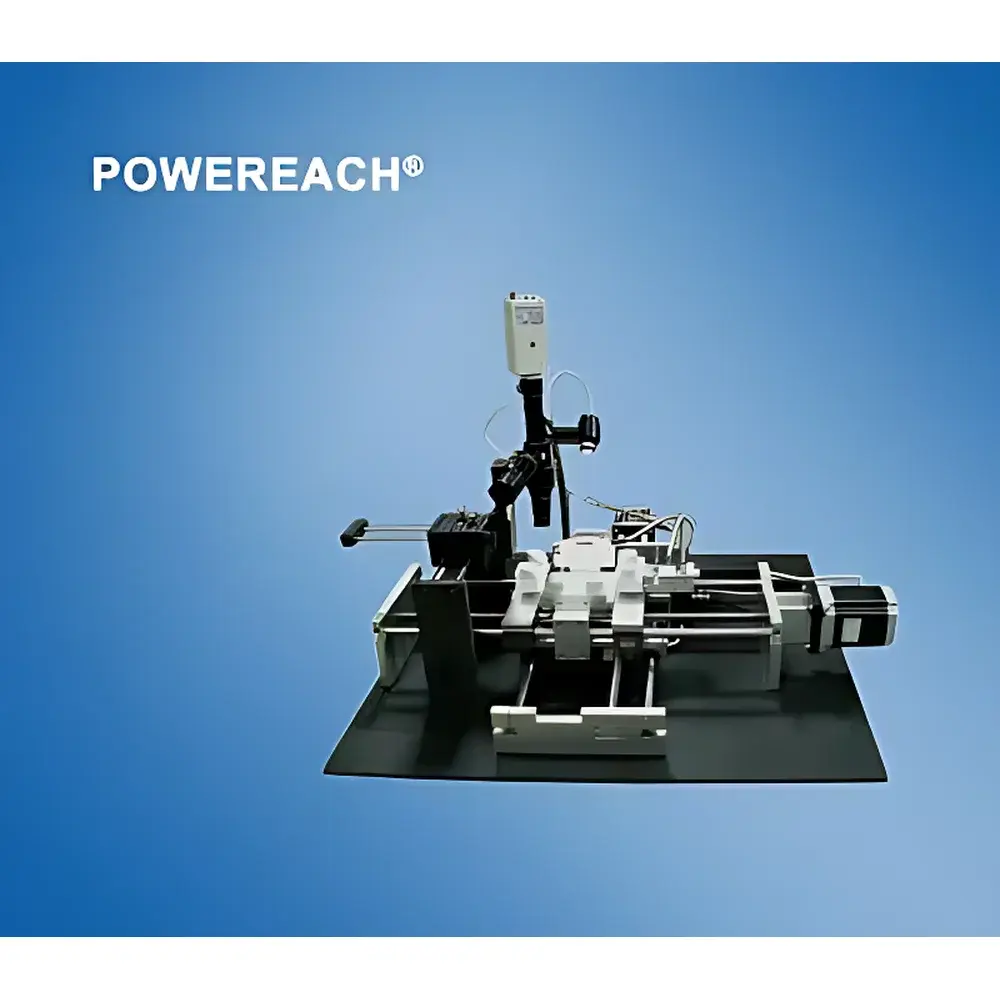
POWEREACH JDS05A Dual-Axis Textile Material Characterization System (50 kg Capacity)
| Key | Brand: POWEREACH (Shanghai Zhongchen) |
|---|---|
| Origin | Shanghai, China |
| Model Series | JDS05 |
| Maximum Biaxial Force per Axis | 500 N |
| Force Resolution | 1/10,000 of full scale |
| Optical Magnification | up to 8 pixels/µm |
| Imaging System | Dual-mode illumination (transmitted + movable reflective), continuous zoom long-focus lens |
| Software | Proprietary textile mechanics analysis suite |
| Compliance | Designed for ASTM D5035, ISO 13934-1, ISO 13935-1, GB/T 3923.1, and custom method implementation |
| Computer Interface | USB + RS-232 (COM port required) |
Overview
The POWEREACH JDS05A Dual-Axis Textile Material Characterization System is an integrated laboratory instrument engineered for simultaneous biaxial mechanical testing and high-resolution surface morphology analysis of woven, knitted, nonwoven, and braided textile structures. Unlike conventional uniaxial tensile testers, the JDS05A implements orthogonal actuation along two independent axes—X and Y—to replicate in-plane stress states encountered during real-world fabric deformation, such as bias extension, shear locking, or balloon inflation simulations. Its core measurement principle combines servo-controlled electromechanical force transduction with synchronized digital image acquisition, enabling correlation between macroscopic load-displacement response and microstructural evolution—including yarn slippage, crimp reduction, interlacing point distortion, and localized failure initiation. The system is calibrated and validated for use in R&D laboratories, quality control departments, and certification bodies engaged in textile performance validation under international standard test protocols.
Key Features
- Biaxial tensile platform with dual independent servo drives, each capable of applying up to 500 N force with 0.01% full-scale resolution and closed-loop position/force control.
- Integrated optical imaging subsystem featuring a continuously variable long-working-distance zoom lens (0.7×–4.5×), precision XYZ motorized stage, and dual illumination modes: collimated transmitted light for fiber-level transparency contrast and a programmable movable reflective light source for surface texture enhancement.
- Real-time image capture at up to 8 pixels per micrometer spatial sampling density, supporting quantitative texture parameter extraction—including weave repeat identification, yarn diameter distribution, inter-yarn gap mapping, and defect localization.
- Modular mechanical architecture allowing interchangeable grip configurations: pneumatic clamps for delicate natural fibers, serrated mechanical jaws for high-strength synthetic or composite textiles, and custom fixtures for small-area specimens (e.g., medical gauze, geotextile coupons).
- Embedded environmental monitoring interface (optional) for humidity and temperature logging during testing, ensuring traceability per ISO 139 environmental conditioning requirements.
- Compliance-ready firmware architecture supporting audit trails, electronic signatures, and user-access-level management aligned with GLP/GMP documentation practices.
Sample Compatibility & Compliance
The JDS05A accommodates specimens ranging from 20 mm × 20 mm mini-coupons to full-width fabric swatches (up to 150 mm × 150 mm). It supports standardized specimen geometries defined in ASTM D5035 (strip method), ISO 13934-1 (grab test), and ISO 13935-1 (seam strength), while also permitting non-standard configurations for research-grade anisotropic characterization. All mechanical and optical modules are factory-calibrated against NIST-traceable reference standards. The system’s software enables direct export of test reports compliant with ISO/IEC 17025 documentation frameworks and supports method validation per FDA 21 CFR Part 11 when paired with approved IT infrastructure. Regulatory alignment includes textile-specific clauses in USP <1059>, EN 14323 (protective clothing), and GB/T 3923.1 (Chinese national textile tensile standard).
Software & Data Management
The proprietary POWEREACH TextileMechanics Suite v3.2 provides synchronized acquisition of force-time, displacement-time, and image-sequence data streams. Time-stamped metadata embedding includes operator ID, calibration certificate IDs, environmental logs, and instrument configuration snapshots. Data export formats include CSV (for statistical process control), TIFF/AVI (for microscopy archives), and XML-based ASTM E1447-compliant test records. Advanced analysis modules enable automated detection of onset-of-yield, linear modulus calculation via tangent slope fitting, energy-to-break integration, and strain field mapping using digital image correlation (DIC) algorithms—without requiring third-party plugins. Audit trail functionality records all parameter changes, report generations, and user logins with immutable timestamps, satisfying internal QA audits and external accreditation body reviews.
Applications
- Development and qualification of smart textiles incorporating conductive threads or phase-change materials under biaxial strain.
- Failure mode analysis of technical fabrics used in airbags, inflatable habitats, or filtration membranes subjected to multi-directional loading.
- Validation of seam integrity and stitch slippage resistance in protective apparel (EN ISO 11611/11612).
- Quantitative assessment of dimensional stability in stretch-knit garments during accelerated wear simulation.
- Correlation studies between surface topography (e.g., pilling propensity, nap uniformity) and mechanical hysteresis in looped structures.
- Supporting ISO 9001-certified production line verification through repeatable, operator-independent test execution.
FAQ
What standards does the JDS05A support out-of-the-box?
Preloaded test methods include ASTM D5035, ISO 13934-1, ISO 13935-1, GB/T 3923.1, and ISO 13936-2. Custom method templates can be configured via the software’s script editor.
Is the system compatible with existing LIMS or ELN platforms?
Yes—via optional OPC UA or RESTful API add-on modules, enabling bidirectional data exchange with LabWare, Thermo Fisher SampleManager, or Veeva Vault QMS.
Does the optical system require external vibration isolation?
No. The base frame integrates passive damping mounts; however, operation on a granite table is recommended for sub-micron feature tracking.
Can the JDS05A perform cyclic or creep testing?
Yes. The controller supports programmable waveforms—including sinusoidal, triangular, and ramp-hold sequences—with dwell time control down to 100 ms resolution.
What maintenance intervals are recommended?
Force sensor recalibration every 12 months; optical path cleaning and focus verification every 90 days; belt and guide rail lubrication every 6 months per maintenance logbook.



