
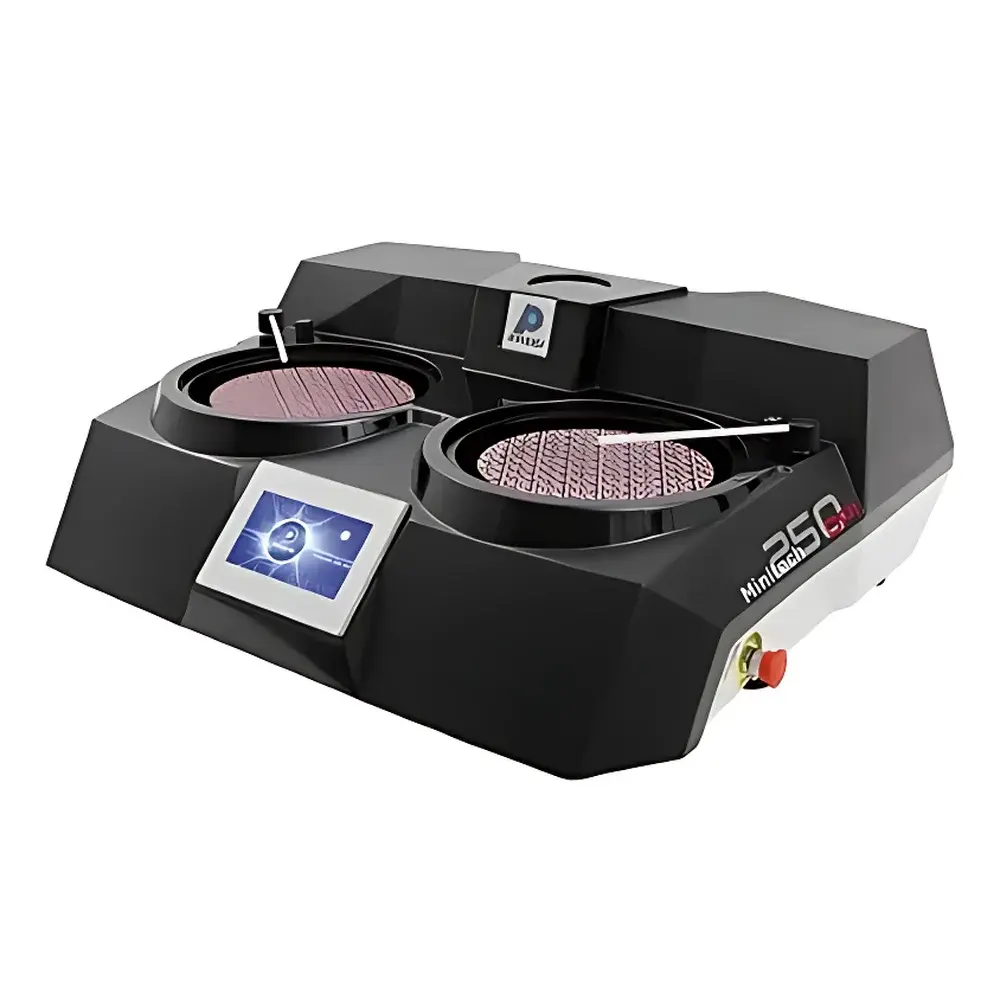
PRESI MINITECH 250 DP1 Manual Dual-Disc Grinding and Polishing System
| Brand | PRESI |
|---|---|
| Origin | France |
| Model | MINITECH 250 DP1 |
| Disc Quantity | 2 |
| Disc Diameter | Ø200 mm or Ø250 mm |
| Speed Range | 20–700 rpm |
| Motor Power | 750 W |
| Dimensions (L×W×D) | 920 × 735 × 330 mm |
| Control Interface | 7-inch color LCD touchscreen |
| Rotation Direction | Clockwise or counterclockwise |
| Timing Mode | Forward or reverse countdown |
| Load Monitoring | Real-time manual pressure feedback display |
| Safety Features | Dual emergency stop buttons, splash guard, inclined base with elevated spindle housing |
| Accessories | Removable polymer support bowl, disc drying function |
Overview
The PRESI MINITECH 250 DP1 is a precision-engineered manual dual-disc grinding and polishing system designed for reproducible metallographic and materials science sample preparation in academic, industrial, and quality control laboratories. Built upon a robust mechanical architecture and integrated vector-frequency motor control, the system delivers stable rotational torque across its full speed range (20–700 rpm), enabling consistent material removal and surface finishing on specimens ranging from soft aluminum alloys to hardened steels and ceramic composites. Unlike fully automated systems, the MINITECH 250 DP1 retains operator control over applied load—critical for optimizing edge retention, minimizing relief effects, and achieving optimal microstructural fidelity—while augmenting manual technique with real-time quantitative feedback via its integrated load sensor and high-resolution touchscreen interface.
Key Features
- Vector-controlled 750 W AC motor ensures constant torque delivery across the entire speed spectrum, eliminating speed droop under variable load conditions.
- Dual independently operable grinding/polishing stations (Ø200 mm or Ø250 mm) allow simultaneous use of different abrasives or polishing cloths for multi-step preparation protocols.
- 7-inch full-color LCD touchscreen provides intuitive access to all operational parameters: speed setpoint, rotation direction (CW/CCW), timer mode (forward/backward), water valve activation, and real-time manual pressure readout (in N or kgf).
- Inclined stainless-steel base with elevated main shaft housing prevents coolant ingress into bearing assemblies; integrated splash ring minimizes aerosol generation and floor contamination.
- Removable high-molecular-weight polyethylene support bowl resists corrosion, staining, and chemical degradation—facilitating rapid cleaning and long-term maintenance compliance.
- Automatic disc drying function engages at process completion to centrifugally remove residual coolant from abrasive papers, polishing cloths, or diamond pads—reducing microbial growth risk and extending consumable life.
- Dual emergency stop buttons mounted on left/right side panels meet EN 60204-1 and ISO 13850 requirements for Category 0 mechanical shutdown.
Sample Compatibility & Compliance
The MINITECH 250 DP1 accommodates specimens up to 50 mm in diameter (standard mounting cups) and supports standard ISO/ASTM-compliant consumables—including silicon carbide papers (P80–P2500), diamond suspension pads (15–0.25 µm), and woven/non-woven polishing cloths. Its manual load application design aligns with ASTM E3-22 and ISO 16062 guidelines for operator-dependent preparation methods, where procedural consistency is maintained through documented operator training and standardized pressure protocols. The unit’s construction materials and electrical safety architecture comply with CE marking directives (2014/30/EU EMC, 2014/35/EU LVD), and its sealed electronics enclosure satisfies IP54 environmental protection requirements per IEC 60529.
Software & Data Management
While the MINITECH 250 DP1 operates without embedded PC-based software, its touchscreen firmware supports hierarchical user access control via password-protected parameter locking—a feature aligned with GLP/GMP documentation practices. Laboratory supervisors can define and lock critical method parameters (e.g., speed limits per step, maximum allowable pressure thresholds, mandatory dwell times), preventing unauthorized deviations during routine operation. All user-initiated changes are timestamped and logged locally within non-volatile memory, supporting internal audit trails. Though not FDA 21 CFR Part 11 compliant out-of-the-box, the system’s deterministic behavior and traceable manual input make it suitable for environments requiring documented procedural adherence when paired with external SOP management platforms.
Applications
- Metallographic specimen preparation for optical and electron microscopy (SEM/TEM cross-section analysis)
- Hardness testing sample conditioning per ASTM E384 and ISO 6507 standards
- Failure analysis workflows requiring controlled subsurface damage minimization
- Geological thin-section preparation for petrographic evaluation
- Quality assurance of additive-manufactured components where layer-bond integrity must be assessed
- R&D prototyping labs performing iterative material evaluation under variable thermal or mechanical histories
FAQ
Can the MINITECH 250 DP1 be used for both grinding and polishing in a single setup?
Yes—the dual-disc configuration permits concurrent use of coarse grinding paper on one station and fine polishing cloth on the other, enabling seamless transition between preparation stages without repositioning the specimen holder.
Is the pressure feedback calibrated and traceable to international standards?
The load sensor provides relative force indication optimized for intra-laboratory consistency rather than absolute metrological traceability; users are advised to establish internal calibration curves using certified dead-weight test loads.
Does the system support automatic protocol recall?
No—it is manually operated with no stored method memory; however, parameter locking ensures that once defined by a supervisor, speed, time, and directional settings remain fixed during operator use.
What consumables are compatible with the Ø250 mm disc option?
Standard 250 mm adhesive-backed abrasive papers, electroplated diamond discs, and hook-and-loop polishing cloths meeting ISO 8442-2 dimensional tolerances.
How is maintenance access facilitated for the drive belt and bearings?
The front panel and upper housing are toollessly removable; the belt tensioning mechanism and sealed SKF deep-groove ball bearings are accessible without disassembling the base chassis.
Related Products



