
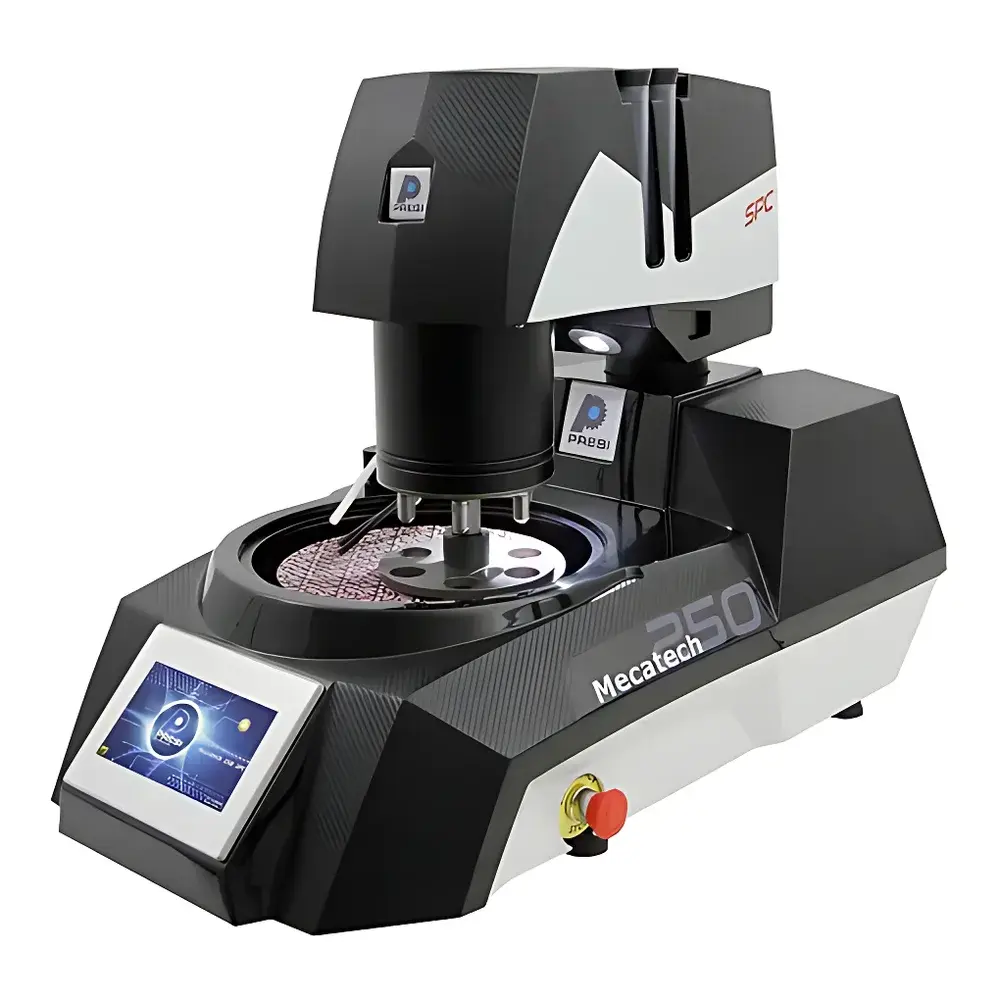
PRESI MECATECH 250 SPC Automatic Grinding and Polishing System
| Brand | PRESI |
|---|---|
| Origin | France |
| Model | MECATECH 250 SPC |
| Dimensions (L×W×D) | 665 × 510 × 810 mm |
| Number of Platen Stations | 1 |
| Platen Diameter | 200–250 mm |
| Rotational Speed Range | 20–700 rpm |
| Motor Power | 750 W |
| Control Interface | 7-inch LCD touchscreen |
| Integrated Peristaltic Pump | Yes, 200 mL dispenser |
| Connectivity | USB + optional Ethernet module |
| Safety Compliance | CE, EN 61000-6-2/6-4, EN ISO 12100 |
Overview
The PRESI MECATECH 250 SPC is a fully automated grinding and polishing system engineered for precision sample preparation in metallurgical, geological, ceramic, and advanced materials laboratories. Based on controlled rotational motion and programmable force application, the system implements standardized mechanical material removal through sequential abrasive stages—grinding, fine grinding, and polishing—using consumables mounted on a single 200–250 mm diameter platen. Its core architecture integrates closed-loop speed regulation via frequency-controlled AC motor drive, ensuring consistent torque delivery across the full 20–700 rpm range, critical for maintaining surface integrity during high-load processing of hard alloys, carbides, or large-section specimens (up to Ø100 mm or 100 × 100 mm). Designed for reproducibility-driven workflows, the MECATECH 250 SPC conforms to ASTM E3, ISO 14577, and EN 10365 standards for metallographic specimen preparation, supporting GLP-compliant documentation when paired with validated method export protocols.
Key Features
- 7-inch capacitive LCD touchscreen interface with intuitive icon-based navigation—enables real-time adjustment of rotation speed, direction (CW/CCW), water valve timing, cycle duration, and dispensing parameters.
- Integrated peristaltic pump driving a 200 mL reagent reservoir; supports programmable volume and frequency control for lubricants, suspensions, or colloidal silica slurries—reducing operator variability and optimizing consumable usage.
- Dual operational modes: “R&D Mode” for full parameter freedom (speed, time, fluid volume, dwell intervals) and “Program Mode” for execution of pre-validated methods stored in internal database (capacity: 100 methods).
- Tilted platen base (3° incline) with elevated main shaft bearing housing and integrated splash ring—prevents fluid ingress into mechanical components and ensures rapid drainage without manual intervention.
- Removable polymer composite bowl (PEEK-reinforced polypropylene) resistant to acid, alkali, and abrasive wear—facilitates rapid cleaning, reduces cross-contamination risk, and simplifies routine maintenance.
- Automatic workhead 180° rotation mechanism—enables ergonomic loading/unloading of specimens from the inner side without repositioning the operator or compromising safety posture.
- Platen spin-dry function activated at cycle end—removes residual slurry and moisture from abrasive papers or polishing cloths prior to storage, extending consumable life and minimizing microbial growth.
- Multi-level access control via password-protected software hierarchy—lab managers configure method templates and restrict editing rights to designated users, enforcing SOP adherence across shifts and departments.
Sample Compatibility & Compliance
The MECATECH 250 SPC accommodates specimens ranging from standard 25–30 mm metallographic mounts to oversized blocks (≤100 mm diameter or square), including hardened steels (HRC 60+), tungsten carbide, silicon nitride, concrete cores, and composite laminates. Its adaptive pressure distribution design minimizes edge rounding and relief effects during planarization. All electrical and mechanical subsystems comply with CE marking requirements under the Machinery Directive 2006/42/EC and EMC Directive 2014/30/EU. The system meets EN ISO 12100:2010 for risk assessment and incorporates dual-channel emergency stop circuitry (EN 60204-1), position-locked workhead interlock, and automatic fluid flow cutoff upon lid opening.
Software & Data Management
Method data—including speed profiles, time segments, fluid dispensing schedules, and directional sequences—is stored internally with timestamped version history. Methods can be imported/exported via USB mass storage or Ethernet (optional network module), enabling centralized library management across multiple instruments. Audit trails are generated for all method modifications and cycle executions when connected to a compliant LIMS or ELN platform. While the system does not natively support FDA 21 CFR Part 11 electronic signatures, its method export functionality enables integration with third-party validation packages for GMP environments requiring full traceability.
Applications
- Preparation of failure analysis samples in aerospace and power generation sectors where microstructural fidelity directly impacts root-cause determination.
- Routine QC metallography in foundries and heat-treatment facilities requiring strict repeatability between shifts and operators.
- Geological thin-section production for petrographic microscopy, especially for siliceous or carbonate-rich rock matrices prone to differential wear.
- Research-scale development of novel sintered ceramics or additively manufactured alloys, where multi-stage polishing protocols must be precisely replicated across iterative batches.
- Forensic materials examination where chain-of-custody documentation must accompany each prepared specimen’s digital preparation log.
FAQ
What is the maximum specimen weight supported by the MECATECH 250 SPC?
The system supports specimens up to 5 kg when properly centered and clamped using standard holders; dynamic balance verification is recommended for loads exceeding 3 kg at speeds >500 rpm.
Can the MECATECH 250 SPC be integrated with DISTRITECH 5.1?
Yes—via optional RS-485 or Modbus RTU interface; DISTRITECH 5.1 replaces manual dispensing with gravimetrically calibrated multi-channel delivery, enhancing precision for critical polishing steps.
Is remote monitoring or firmware update capability available?
Firmware updates require local USB connection; remote diagnostics are not supported out-of-the-box but may be enabled via customer-specific OEM agreements with PRESI.
Does the system include calibration certificates for speed or time accuracy?
Factory calibration documentation is provided; NIST-traceable speed verification requires external tachometer measurement—no built-in metrological certification is included by default.
How often does the peristaltic pump tubing require replacement?
Under typical usage (20 cycles/day), tubing life averages 6–9 months; PRESI recommends quarterly visual inspection for cracking or swelling, especially when handling acidic or organic solvents.



