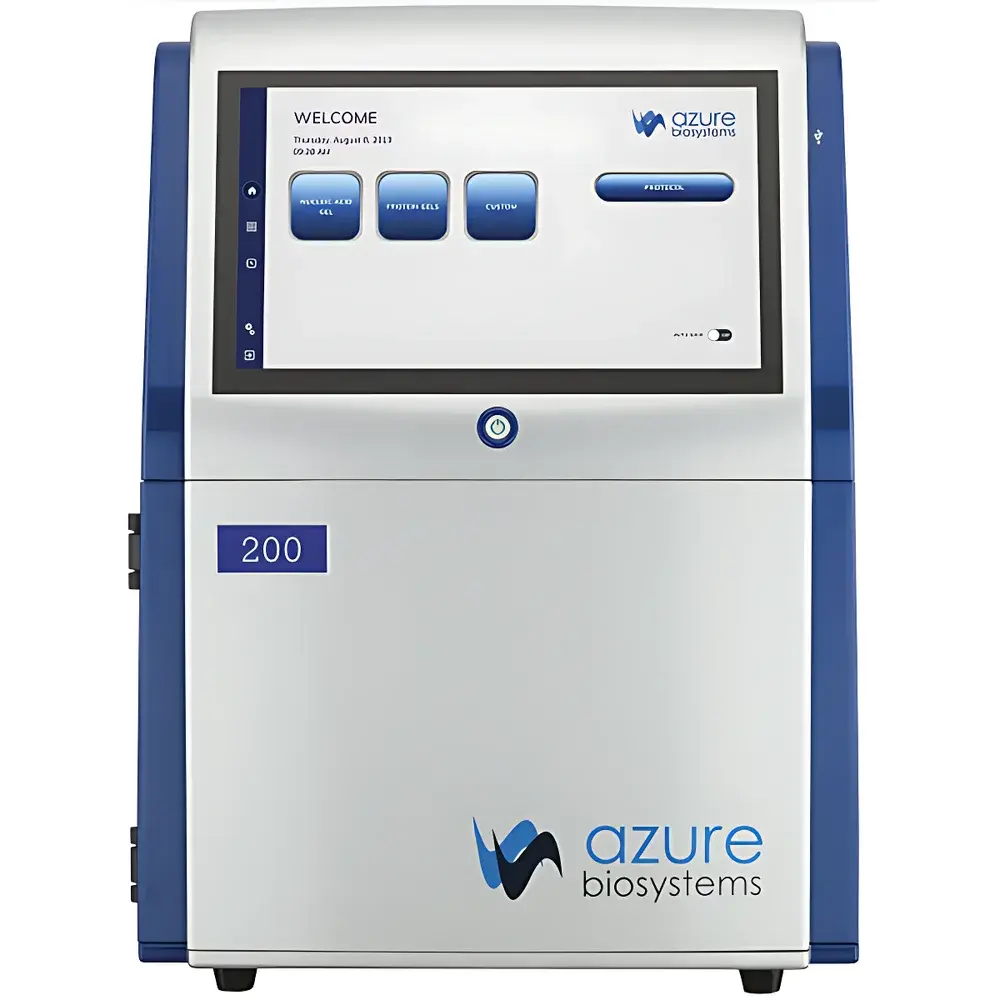
Azure Biosystems Azure 200 Gel Imaging System
| Brand | Azure Biosystems |
|---|---|
| Origin | USA |
| Model | Azure 200 |
| Instrument Type | Standard Gel Imaging System |
| CCD Resolution | 5.4 MP |
| Bit Depth | 16-bit |
| Dynamic Range | 4.8 OD |
| CCD Sensor Size | 2/3-inch |
| Detection Sensitivity | fg-level |
| Signal-to-Noise Ratio | High |
| Lens | Motorized Autofocus |
| Integrated Display | 13.3-inch HD Touchscreen PC |
| Excitation Sources | Dual-wavelength UV (e.g., 254 nm & 302 nm), Blue Light (470 nm) |
| Imaging Modes | DNA, Protein, Colorimetric, Fluorescent (with compatible dyes) |
Overview
The Azure Biosystems Azure 200 Gel Imaging System is a compact, integrated benchtop instrument engineered for high-fidelity digital capture and quantitative analysis of nucleic acid and protein electrophoretic gels. It operates on the principle of fluorescence excitation and emission detection—utilizing precisely controlled UV and blue-light sources to excite common nucleic acid stains (e.g., ethidium bromide, SYBR Safe) and protein-compatible fluorescent dyes (e.g., SYPRO Ruby, Deep Purple). The system employs a cooled 5.4-megapixel scientific-grade CCD sensor with 16-bit digitization and a measured optical dynamic range of 4.8 optical density (OD) units—enabling linear quantification across three orders of magnitude in signal intensity. Its fully integrated architecture incorporates a dedicated 13.3-inch HD touchscreen computer, eliminating external hardware dependencies and minimizing footprint in regulated or space-constrained laboratory environments.
Key Features
- Motorized autofocus lens system ensures consistent focus calibration across sample batches, reducing operator-induced variability.
- Dual-wavelength UV transilluminator (254 nm and 302 nm) and narrow-band blue LED (470 nm ± 20 nm) provide optimal excitation for a broad spectrum of fluorescent dyes while minimizing photobleaching and DNA damage.
- Scientific CCD sensor with 2/3-inch format delivers high quantum efficiency (>65% at 550 nm) and low read noise (<5 e⁻ RMS), supporting fg-level detection sensitivity for both ethidium-stained DNA and chemiluminescent Western blots (when used with appropriate adapters).
- Automated exposure control dynamically adjusts integration time based on real-time preview histogram analysis—ensuring optimal signal capture without saturation.
- Pre-configured and user-defined imaging protocols store complete acquisition parameters (wavelength, exposure, binning, lens position), enabling strict adherence to SOPs and inter-operator reproducibility.
- FDA 21 CFR Part 11-compliant software module available with electronic signatures, audit trail logging, and role-based access control—meeting GLP/GMP and journal submission requirements (e.g., Nature, Cell, JBC).
Sample Compatibility & Compliance
The Azure 200 supports standard slab gel formats including mini-gels (up to 10 × 10 cm) and midi-gels (up to 15 × 15 cm), accommodating agarose, polyacrylamide (PAGE), SDS-PAGE, and native PAGE systems. It is validated for use with commercially available fluorescent, colorimetric, and chemiluminescent detection reagents—including SYBR Gold, GelRed, Coomassie Brilliant Blue R-250, and enhanced chemiluminescence (ECL) substrates. All optical components comply with IEC 61000-4 electromagnetic compatibility standards and UL/CSA safety certifications. Instrument firmware and software are designed to support ISO/IEC 17025-aligned quality management systems, and raw image files are saved in vendor-neutral TIFF format with embedded EXIF metadata for traceability.
Software & Data Management
Acquisition and analysis are performed using AzureSpot™ Software—a native Windows application pre-installed on the integrated touchscreen PC. The software provides real-time preview, multi-channel overlay (e.g., merged UV + blue-light images), background subtraction, lane/profile tracing, molecular weight estimation, and relative band intensity quantification with coefficient-of-variation (CV) reporting. Export options include publication-ready PNG, PDF, and Excel-compatible CSV outputs. For enterprise deployment, optional network licensing supports centralized software updates and instrument fleet monitoring. Audit trail records document all user actions—including image acquisition, parameter modification, and export events—with timestamps and operator IDs—fully compliant with FDA 21 CFR Part 11 Annex 11 and ALCOA+ data integrity principles.
Applications
- Agarose gel electrophoresis: Rapid visualization and quantification of PCR products, restriction digests, and plasmid preparations.
- Protein gel analysis: Detection of Coomassie- and silver-stained SDS-PAGE gels; semi-quantitative assessment of expression levels and purity.
- Fluorescent staining workflows: High-sensitivity imaging of SYBR Green–stained DNA, SYPRO Ruby–stained proteins, and GFP-fusion constructs.
- Colorimetric blot documentation: Digitization of chromogenic Western and dot blots without overexposure artifacts.
- Educational and core facility use: Intuitive interface and protocol-driven operation reduce training time and improve cross-user consistency.
FAQ
Does the Azure 200 support chemiluminescent detection?
Yes—when equipped with the optional chemiluminescence adapter kit (sold separately), the system enables sensitive detection of HRP- and AP-conjugated antibodies with sub-pg sensitivity.
Can I export raw image data for third-party analysis?
Yes—all acquired images are saved as uncompressed 16-bit TIFF files with full metadata, compatible with ImageJ/Fiji, MATLAB, and commercial bioinformatics platforms.
Is remote instrument control supported?
Yes—the AzureSpot software includes LAN-enabled remote desktop capability, allowing full control from an external Windows workstation via secure RDP or VNC protocols.
What regulatory documentation is provided with the system?
Each unit ships with a Certificate of Conformance, Factory Calibration Report, and IQ/OQ documentation templates aligned with ASTM E2500 and ISO 13485 requirements.
How frequently does the UV source require replacement?
The solid-state UV LEDs have a rated lifetime of ≥10,000 hours; no routine lamp replacement is required during normal laboratory use.